

Preserving the Pulse of Pop Culture: Inside MOPOP’s Icons Gala

In the heart of downtown Seattle, beside the iconic Space Needle, the Museum of Pop Culture (MOPOP) stands as a major institution dedicated to honoring global movements, cultural artifacts and revolutionary artists.
While the venue originally opened in 2000 as the Experience Music Project, its evolution led to a broader rebrand in 2016, and the institution now encompasses fashion, film, gaming= and music across an archive of 85,000 items.
At the core of MOPOP's yearly mission sits the Icons Gala—the organization's flagship fundraising initiative celebrating trailblazers whose creative work shattered barriers and reshaped societal narratives.
Read More on Entertainment
A Strategic Vision for Cultural Preservation
When CEO Michele Smith arrived at MOPOP in 2023, she sought to clarify the institution's strategic role within an increasingly polarized landscape. "In 2023, when I got here, one of the things that the funders were asking was: 'Who is MOPOP? What is MOPOP? What is the power of pop culture?'" Smith told Newsweek. To answer these questions, Smith established a comprehensive three-year installation workflow, anchoring all initiatives in four primary pillars while centering marginalized communities.
Community engagement guided this programmatic shift after surveys revealed local populations demanded authentic representation. "If we don't see ourselves within the museum, why would we come?" community members noted, prompting MOPOP to amplify stories from BIPOC, LGBTQ+ and Asian American creators throughout its exhibits. Furthermore, Smith incorporated a layer of social activism into the strategic framework, asserting public figures frequently leverage their platforms to drive meaningful societal change.
Because political discourse dominated national conversation, MOPOP launched its long-term exhibit, Massive: The Power of Pop Culture, which examines celebrity activism through historical artifacts like a Black Lives Matter mural and a protest sign carried by Billie Eilish.
Smith reaffirmed the museum's stance on equity and inclusion. "We are living in a city that is focused on DEAI; we are not moving away from it," Smith said.
The CEO also emphasized the scholarly validity of pop culture, demonstrating how contemporary media serve as accessible educational instruments. "Pop culture is scholarly, and by applying a different lens, our museum works to combat those biases," Smith said, pointing out how the elements of DJing can effectively bridge youth engagement with STEM education.

Background and Impact of the Icons Gala
The museum's largest annual fundraiser, the Icons Gala, serves as the primary engine funding educational programs, youth advisory initiatives and community outreach. As the gala entered its third decade, leadership renamed the event from the Founders Gala to align directly with its core foundational disciplines: fashion, film, gaming and music.
"It's a chance to celebrate the people who have left a permanent mark on pop culture," Smith observed.
Honorees are selected based on their lasting cultural contributions and dedication to lifting up underrepresented communities. Past galas celebrated visionary figures including Janelle Monáe, Jimi Hendrix, Jeremy Scott and Bruce Lee.
For this year's iteration, MOPOP selected hip-hop pioneers Salt-N-Pepa, celebrating their barrier-breaking impact alongside the museum's Contact High: Women in Hip-Hop exhibition.
Redefining Hip-Hop and Female Empowerment
When Salt-N-Pepa entered the music industry, hip-hop operated primarily as a male-dominated domain, yet the group established an enduring standard for female empowerment. Sandra “Pepa” Denton reflected on the group's foundational ethos, emphasizing that their success stemmed from self-assurance.
"Salt-N-Pepa was built on confidence, individuality, and the freedom to express ourselves unapologetically, and those values are just as relevant today as they were when we started," Pepa told Newsweek.
Although critics often reduce hip-hop to pure entertainment, the genre functions as an essential educational medium, and it documents real-life experiences unrepresented in mainstream classrooms.
Pepa highlighted this storytelling power, saying, "Hip-hop gives people a voice, preserves our history, and speaks to real-life experiences that aren’t always represented in traditional classrooms or mainstream media.”
By challenging industry expectations without seeking permission, the group created space for future generations of female creators.
The group's visual identity—from bold hairstyles and gold jewelry to custom leather jackets—became an extension of their lyrical message.
Reflecting on their visual style, Pepa noted, "We wanted to celebrate women’s confidence, independence, sexuality, and individuality on our own terms. We understood that fashion could be a powerful form of self-expression, and we used it to challenge expectations and make a statement."

Four Decades of Authenticity, Growth and Independence
For Cheryl "Salt" James, receiving recognition at the Icons Gala represents a milestone across four decades in the music business. "It just means that we've made an impression, an indelible impression on pop culture in all the areas: music, fashion," Salt told Newsweek.
"After 40 years in the game, you want to be remembered and celebrated and appreciated, and we've been receiving so much love and appreciation.”
While modern artists navigate rapid digital trends, Salt attributes their endurance to sheer authenticity and distinct visual storytelling. Remembering the creation of their famous "Push It" aesthetic, Salt described how grassroots creativity birthed an iconic look.
"Play from Kid 'n Play was a designer; he designed the jackets, and Dapper Dan constructed the jackets," Salt recalled. She added, "We got the boots from Payless. Me and Pep picked the hats up from a shop next door to the Apollo in Harlem. We looked like hip-hop superheroes.”
Newsweek’s reporters and editors used Martyn, our AI assistant, to produce this story. Learn more about Martyn here. Contact Newsweek editors on this story: Mark Muir and Edward T. Cummins
[ad_2]

Take Fox News Digital’s Entertainment Quiz, and test your celebrity knowledge
NEWYou can now listen to Fox News articles!
The Pop Culture Quiz is your weekly test of what’s making headlines and breaking the Internet, from the Heartland to Hollywood.
This week's quiz spotlights Halloween costumes and rumored relationships.
Can you get all 5 questions right?
For more Entertainment articles, visit www.foxnews.com/entertainment
To try your hand at more quizzes from Fox News Digital, click here.

Pop Culture Quiz! How well do you know this week's topics? (iStock; Fox News Digital)
[ad_2]

How to Move Steam Games to Another Drive in 12 Steps [2026]
[ad_2]

5 Best-Written PS2 Games, Ranked

By the 21st century, video games had increasingly established themselves as a medium for ambitiously sophisticated storytelling rather than being devoid of a rewarding plot. Leading this charge was the PlayStation 2, which launched in 2000 and took the industry by storm. From the continuation of fan-favorite franchises to brand-new properties, the PS2 had a deep bench of story-driven games. This ranged from RPGs powered by a sweeping to horror games with narratives that put players on edge and really made them think about its implications.
Some of the best PS2 games of all time had fantastically crafted stories, and we're highlighting them here. The games we're mentioning really got players emotionally invested in the characters and their arcs between all the requisite mayhem. Even over 20 years later, some of these titles feature some of the most memorable storytelling that the gaming medium has ever released.
These are the five best-written PS2 games ranked, each offering their own enduringly entertaining story.
5. Final Fantasy X
Between "Final Fantasy" and "Kingdom Hearts," Square Enix had plenty of fan-favorite games with strong stories released for the PlayStation 2. We personally have to give it to "Final Fantasy X," which felt like it heightened the level of RPG storytelling across the board. The 2001 game centers on Tidus, an athlete who arrives in the lush fantasy world of Spira after his home is destroyed by a malevolent entity known as Sin. Teaming up with a hearty band of heroes, Tidus and his strange companion Auron prepare to stop Sin from devastating Spira.
It takes a particularly long time to beat "Final Fantasy X," but the gameplay and grandiose story makes it all feel rewarding. The game also features one of the most robust ensemble casts in the series, each with their own arcs throughout the campaign. But the highlight is the relationship between Tidus and Yuna, exploring the story's ephemeral themes regarding reality and mortality. "Final Fantasy X" heralded Square Enix's marquee franchise to the PS2, and the game's dreamy story did not disappoint.
4. Grand Theft Auto: San Andreas
"Grand Theft Auto" had a particularly prominent presence on the PlayStation 2, with the best-selling PS2 game of all time being "Grand Theft Auto: San Andreas." The third "GTA" title released for the console, the 2004 game introduced the fictional state of San Andreas, a pastiche of California and Nevada. The game's story and setting are heavily inspired by early '90s urban crime dramas like "Menace II Society" and "Boyz n the Hood," right down to its time period. The protagonist, CJ Johnson, returns to his hometown to investigate his mother's murder and help his street gang reclaim its former glory.
What gives "San Andreas" an edge over "Vice City," as far as their stories are concerned, is that the 2004 title has a more personal motivation for its protagonist. It also has a far superior villain in Officer Tenpenny, played with the usual intense cool by Samuel J. Jackson. The game also fills out its sun-baked Southwestern setting with a bigger map than any "GTA" title before it, complete with colorful personalities and side quests. A high point for the series at the time, "San Andreas" boasts the best "GTA" villains and is elevated by its clear cinematic influences.
3. God of War II
How do you continue a revenge story after that initial vendetta has seemingly been satisfyingly fulfilled? That's the question going into "God of War II," with the 2007 game picking up after returning Kratos has killed Ares and ascended to become the new God of War. Betrayed and depowered by Zeus, Kratos vows his revenge, putting him on a collision course with the entire pantheon. This drives Kratos into an alliance with the Titans, who have their own grudge against Zeus and his Olympian cohorts.
"God of War" always had more of a story than the standard hack-and-slash title but it takes things to the next level with "God of War II." The sequel finds more ambitious ways to incorporate classic Greek mythology into its saga while keeping a close eye on Kratos' raw vengeance. It's with this game that the consequences of Kratos' unchecked fury begins to really come into focus, which is only heightened in subsequent titles. An important chapter in the stunning transformation of "God of War," the 2007 PS2 sequel heightened the spectacle without compromising its emotional core.
2. Metal Gear Solid 3: Snake Eater
Hideo Kojima revolutionized storytelling in video games, primarily through his "Metal Gear" franchise. The series was really hitting its stride on the PlayStation 3, reaching its pinnacle with 2004's prequel "Metal Gear Solid 3: Snake Eater." The earliest story in the entire "Metal Gear" timeline, the game follows American special forces soldier Naked Snake after he's deployed deep into the Soviet Union. Tasked with tracking down his mentor who seemingly betrayed him, Snake evades the Soviet military as he closes in on his targets.
"Metal Gear Solid 3" feels like the full realization of the stealth-oriented gameplay that Kojima envisioned for the series. At the same time, the title retains Kojima's sharp attention to detail, different strategies to get the job done, and, of course, cinematic storytelling. With its '60s setting, Kojima is taking heavy influence from James Bond movies, as well as other American military thrillers and war movies. Arguably the best Hideo Kojima game of all time, "Metal Gear Solid 3: Snake Eater" is an earnest tale of duty and betrayal that fires on all creative cylinders.
1. Silent Hill 2 (2001)
While the original "Silent Hill" introduced its creepy titular small town and an eerie missing persons mystery, the horror series elevated its storytelling significantly with its 2001 sequel. "Silent Hill 2" follows widower James Sunderland as he arrives in town when he receives a letter from his late wife directing him there to reunite. As James explores Silent Hill, he meets other troubled individuals with their own deep-seated trauma that becomes more apparent as he progresses. This investigation is mired by the town turning into a monster-filled nightmarish version of itself reflecting James' own dark past and raging inner demons.
"Silent Hill 2" is an essential horror video game that everyone needs to play at least once, and most of that importance comes from the strength of its story. Finding out what haunts the main characters, especially James and what actually happened to his wife, draws gamers into the experience. When that final twist plot hits, it still stands as one of the most disturbing reveals in the series, which can be paid off in the game's multiple endings. Among the greatest horror games of all time, "Silent Hill 2" is a deep dive into one's own heart of darkness.
[ad_2]

Microsoft Researcher John Langford Exits as AI Frontiers Group Is Declared Finished

[ad_2]

How Modders Spent Three Years Remastering Mass Effect 3’s Fantastic Multiplayer For Legendary Edition: ‘Let’s Do Something Stupid’
When the Mass Effect: Legendary Edition remasters launched in 2021, they had just about everything you could have wanted from a modern-day port of BioWare’s sci-fi RPGs. There were, however, two major exemptions: the original game’s Pinnacle Station DLC, and Mass Effect 3’s cooperative multiplayer mode. In 2021, the ME3Tweaks modding group brought back Pinnacle Station. Now, five years later, it’s back to finish the job, and is releasing a remastered mod of the multiplayer mode for those who have the Legendary Edition on PC.
The project began in earnest three years ago, with modder Mgamerz coming up with the idea shortly after wrapping up a randomizer mod for the Mass Effect 2 remaster. Luckily, the ME3Tweaks group had a lot of the foundations set in place to bring the missing mode into the Legendary Edition after years of working in the Mass Effect modding space.
“There was somebody who had shown that they could port a level when they found an unused level in [Mass Effect 1’s remaster],” he tells Kotaku. “There was like an extra Citadel area, and I was like, ‘Oh man, what if I could port that to another game?’ Sometimes I just get these crazy ideas, like, ‘What if I just did something crazy?’ And so I tried porting it, and I was able to actually get it to port because we did Pinnacle Station, so we had a lot of the infrastructure to do it, and I was able to port it. I’m like, ‘man, what if we could do like a multiplayer level?’ And I was able to port, I think it was [Firebase] Condor. It’s one of the first DLC maps. It looked terrible, but you didn’t immediately crash the game loading into it. And I had already ported multiplayer levels before in my Redemption map pack that I had made from single player to multiplayer, so I kind of knew everything that was needed. And then it was like, ‘Okay, well, I made this map, but there’s no game mode; you can’t do anything on it. Really, it looks terrible.’ And so I kind of shelved it for a couple of months.”
After some time, Mgamerz decided he wanted to make a multiplayer mod, and thus went back to the original Mass Effect 3, and says he was struck by how much “further advanced” the group’s modding tools had become while working on the remaster.
“Literally probably about three hours into it, I’m like, ‘These tools suck,’ and I say that as someone who helped write most of them. Our tooling for the original trilogy is so bad compared to what we got in Legendary Edition.”
Part of that is because, prior to the remaster’s launch, the ME3Tweaks group had meetings with folks at BioWare about making the Legendary Edition more modder-friendly, and although the company wasn’t able to implement everything, it did give the group a better starting point.
“It was probably just like a month before the game release,” he recalls. “We gave them a list of some of the most awful things we have to deal with, and we kind of didn’t expect them to do most of the changes. And they didn’t. I mean, it’s one month before launch, so you can’t really make big changes. But they snuck a few in right at the end of development for us, which has helped a lot of single-player development. They gave us some information that we couldn’t really leverage until we started working on stuff like this, like how does DLC mount work? When the game loads, DLC mounts into the game, but in ME3, it loads single-player versus multiplayer, and we didn’t really have any idea how any of that worked. So they gave us information about that, and then we, you know, over the years we built on top of it.”
Over two years later, on November 7, 2023, Mgamerz created a Discord server for Project Milan, what would become the Mass Effect 3 Legendary Edition multiplayer remaster mod, telling the rest of the ME3Tweaks modders, “Let’s do something stupid. Let’s port multiplayer.”
He says that development was on and off over the course of three years, citing some personal matters that got in the way including breaking his arm at some point during the whole effort, but the group had a working prototype of the mode as early as December of 2023.
“You could pick at least one kit, and the game didn’t crash until you got to wave three,” he recalls. “Enemies would spawn. Audio was totally broken. Like there was virtually no audio. The shaders were all broken, so you just got checkerboards all over the place. But you could actually play it, and enemies spawn. You could kill them. You get points. You know, the absolute bare bones were there.”
From there, the team built the rest of the multiplayer mode back up, but it isn’t just what BioWare created in 2012, as the mod includes new ways of play, as well as some alterations to the multiplayer’s progression system. What started as a scheme to bring the old multiplayer mode back to the masses became much more as Mgamerz says the team got “too ambitious” and decided to add more on top of the old bones. This includes new modes Coalition, which pivots between different enemy factions across a match with each wave hosting a different group, and Unified, which mixes enemies from all groups together.
“it picks a quasi-random list of enemies,” Mgamerz says. “Originally we had it fully random, and that was terrible. It was so bad, but now it draws from all of the different wavelist options and picks from those, so you get like a mix of the original compositions that we made, and that one actually is pretty fun.”

One notable fact about the multiplayer mode is that it was one of the earliest examples of a game using modern-day loot boxes to let players unlock characters and acquire consumables. The progression system remains intact in the mod, but the ME3Tweaks modders wanted to give players options for whether they wanted to engage with the system or not.
“There’s going to be options for you to choose how much you want unlocked at the start,” Mgamerz says. “Do you want the full grind? If you want to do the full grind, nothing changes. Do you want to start with tons of credits? We can just edit the same file to give you 10 million credits so you can get a nice start. Maybe you want us to just give you one of everything. ‘Give me the level one of every item, so that I have everything I want, but I still have to level it.’ I want to respect people’s time because when I started playing this game, I had a lot of free time to play this game, and now that I’m much older, I would never dedicate the time to grinding everything out.”
The team is hoping to add a straightforward store for players to just buy things with credits directly, but Mgamerz says that won’t be available at launch.
“It’s definitely something we want to do, but it takes a new interface and hooking all of it up and testing it,” he says. “That takes several days, even with people that know how to edit interfaces better than me.”
The mod is also adding new items to the store, including new banners that feature images from the now-cancelled Mass Effect: Universe, so there’s more to unlock and see than there was in the base game, on top of playing and unlocking old stuff.
One advantage of the mod is that it’s not reliant on BioWare’s servers and allows players to make their own private servers to play with friends. In theory, that means it could outlast Mass Effect 3’s official multiplayer. When BioWare was shut down on October 21, the N7HQ website where players were able to track their multiplayer stats was seemingly also lost, which has fans concerned that ME3’s actual servers could follow sometime in the near future. For the ME3Tweaks mod group, this didn’t start out as a preservation project, but now that EA has closed BioWare, it has, perhaps involuntarily, become one, and Mgamerz says he has complicated feelings on that.
“When I had an interview for Pinnacle Station, people said the same thing,” he says. “They asked me, ‘Is this like game preservation to you?’ And I’m like, ‘Not in the sense that I think most people say, ‘Oh, well, you’re making it so that this stuff exists in the future,’ and it’s like no, I don’t know. It’s hard to explain how I feel on that front, but it’s going to continue. But I don’t feel like this replaces the original. I’m like, this is my rendition of it. BioWare’s will always be Bioware’s. Mine will build on BioWare’s, but I don’t ever want to feel like it replaces it because, you know, BioWare didn’t make it. I don’t feel like it’s fair to say that I built on top of your work and now my version replaces your work. That never feels right to me. But, I mean, once it goes away, this is the only way you’ll even be able to experience it.”
For the ME3Tweaks team, the notion of “replacing” BioWare’s work is daunting given the group had a long-standing relationship with the company.
“I went to work, and during the day, it was like it really started dawning on me,” Mgamerz says about the closure in October. “I’ve worked with this company on this company’s stuff for 14 years now. I’ve had an NDA with them for LE. I’ve toured their office in 2019. And so when it was gone, it was just kind of like this empty feeling. As a modder, and this is something I actually remember bringing up to EA in our call we had for Legendary. It was like, ‘you guys always recognize the artists. You guys always recognize the cosplayers and stuff, but it’s like you guys would literally never even acknowledge the modding scene, even though we did all this stuff.’ And they told us some stuff like, ‘Legendary Edition kind of came about because of the work you guys did. We saw what the modders were doing.’ I was on the team of the texture mod that they were pretty much citing. They’re like, “You’re the reason we kind of made this.’ right?” And so it was like, ’Oh, well, that’s quite a bit of acknowledgement.’ Yeah, that’s not public. And so you know, you build this hoping they would notice, even though you kind of know they never can really say anything.”

Mgamerz said that his contacts at BioWare were especially excited when the team brought Pinnacle Station to the Legendary Edition, which wasn’t included in the collection due to the source code being lost.
“They’d reach out and be like, ‘Oh my god, that’s crazy, dude. We never thought that’d be possible,’” he says.
As AI and vibe coding have become more prominent in the modding space, with some modders using AI to create assets and entire projects, Mgamerz says that the ME3Tweaks team didn’t use any AI to create or generate assets. However, he does say they used it in researching the actual game files. We’ve included his full explanation on the extent of AI use in the project below:
I don’t use it to make any assets, no visual, audio. I don’t use it for any of that kind of stuff. I have a tool I made that can research into the game files, but I literally made it so it never can save anything. It can only tell me like findings. So, it’s like, one of our kits for some reason just won’t appear, even though we are like 99 percent sure we’ve configured it properly. And it’ll go through, and I’ll be like, ‘Okay, well I looked at how the game code works, and I looked at how you define this kit, and there’s a flag that makes it only appear if it’s been unlocked with this entitlement, which is just like a number that we weren’t sure where it actually came from.’ And then, that reminded me, ‘Oh yeah, BioWare drip-fed old kits back in 2012 on one of their DLCs to pad it out a bit, and that was the flag that was causing this.’ And so, we would use AI to do stuff like that. You know, it can help us prototype some interface design outside of the game and get a feel of what actually works, what doesn’t. But I’ve been on the scene for so long. I know when I make a certain change, what kind of wider impact it has versus, now this isn’t me trying to talk down on [developers who vibe code] or anything. Vibe coding is one thing when you make something for yourself and you don’t release it because you’re the only person it affects, but when you release it and it becomes a wider product and it starts causing problems for other people, you’re not going to be the only one that has to deal with those problems. So, I don’t like when stuff like—We’re seeing a lot of vibe coded apps or mods now. The first sentence of the description is, ‘I didn’t write a single line of this; it was all done by Claude.’ And so, whenever it’s like reviewing scripts and helping me design stuff, I review every single line that gets output, and it’s so tedious, and I hate doing it. So I totally understand why vibe coding is a thing, but I understand that if I’m releasing this, I’m responsible for this, so I should be the one that reviews it. So if AI goes away, for whatever reason, there’s still some chance someone can understand what the heck this thing is doing. And so I spend an awful lot of time going through all of the changes that we’re making. We didn’t really use AI until the last probably four months. Almost everything before that was all done by hand.
With BioWare’s closure, Mgamerz and the ME3Tweaks team are now expecting “a lot more attention” than they were previously, as the mod is launching on N7 Day, a day when fans have celebrated the series’ legacy. Now, fans are more tuned in to the release than they might’ve been, as online and IRL demonstrations are underway and fans rally under the #SaveMassEffect banner. Some fans are even calling for people to play the Mass Effect: Legendary Edition on Steam for N7 Day in order to raise the collection’s concurrent player count.
“We’ve been doing this in secret, so it’s not going to be super…I mean, we’ve tested it, but I don’t know if it’s going to handle whatever influx of users it may get on the first day,” he says. “I’ve never run like a live-service kind of deal, even though it’s just like a server. So I’m like, yeah, going to be a stressful first day, probably for sure. But I’m sure it’ll even out. It always has. But yeah, I hope someone at BioWare—or former BioWare— notices.”
[ad_2]

Great Bend’s Fuller Industries sells brush and chemical businesses, marking end of an era

[ad_2]

Here’s How These 6 Big Bank Stocks Make Their Money
JPMorgan Chase (JPM -0.84%), Bank of America (BAC -0.68%), Wells Fargo (WFC -0.43%), Citigroup (C +0.51%), Goldman Sachs (GS -0.36%), and Morgan Stanley (MS -0.55%) have something in common: They're among the biggest names in American banking. But how they make their money can be surprisingly different.
Some rely heavily on traditional lending, collecting interest on mortgages, credit cards, and business loans. Others generate billions from investment banking, trading, and managing money for wealthy clients. Some do a little bit of everything.
All six banks reported third-quarter earnings on Oct. 13 and 14, giving investors a closer look at the businesses driving their profits. Here's what stood out with these six bank stocks.

Image source: Getty Images.
JPMorgan Chase: A little bit of everything
JPMorgan Chase is the U.S.'s largest bank, and one of its biggest advantages is its ability to earn money in multiple ways. Its asset management business generated $5.9 billion in fees during Q3, a 15% increase from a year ago. Investment banking fees climbed 13% to $3 billion, including a 32% jump in advisory fees.
Don't overlook the credit card business. Card income surged 25% to $1.43 billion, helped by higher annual fees. Meanwhile, revenue from Card Services & Auto increased 15% to $8.28 billion. Even automobile leasing is contributing to growth. Operating lease income reached $1.2 billion, up from $987 million a year earlier, as the bank expanded its portfolio of leased vehicles.
That's the appeal of JPMorgan Chase's business model. It can generate revenue from everyday consumer banking while collecting substantial fees from wealthy investors and corporate clients.
JPM JPMorgan Chase
$334.49-$2.85 (-0.84%)
NYSE · As of 4:00 PM ET 11/06/26
Bank of America: Wealth management is doing the heavy lifting
Bank of America is another banking giant with several revenue streams, but its wealth management business has become a particularly important source of growth. Global Wealth & Investment Management generated $7.1 billion in Q3 revenue, up 13%, while net income reached $1.54 billion. Asset management fees climbed to approximately $4.5 billion from $3.9 billion a year earlier. Client balances reached a whopping $5.1 trillion.
Bank of America also makes substantial money from a business that most people rarely think about. Its Global Transaction Services operation helps companies manage payments, cash, and other financial transactions. Revenue from that business increased 11% to $3.04 billion.
Not everything was growing. Investment banking fees in its Global Banking segment declined to $971 million from $1.16 billion. Still, Consumer Banking generated $3.52 billion in net income on revenue of $11.6 billion, demonstrating the strength of its traditional banking operations.
BAC Bank of America
$49.42-$0.34 (-0.68%)
NYSE · As of 4:00 PM ET 11/06/26
Wells Fargo: More customers, more loans
Wells Fargo has a more traditional approach to generating profits, relying heavily on lending and deposits. During Q3, it was doing more of both. Average loans and deposits each increased 11% from a year earlier, helping push net interest income up 5% to $12.52 billion.
Net interest income is the difference between what a bank earns from lending money and what it pays depositors. Wells Fargo's net interest margin declined to 2.43% from 2.61%, meaning the bank earned less on each dollar of interest-earning assets even as its overall lending business expanded.
Consumer Banking and Lending was particularly strong, with revenue increasing 5% to $10.66 billion. Net income in that segment jumped 21% to $2.76 billion, helped by a 3% reduction in expenses.
Wells Fargo is demonstrating that growing its loan portfolio and controlling costs can offset some of the pressure from narrower lending margins.
Citigroup: The business behind the business
Citigroup may be best known for its consumer banking operations, but its biggest profit engine is a business that operates largely behind the scenes. Citi's Services division helps corporations and financial institutions manage cash, move money internationally, and conduct financial transactions.
Business is booming. Q3 Services revenue increased 15% to $6.6 billion, while net income jumped 27% to $2.64 billion. Average deposits climbed 16% to $1.04 trillion.
Meanwhile, Citi's wealth management business is showing substantial improvement. Net income reached $585 million, up from $303 million a year earlier. The business also attracted $38 billion in net new investment assets.
For Citigroup, corporate cash management and wealth management are proving to be powerful sources of earnings.
C Citigroup
$119.05+$0.60 (+0.51%)
NYSE · As of 4:00 PM ET 11/06/26
Goldman Sachs: Wall Street is the business
Goldman Sachs doesn't depend on traditional consumer banking nearly as much as some of its competitors. Instead, it makes much of its money helping corporations raise capital, advising on transactions, and trading financial securities.
During Q3, equities trading was particularly lucrative. Equities revenue reached $6.44 billion, accounting for more than one-third of the company's total revenue. Within that business, equities financing revenue nearly doubled, climbing 96% to a record $3.37 billion. The increase reflected strong activity in prime brokerage and portfolio financing.
Goldman Sachs' Global Banking & Markets division generated 72% of total net revenue. That's a striking concentration, but it also illustrates what makes the company different from traditional banks. When activity in financial markets is strong, its trading and investment banking businesses can generate enormous amounts of revenue.
Morgan Stanley: Managing the money
Morgan Stanley also has a substantial presence on Wall Street, but wealth management has become a defining part of its business, and the numbers are impressive.
Q3 Wealth Management revenue reached a record $9.07 billion, up 10% from a year earlier. The division generated a pretax profit margin of 30.4%, helped by record asset management revenue and higher interest income. Loans in the division increased to $201 billion from $174 billion.
Perhaps the most impressive number was the amount of new money flowing into the business. Morgan Stanley attracted $232 billion in net new assets during the quarter, compared with $81 billion a year earlier. Fee-based asset flows nearly doubled to $80.5 billion.
Bank stocks to buy
America's biggest banks may compete for many of the same customers, but their businesses aren't interchangeable.
JPMorgan Chase benefits from its diversified operations, Bank of America and Morgan Stanley are collecting substantial wealth management fees, and Citigroup is finding success in corporate financial services. Wells Fargo is growing through traditional lending, while Goldman Sachs continues to capitalize on activity in financial markets.
For investors, understanding where those profits come from is an important part of understanding what makes each bank different.
[ad_2]
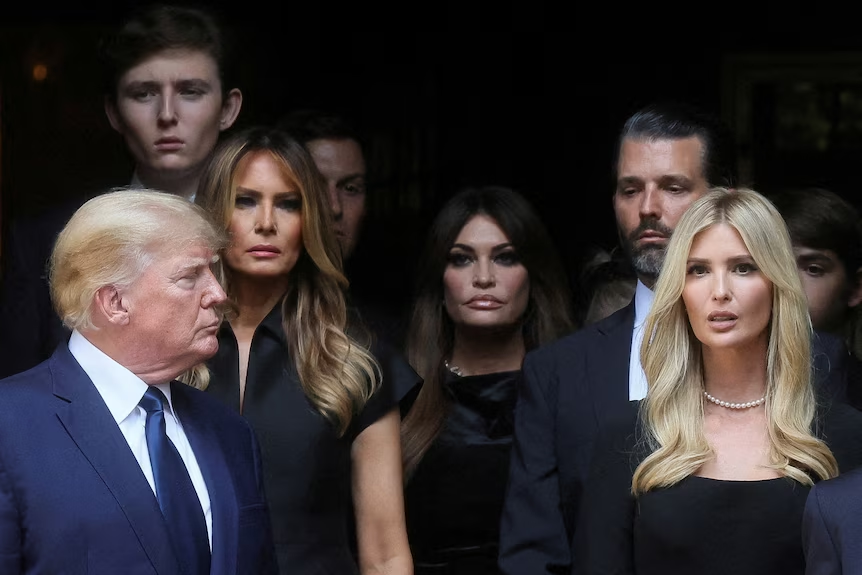
The midterms were fantasy politics for Democrats. What now for Trump?
The Trump political juggernaut has hit a wall. But while Democrats are celebrating, the battle for America's political future is only just beginning.
In the year America celebrated its 250th birthday, voters delivered a once-in-a-century election result signalling a break from a president who has dominated US politics for the past 10 years.
Donald Trump, to mark both the US semi-quincentennial and his own 80th birthday in June, put on a cage fight on the South Lawn of the White House. At these midterm elections, he was repeatedly body-slammed by voters. This was a very personal repudiation of a pharaoh-like figure who had tried, implausibly, to convince Americans they were enjoying a "golden age".
It represented the rebuke of a leader with authoritarian leanings who has sought to turn the White House into something akin to a palace, and Washington into a monument to himself.
Needless to say, exit polls showed voters were angry about the spike in fuel, food and, in rural states, fertiliser prices caused by a trade war that Trump framed as a "Liberation Day". The conflict with Iran had turned every gas station in America into a billboard for the Democrats. But alleged government corruption was also prominent in voters' minds, even higher in some exit polls than cost-of-living concerns.
Ahead of the election, a poll by Fox News showed alleged government corruption was actually the number one issue.
The billionaire president and his family have been getting ostentatiously richer while many Americans are suffering personal recessions.
Hard-pressed voters eyed decadence in the gold-bedecked walls of the Oval Office when their own quality of life was deteriorating. When Trump flew into the heartland to campaign, he did so aboard a $400 million Boeing 747-8 luxury airliner gifted by the Qatari royal family.
This wasn't simply an "it's the economy, stupid" election. It was also about the self-enrichment of Trump, his family members and acolytes such as Elon Musk, the world's first trillionaire. American voters were rejecting the excesses of an increasingly imperial presidency. Ending his campaign in front of the renovated Reflecting Pool in Washington seemed to many voters the perfect expression of his narcissism and tone-deafness.
Fantasy politics for the Democrats
More so than winning this election through the attractiveness of their policies, Democrats became the beneficiaries of the anti-Trump backlash. And theirs was a landslide win. The stuff of fantasy politics.
In regaining control of the US Senate, they took deep red Republican bastions: Texas, Kansas, even South Carolina.
In the House of Representatives, Democrats will enjoy at least a 50-seat advantage. It is the kind of lopsided congressional majority not seen since Barack Obama's victory in 2008 which took a couple of successive waves to achieve. The cumulative vote in all the House seats, which gives the national picture, showed the Democrats had close to a 13-point lead over the Republicans.
To put that in historical perspective, in the famed "Republican revolution" of 1994 the GOP beat the Democrats by 6.8 points.
For the first time in 16 years, the Democrats will control a majority of governorships. These include noteworthy racial firsts. In Georgia, Keisha Lance Bottoms became the first Black woman ever elected governor of an American state. Texas will now have a Latina governor, Gina Hinojosa. Disquiet and fear amongst Hispanic voters over ICE raids helped her triumph.
Not only the landscape but the face of US politics changed. For the first time in the country's history, the House of Representatives will have a Black speaker, New York congressman Hakeem Jeffries.
Small wonder, the term "bluenami" is being used. But it is also a red meltdown.
This is the first time in the Trump era his Republican Party has been severely punished. This result recalls the post-Watergate midterms in 1974 when Republicans were punished for the transgressions of Richard Nixon. Nixon had been forced to resign the presidency less than three months before Election Day.
That 1974 election brought about a generational shift. The Class of '74 included the so-called "Watergate babies". Remarkably, 87 members of the new Congress were aged under 40.
This election hasn't produced quite such an infusion of young blood. Still, at a time when Capitol Hill has often looked like a gerontocracy, the average age of lawmakers will be significantly lower. James Talarico, the Presbyterian seminarian with choir boy looks who won in Texas, is 37. Incumbent Democrat Jon Ossoff, who comfortably regained his seat in the Republican target state of Georgia, is 39. Abdul El-Sayed, who will become the first Muslim US Senator, is 42. Annie Andrews, who took South Carolina, is 46. Melat Kiros, who was endorsed by the Democratic Socialists of America in Colorado's first district, became the first Gen Z woman elected to Congress. She is just 29 years old.
A political realignment is on hold
What this election does not necessarily signify is a long-lasting political shift, or permanent realignment.
While the Republican Revolution of 1994 seemed to herald a period of conservative domination, just two years later Democrat Bill Clinton won his second term as president.
The 1974 midterm elections foretold that Republicans were set for a prolonged spell in the political wilderness. Yet Ronald Reagan won the presidency in 1980, and Republicans dominated the presidency for the next 12 years.
Democrats, understandably, are joyous about the outcome of the 2026 midterms. Yet their celebrations should come with circumspection.
A poll conducted in the run-up to this election suggested 52 per cent of voters had an unfavourable view of the Democratic Party; only 29 per cent had a favourable view. For months beforehand, the Real Clear Politicspolling average showed the American public looked on the Democrats only marginally more favourably than the Republicans.
Nevertheless, this is a mighty political achievement, which raises an important question: has the curtain come down on the age of Donald Trump?
A Trump dynasty snuffed out
As always, it is dangerous to write off or underestimate Donald Trump.
Just seven weeks after the storming of the US Capitol on January 6, 2021 as Congress met to certify the 2020 presidential election results, I watched as Trump was greeted like a conquering hero at a conservative conference in Orlando, Florida. The event had the feel of a cargo cult.
Likewise, after Trump-backed Republican candidates failed to make expected breakthroughs in the 2022 congressional midterms, pundits composed obituaries for the MAGA movement which proved wildly premature.
Yet this week's results are certainly a game-changer.
Any ambitions Trump might harbour of illegally defying the 22nd Amendment, which limits presidents to two terms in office, have surely been snuffed out. The notion of Trump 3.0 is even more outlandish now. A Trump dynasty also seems more unlikely. The thought of President Donald Trump Jr taking the oath of office in 2029 or 2033 requires a giant leap of imagination.
Instead, Trump has been badly weakened. His fear factor, within a Republican Party that over the past decade has come to resemble a Trump Party, has been diminished. Signs of his waning power have come already from his Vice President JD Vance who, in a 600-word screed on social media, broke spectacularly with the president.
"The reason we lost is the war," he wrote. "The president himself said so last night."
But the president had not said so last night, and the ambitious vice president, who is eyeing a bid for the 2028 Republican presidential nomination, is already trying to distance himself from a damaged brand.
In anointing his political heir, Trump might not be the all-powerful kingmaker after all. Maybe Republican presidential aspirants will not even crave his endorsement. When Texas Republican Senator Ted Cruz published his own 1700-word election post-mortem on X — he described the midterms as "an ass kicking" — it did not include a single word of praise for a president who is used to sycophantic encomiums from his party.
Trump, however, still commands fierce loyalty from millions in his MAGA base. His approval rating among self-described "MAGA Republicans" is 96 per cent. Again, it is worth remembering what happened in the aftermath of January 6. Republicans could have banished Trump into the political wilderness. Instead, his grip on the party tightened. He successfully managed to purge the party of Trump critics, such as former Congresswoman Liz Cheney, and easily saw off the challenge from rivals such as Florida Governor Ron DeSantis in the 2024 Republican primaries.
The MAGA agenda survives
This election was not only a rejection of Trump but a repudiation of his hyper-aggressive style of politics.
In Michigan, he slandered Democrat Abdul El-Sayed as a "jihadist" and "terrorist", repeatedly called him "Mohammed". But in this bellwether of bellwethers, El-Sayed won comfortably.
The defeat of Trump acolyte, Vivek Ramaswamy, was also emblematic. Ramaswamy aired one of the most vile political attacks in US campaign history, which featured the mother of his Democratic rival, Amy Aston, castigating her daughter as a liar for accusing her ex-husband, who had been criminally charged of rape and then fled from police, of sexually molesting her as a child. Senior Republicans, including the state's outgoing Governor Mike DeWine, called for Ramaswamy to take down the ad. Trump described it as "very powerful".
Voters overwhelmingly rejected that kind of hateful politics.
James Talarico, who Trump labelled "Talafreako", made this yearning for a gentler kind of politics the centrepiece of his victory speech in Texas.
"We are tired of being told to hate each other," said Talarico. "It has been 10 years of this kind of politics, politics as blood sport, politics as trolling and owning, politics as professional wrestling."
Much of the MAGA agenda, however, will survive. Strong borders. Economic nationalism. A rejection of globalisation and frictionless free trade. The insistence that US allies must cough up more money for their own defence.
Democrats will be more wary of pushing what might be called "woke" issues. Even New York congresswoman Alexandria Ocasio-Cortez remarked in August that "Woke 1.0 was crazy".
Democrats have already made concessions to Trumpism.
This election they focused on economic issues rather than identity politics. Crucially, however, in the 11 years since Trump came down that golden escalator he has not managed to create a pre-eminent new political order.
For much of the past century, as the historian Gary Gerstle noted in his 2022 landmark study, The Rise and Fall of the Neoliberal Order, US politics was dominated by two political orders.
First, the New Deal created in the 1930s by Franklin Delano Roosevelt, marked by broad consensus between Democrats and Republicans on the role of the state in regulating capitalism and providing a basic welfare safety net for the economically disadvantaged.
Next, from the 1970s to the 2010s, came the neoliberal order, based on a reduced role of government and greater emphasis on the market, which was championed by Reagan and acquiesced in by Clinton, who presented himself as a market-friendly "New Democrat".
Since the Great Recession of 2008, however, no party has managed to impose its ideas on the other, or accrued enough power for long enough in Washington to do so. Instead, we have entered what Gerstle describes as an "interregnum characterised by disorder and instability".
This election offers further proof that we remain in this liminal phase, with neither side establishing lasting dominance.
Trump believed there had been a conservative vibe shift in 2024 after he regained the presidency by winning all seven battleground states. Republicans also controlled both houses of Congress. Two years later, Trump and his party have been hammered.
Where to for the left?
In a chronically polarised nation, we are witnessing a period of unusual political volatility.
At the presidential level, three consecutive two-term presidencies (Democrat Bill Clinton, Republican George W Bush and Democrat Barack Obama) have been followed three consecutive one-term presidencies (Republican Trump, Democrat Joe Biden, Republican Trump).
Not since the late 19th century, when Grover Cleveland lost the presidency only to win it back four years later, have we seen the presidency switch quadrennially between the parties. Likewise, no party has managed to command Capitol Hill for an extended period. Already this century the House has changed hands five times.
In the entire second half the 21st century, during which Democrats dominated the House of Representatives, that scenario has only occurred three times. In the final 25 years of the 20th century, the Senate changed majority control just three times. In the first 25 years of the 21st century, it has flipped eight times.
Now we will see divisions not only between the parties but within them. Progressive Democrats will point to the success of El-Sayed in Michigan, and the energising effect of Zohran Mamdani's 2025 mayoral victory in New York, as proof that a left-wing version of economic populism can succeed at the national level.
Among the Democratic victors on Tuesday were a record number of candidates backed by, or affiliated with, the Democratic Socialists of America. Centrists will cite the breakthrough in Texas of Talarico, a moderate Christian Democrat, and the mega-church pastor Adam Hamilton in Kansas as evidence that the party should occupy the middle ground.
All the party's winning presidential candidates since World War II — Harry Truman, John F Kennedy, Lyndon Johnson, Jimmy Carter, Bill Clinton and Barack Obama — have been pragmatic centrists.
The orthodoxy that only a moderate can win the White House will now be challenged, and contested, ahead of the 2028 presidential election.
Where to now for the right?
On the right of politics, what remains of the more traditionalist wing of the Republican Party might argue the party has to move away from its Trump branding and become more recognisably Reaganesque. Reagan was a free-trade internationalist who backed traditional conservative governance, compared with Trump's populist nationalism that embraces economic protectionism and rejects global alliances and institutional norms.
MAGA diehards will remain faithful to Trump, though some will argue he has not been MAGA enough, especially by launching an unpopular war with Iran. Think-tanks, such as the Heritage Foundation which produced the controversial policy blueprint Project 2025, have lurched a long way to the right. So, too, have media channels such as Fox News and NewsMax, whose "angertainment" business models are based on stoking culture war outrage.
So, it is by no means inevitable that the party will move back towards what is sometimes called the sensible centre.
How could the Republicans remain viable if MAGA voters withdrew their support? Some are now likening the Trump Republican Party to the Trump casino empire. That did not end well.
If, moreover, Texas becomes the new California — the Golden State voted Republican in every presidential election between 1968 and 1988 but Democrat ever since — then it could face a prolonged shut-out from the White House. Try gaining an Electoral College majority without at least one of the country's two most populous states.
Looking to the future, the youth vote does not augur well for the Republicans. Nationally, in House elections, exit polling suggest 66 per cent of voters aged 18-29 voted for a Democrat candidate.
Always, though, we must be wary of over-extrapolating in the aftermath of what look like transformative elections. I have seen too many victorious parties over-reach and then face push-back from voters. Remember the heady talk after Barack Obama's election in 2008 that suggested he would usher in a phase of post-partisanship, and even post-racialism.
As a correspondent in the US at the time, I witnessed how the country's first African-American president was followed into the White House by the untitled leader of the Birther Movement, who placed himself at the head of the anti-Obama white backlash. As Obama himself described the shift after Trump's victory in 2016: "History doesn't move in a straight line. It zigs and zags."
Democrats have authority to scrutinise
For the past decade, anti-incumbency has so often been the driver of American politics. That, and the negative partisanship that comes with it. Voters often cast their ballots against a party rather than for a party. In these midterms we saw it again. In a 50/50 nation, where for much of this century the results of elections have been far narrower than on Tuesday night, politics has been marked by deadlock not dominance.
What we do know for sure is that the Democrats have just won the authority to scrutinise and investigate. When the new Congress meets on January 3, expect Democratic lawmakers to use those subpoena powers to the full.
Robert Garcia, the top ranking Democrat on the House Oversight Committee, which tends to spearhead congressional investigations, has said already that allegations of Trump family corruption will be his main priority, with the president's eldest son, Donald Trump Jr, and his son-in-law, Jared Kushner, coming under closer scrutiny. On election night, he posted two words on social media: "LAWYER UP!"
Garcia also released a statement pledging to take on "the Trump Crime Family, corporate corruption, DHS [Department of Homeland Security] and ICE abuses, and the cover-up of the Epstein files". Hakeem Jeffries has accused the "Trump Cartel" of "massive corruption" and warned: "We are going to hold the crooks accountable."
With a majority in the House, the Democrats could for a third time impeach Donald Trump (previously, only two presidents — Andrew Johnson and Bill Clinton — have faced the charge of committing high crimes and misdemeanours). But winning a conviction in the Senate trial that would ensue requires 67 votes, the kind of super-majority the Democrats are not close to achieving. Besides, attempts to punish Trump have often worked in his favour, by allowing him to claim a political form of martyrdom.
The Democrats could also try to impeach Secretary of War Pete Hegseth for waging military hostilities without congressional authorisation, which is a violation of the 1973 War Powers Resolution. Moves are already afoot in what is now a lame duck Congress, spearheaded by the anti-Trump Republican Thomas Massie, to trigger an impeachment vote against Hegseth as soon as this week.
Accountability and action
The newly-elected 120th Congress, whose members will take their seats in the new year, could become known as the Accountability Congress. But House Democrats will also want to make it an Action Congress, by passing bills, on healthcare especially, that meet the concerns of struggling American voters — even though they could be blocked by Republican filibusters in the Senate, which require 60 votes to break, or vetoed by the president.
Ethics reform is an area the Democrats could highlight, such as beefing up financial conflict-of-interest rules in the executive branch and placing limits on presidential pardons. The post-Watergate Congress placed a heavy emphasis on ethics reform, with the creation of the Office of Government Ethics and independent Inspectors General within federal departments.
Among the challenges for the Democrats will be to restore the power of Capitol Hill, which has been the home for the past two years of an incredible shrinking Congress.
Since returning to the White House, Trump has sought to expand the power of the presidency and to govern almost by decree through signing so many executive orders with the flourish of his Sharpie felt tip pen. Already, he has signed 292 executive orders during his second term, well over 100 more than Joe Biden issued during his entire four-year term.
The conservative-dominated Supreme Court, while sometimes checking his power, has helped him create a more maximal presidency. In Trump v Slaughter, the court ruled in June that the president can fire the heads of independent regulatory agencies at his behest, without being required to show "cause".
In its landmark Trump v United States ruling in 2024, brought in connection with the criminal charges he faced over his attempt to overturn the presidential election, it decided presidents possess substantial immunity from criminal prosecution for official acts taken while in office. Among the three branches of government, Congress has felt like the third wheel.
The founding fathers, however, had a very different power ranking in mind. The legislature was supposed to be the most powerful branch of government, which is why Congress was vested with the power of the purse. The presidency was meant to be second. The Supreme Court a distant third.
Democrats on Capitol Hill will attempt to restore parity with the executive branch, especially over trade policy, and to overtake the Supreme Court. Supreme Court Justice John Roberts has been a more influential figure than the departing Republican House Speaker Mike Johnson. Incoming House Speaker Hakeem Jeffries will attempt to restore the sway of a role traditionally regarded as the second most powerful government position in the country.
Trump is no lame duck
After the Republicans' shellacking at the polls, it will be tempting to describe Trump as a "lame duck" president, the usual descriptor for an incumbent whose party loses control of Congress and cannot seek re-election. With Trump, that would be an act of folly. Normal nomenclature does not apply to such an abnormal president.
Trump will not be a lame duck until the final second of the final minute of his presidency. In his last supposed lame-duck phase, from his defeat at the 2020 election to inauguration day in 2021, he propagated the "Big Lie" about Joe Biden stealing the election, amassed his supporters in Washington and did little to restrain them when they first started storming the US Capitol.
Trump still has enormous executive powers at his disposal. He remains the commander-in-chief of the world's most powerful military. He still has control of the FBI and Justice Department, and could use both in an attempt to take vengeance on political opponents. Overcoming a presidential veto requires a two-thirds super-majority in both houses of Congress, which alone the Democrats cannot muster. Trump has issued 12 vetoes over the course of his two terms; congress has only overridden one of them.
By appointing as his new White House chief of staff arch loyalist Stephen Miller, the hardline architect of the ICE immigration crackdown, Trump is signally there will be no retreat from MAGA. Heading the West Wing is a figure who Trump will regard as a wartime consigliere, an aggressively combative figure in upcoming battles with Congress.
Often, if presidents are thwarted on the home front by an obstructionist Congress, they look to make their mark in the foreign realm. Trump could press for a peace deal in the Ukraine war, on terms that would likely be highly favourable towards Vladimir Putin. He could renew the kind of summitry with North Korean dictator Kim Jong Un, which became such a feature of his first term diplomacy.
He might agree to carve up the world into spheres of influence as part of a grand bargain with Putin and President Xi Jinping of China, which would require concerns in Taiwan. Trump has made no secret of his desire for regime change in Cuba.
As the dust settles after such an extraordinary electoral event, it is worth noting what did not happen in the 2026 congressional midterms.
For sure, Donald Trump tried to disrupt the polls beforehand, by attempting to limit postal voting and demanding, unsuccessfully, that states surrender their voter registration lists to the Justice Department in Washington.
Yet worries that Immigration and Customs Enforcement (ICE) agents, or even federal troops, would be deployed at, or in the close vicinity of, polling stations on Election Day did not eventuate. Nor has Trump tried to interfere with the count. The Republican defeat, of course, was too big to rig. In a closer election, disputed contests could easily have become flashpoints. But it is worth pointing out that, although he has distanced himself from the results, he had not disputed them.
In the year America marked its 250th birthday, the country faced a democratic test, and passed.
Nobody was assassinated during the campaign. Election Day passed without violence. On January 3, when the new Congress is seated we will not see a repeat of the American insurrection that unfolded on January 6, 2021.
That alone, in a country as divided and fractious as America, is cause for celebration.
Credits
Words: Nick Bryant
Illustrations: Lindsay Dunbar
Photographs: Reuters
Editing: Catherine Taylor
[ad_2]

Scott Colom and Black Mississippians stand on the cusp of Senate history as vote count stretches on
JACKSON, Miss. (AP) — Democrat Scott Colom hasn't won Mississippi's U.S. Senate race, but the local prosecutor was welcomed as a historic figure Friday as he strolled through the Farish Street business district where civil rights leaders once organized.
"It's so wonderful! It's so wonderful to have Scott Colom as our representative," said Maati Jone Primm, who owns Marshall's Music & Bookstore in Jackson.
Stand with free and independent journalism. Join Press Pass from PBS News
The state is still tallying ballots that could make Colom the first Black senator from this Deep South state since post-Civil War Reconstruction. The possibility of Colom defeating Republican Sen. Cindy Hyde-Smith puts many Black voters somewhere between cautious optimism and outright celebration in a state where nearly 40% of the population is Black but the top representation for generations has been white.
"I'm so glad we are at the point where we are," said Sorie Tarawally, a 76-year-old attorney who has long known Colom's father. He called the 43-year-old candidate "the man, our messiah, our savior."
The contest remains too early for The Associated Press to call, and Colom's historic bid will hinge on a tedious process playing out in elections offices across Mississippi's 82 counties. Local officials are receiving and examining absentee and provisional ballots, called affidavit ballots, before deadlines next week. Volunteers and lawyers representing each campaign look on in anticipation of potential litigation.
Live Results: Mississippi Senate midterm election
"We're going to make sure everything is followed according to the law, and I have confidence in those local officials," Colom said. "They're doing their jobs. Got to be patient with them."
Colom said ballots tallied since Tuesday's election lean in his favor, and he chided Hyde-Smith for not explaining her strategy going forward.
"She's still our senator. Where is she? Why is she not doing any interviews?" Colom asked. "Why can't she explain what her pathway to success is?"
Hyde-Smith has not appeared publicly since election night, when she essentially declared victory despite a razor-thin margin with ballots still uncounted.
"We are not backing down," she posted Friday on social media. "This election is not over. Our team is working across Mississippi to monitor the remaining ballots and protect the integrity of the process. We will see this through to the very end!"
The precise number of outstanding ballots is not known
The pool of outstanding ballots includes absentee ballots, which can be counted in Mississippi as long as they are received by Tuesday, five business days after the election. The rest are affidavit ballots, which are cast at the polls when there's a glitch: Perhaps the person's name was not on the rolls or the person did not have proper identification, or a poll worker determined the person's identification did not precisely match the name on the list.
Citizens who had identification issues have until Tuesday to address those matters in person at their local elections office. For people who were not on a precinct's rolls, local officials can verify a person's status using previous records and information on the affidavit that person filed when filling out a ballot. That person typically has no responsibility to come to a local elections office; ballot status can be found on the Mississippi secretary of state's office website.
Counties have until Friday to certify complete results to the secretary of state.
Mississippi law has no provision for a statewide recount. Campaigns could seek court orders, usually county by county, seeking to examine ballots.
The seismic effect would be in Mississippi, not Washington
Democrats already have won control of the Senate, so the result in Mississippi would not change the balance of power in Washington.
But it would mark a seismic shift in the state, where white conservatives have dominated the Statehouse and congressional delegation for nearly 150 years. Through Jim Crow segregation and the Civil Rights era, those leaders were nearly all Democrats. After the Civil Rights Movement, they overwhelmingly shifted to Republicans. For Black Mississippians, the result was the same: a lack of proportional representation at the top levels of state government and in Washington.
Colom was initially viewed as a long shot, and it wasn't until late October that Senate Democrats' top campaign group started spending on advertising to support him. But the midterms revealed a broad backlash against redistricting efforts in the South that were aimed at boosting Republicans and, by extension, reducing Black representation.
Primm's bookstore, where Colom visited on Friday, opened in the 1930s and is recognized as the oldest Black-owned bookstore in the U.S.
She said the Farish Street neighborhood still represents Black Mississippians' "first migration, from the plantation to the city." Having Colom there as a potential senator "makes us so proud, and it gives us someone to aspire to. Our youth need to see the possibilities for their lives, and we do when we see our next senator from Mississippi."
READ MORE: The election brought a wave of historic firsts. Here are some groundbreaking winners
As he campaigned, Colom emphasized that he can represent all Mississippians, and he said President Donald Trump's policies — the war with Iran and tariffs, especially — cut across all demographic lines. He even celebrated the extended ballot counting process as a benefit to the state's 2.95 million residents.
"I'm so glad the national press is getting to see the beauty of our state," he said.
But Colom and his Black supporters also have never ignored the significance of his candidacy as a Black man.
"We are motivated by the gross inequalities we have seen in society and how only one side seems to benefit," said Tarawally, who was born in Sierra Leone and arrived in the Deep South to attend law school at the University of Mississippi. "So, we want a person who speaks to our benefit."
Colom ended his campaign with an ad set at the Jackson home of Medgar Evers, the civil rights leader who was gunned down in 1963 in his own driveway, dying in front of his wife and children.
"It's a powerful reminder of the sacrifice to gain the ballot, and nobody sacrificed more than Medgar Evers and his family," Colom said Friday.
"What was important to me about that ad is we didn't ask people to vote for me. We just talked about the sacrifice, talked about the story," he continued. "We just wanted that to be the closing ad because I wanted that to be the last message that the people of Mississippi heard."
[ad_2]