- The EU depends on nuclear power for about one-quarter of its electricity, and a higher proportion of base-load power. Nuclear provides about one-third of the low-carbon electricity.
- Very different energy policies pertain across the continent and even within the EU, but attention is now being given to an EU energy union.
- A substantial degree of transmission interconnection exists in western Europe, but much more investment is needed.
- Electricity markets are a key to the future of reliable generation capacity, including nuclear.
NB please consult individual country pages for country-specific details; this page only provides an overview.
The European Union (EU) comprises 27 countries across continental Europe which are committed to working together and sharing unrestricted trade. Since six countries founded it in 1958 as the European Economic Community free trade area, it has acquired more members, and in 1993 its name became the European Union (EU). The UK joined in 1973 but left in January 2020 following a national referendum in 2016 on its membership. In the 1980s and 1990s it gained political substance as members transferred some powers to it, and it increasingly became characterized by regulation, including of energy. The former East Germany was admitted as part of reunified Germany in 1990. A number of treaties agreed by member states define these central powers wielded from Brussels. The total EU population is approximately 450 million.
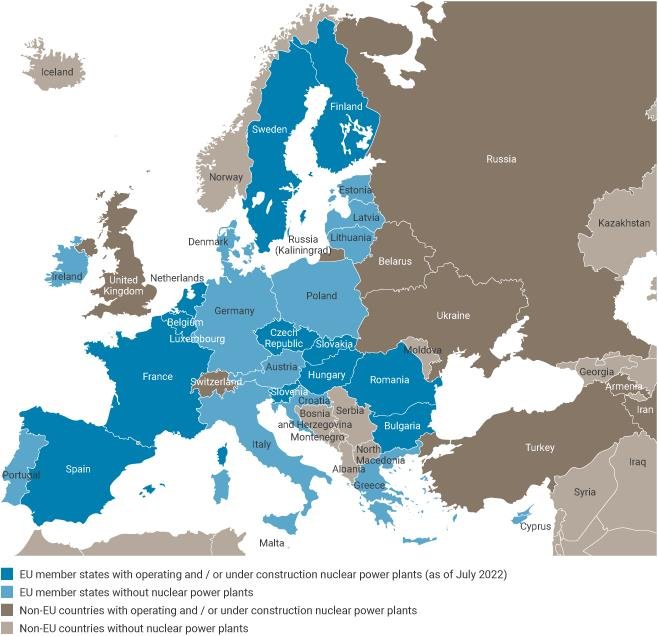
The non-EU European countries of Switzerland, Norway, the United Kingdom and some Balkan states* are to some extent electrically networked with the EU. Norway participates in the EU Emissions Trading System. In March 2022, following Russia’s invasion, Ukraine’s grid was synchronized with and connected to the European grid.
*Serbia, Bosnia & Herzegovina, Montenegro, Albania, North Macedonia
The European Parliament is directly elected from within each EU member state and can pass laws. The EU’s broad priorities are set by the European Council, which brings together national heads of state and a rotating EU president. The interests of the EU as a whole are promoted by the European Commission (EC), whose members are appointed by national governments. The EC, based in Brussels, proposes legislation, and is then responsible for implementing it. Governments defend their own country’s national interests in the EU Council.
In 2025 in the EU, 34% of electricity was generated from fossil fuels and biomass, 23% from nuclear, 30% from wind and solar, and 12% from hydropower.
EU energy policy, energy union
Member states of the EU have a wide range of views on the use of nuclear energy. As such EU level policies do not stipulate future deployment levels of nuclear technologies, unlike for renewables. The policies of countries in the EU with civil nuclear power plants are outlined in dedicated country profiles.
Since 2015, the EC has been implementing the energy union strategy. The energy union aims to integrate and strengthen the EU’s internal energy market, and its five priorities are: enhance security of energy supply; build a single integrated energy market; increase energy efficiency; decarbonize the economy; and boost research and innovation.
However, two developments are cutting across the single electricity market concept, both related to ensuring that critical future demand can be met: national capacity markets; and demand response markets. France, Italy, Spain, Portugal, Greece and Ireland all offer capacity payments of some sort, which are often costly, distort the market, and run counter to the idea of phasing out fossil fuel subsidies in the long term.
In November 2016 the EC proposed the EU Clean Energy Package, a set of eight legislative proposals designed to implement the energy union strategy. The legislative acts, adopted 2018-2019, set ambitious targets for energy efficiency, renewable energy and emissions reductions by 2030. The package also removed priority dispatch for new renewables capacity. EU energy regulators European Union Agency for the Cooperation of Energy Regulators (ACER) and the Council of European Energy Regulators (CEER) in May 2017 called for its removal for existing renewable energy capacity as well, in order to avoid the “perverse outcome” of inefficient old plant continuing to operate, adding to system costs. In Germany, many wind projects had started to approach 20 years of operation, with decisions needing to be made on operating lifetime extension, or closure or repowering. ACER and CEER also called for removal of the 90% compensation floor for renewable energy curtailment, making the approach to redispatch and curtailment less prescriptive, with market-based prices being the basis for compensation for renewable energy plants.
In December 2019 the EC created the European Green Deal, which pledged to reduce greenhouse gas emissions in 2030 by 55% compared to 1990 levels, and that the EU would become climate neutral by 2050. These objectives became mandatory under the European Climate Law passed in June 2021. Proposals under the ‘Fit for 55’ package, intended to bring EU energy and climate legislation in line with the pledge to reduce greenhouse gas emissions by 55% by 2030, were released in 2021. Both directives were formally adopted by the European Council in 2023. The directives increased the binding targets for the share of energy from renewables to 42.5% (from 32%) by 2030. In March 2026 a further amendment to the European Climate Law set a binding intermediate target of a 90% reduction in net greenhouse gas emissions by 2040 compared with 1990 levels, allowing up to five percentage points of this to be met by international carbon credits from 2036.
Following the major impact on European energy supply from the war in Ukraine, the EC in May 2022 presented its REPowerEU Plan that aims to phase out dependence on Russian fossil fuels. It called for a further increase to targets for energy efficiency and renewables deployment by 2030.
Earlier in February 2021 a report commissioned by the European Conservatives and Reformists (ECR) and the Renew Europe groups of the European Parliament examined three issues key to the EU’s ambition to be climate neutral by 2050: the effect of EU climate neutrality on the average global atmospheric temperatures by 2050 and 2100; the spatial (land and sea) requirements for wind and solar energy compared with nuclear energy in the Czech Republic and the Netherlands; and the cost of wind/solar energy and of nuclear energy for these two countries. The study found that, in realistic scenarios, there is insufficient land to meet all the power demand of the Netherlands – “a country along the North Sea with abundant wind” – and the Czech Republic – “a landlocked country with no access to the sea and a geographically more challenging landscape” – if they were to rely solely or predominantly on wind and solar power. It also concluded that nuclear energy is more cost-effective than renewables. Even when major efficiency improvements in solar and wind farms are taken into account, nuclear energy would remain the cheaper option in 2050, it said.
In March 2023 the EC proposed electricity market reforms under the Net-Zero Industry Act to scale up manufacturing of clean technologies in the EU as part of the clean-energy transition. Under ‘advanced technologies’, small modular reactors (SMRs) were mentioned as one of the technologies that could make a significant contribution to decarbonization.
In October 2023 the EC agreed to include existing nuclear plants in the electricity market reforms. The agreement stipulated that governments may apply contracts for difference (CfDs) for investments aimed at extending the operating lifetimes of existing power plants, but these would be subject to specific “design rules” established by the EC to prevent market distortion. The reform was part of a wider reform of the EU’s electricity market design which also included a regulation focused on improving the EU’s protection against market manipulation. The reform was formally adopted in June 2024 and entered into force the following month.
In November 2023 the European Parliament approved the Net Zero Industry Act (NZIA) by a 376 to 139 vote. The NZIA sets a target for Europe to produce 40% of its annual deployment needs in net-zero technologies by 2030 and to capture 15% of the global market value for these technologies. Included in the ten proposed technologies was “advanced technologies to produce energy from nuclear processes with minimal waste from the fuel cycle, small modular reactors, and related best-in-class fuels.”
In response to impacts on oil and gas supplies due to closures of the Strait of Hormuz, in July 2026 the EC proposed the Electrification Action Plan. It set an indicative target for 46% electrification of the economy by 2040, up from 32% by 2030 which had been previously indicated by its Clean Industrial Deal and Affordable Energy Action Plan. The EC said reaching this would save the EU €260 billion per year in 2040. The new electrification goal could be included in the Energy Union Package for the period after 2030.

EU nuclear generation capacity
The 98 nuclear power reactors (96 GWe) operating in 12 of the 27 EU member states account for about one-quarter of the electricity generated in the whole of the EU. Over half of the EU’s nuclear electricity is produced in only one country – France. The 64 units operating in five non-EU countries (United Kingdom, Belarus, Russia, Ukraine and Switzerland) account for just over 30% of the electricity in the rest of Europe. Norway and Switzerland are effectively part of the EU synchronous grid (see later section on Interconnection: European Transmission Infrastructure).
Nuclear energy in the EU is governed to a large extent by the Euratom Treaty, which was one of the founding treaties establishing the EU. All EU member states are party to it by default. The European Atomic Energy Community (Euratom) was established in March 1957 and associated with the Treaties of Rome in 1958 to form a common market for the development of the peaceful uses of atomic energy (see below).
The Euratom Treaty requires the EC to periodically issue a nuclear illustrative programme (PINC), based on data from member states, and the latest of these was published in June 2025 (the first since May 2017). It forecast a base case for nuclear capacity of 109 GWe net capacity in 2050. This scenario would require €241 billion to be invested with new-build large-scale reactors accounting for €205 billion and operating lifetime extensions accounting for €36 billion. It was adopted in March 2026.
Although the establishment and operation of power generating capacity is undertaken on a national basis, a lot of electricity trading is undertaken across national boundaries in the EU, and any country’s energy policies have significant implications for neighbours. While economic considerations are normally paramount, energy policies relating to carbon emissions, energy security or ideology may trump economics and skew the choice of generating technology.
Although nuclear is a proven source of low-carbon, dispatchable electricity giving a high degree of energy security, the sector today faces major challenges within the EU. Some member states are strongly anti-nuclear, and electricity markets are often structured in response to populist support for renewables. In the period to 2030, nuclear capacity that will be lost due to the closure of a number of reactors – either because they have reached the end of their operating lifetimes or due to political interference – is expected to outweigh that gained from new reactors. A slight decrease from the current EU nuclear capacity is therefore expected in the near term.
Nuclear plant construction is currently under way in two EU member states – Slovakia, where Mochovce 4 completed fuel loading in July 2026 ahead of startup, and Hungary, where first concrete for the first Paks II unit was poured in February 2026. France’s Flamanville 3 EPR was the most recent unit in the EU to be connected to the grid, in December 2024, reaching full power in December 2025. These construction projects have experienced cost overruns and delays. Further new units likely to come online within the next 15 years are outlined in the table below.
EU nuclear power
|
COUNTRY
|
NUCLEAR ELECTRICITY GENERATION 2025* |
REACTORS OPERABLE |
REACTORS UNDER CONSTRUCTION |
REACTORS PLANNED |
REACTORS PROPOSED |
URANIUM REQUIRED 2025 |
|
TWh |
% |
No. |
Net MWe |
No. |
Gross MWe |
No. |
Gross MWe |
No. |
Gross MWe |
tonnes U |
| Belgium |
22.6
|
33.7
|
2
|
2056
|
0
|
0
|
0
|
0
|
0
|
0
|
276
|
| Bulgaria |
14.7
|
38.3
|
2
|
2006
|
0
|
0
|
2
|
2500
|
0
|
0
|
338
|
| Czech Republic |
30.3
|
42.1
|
6
|
3972
|
0
|
0
|
3
|
2570
|
5
|
3810
|
707
|
| Estonia |
NA
|
NA
|
0
|
0
|
0
|
0
|
0
|
0
|
2
|
600
|
0
|
| Finland |
31.3
|
39.6
|
5
|
4369
|
0
|
0
|
0
|
0
|
0
|
0
|
609
|
| France |
375.7
|
68.1
|
57
|
63,000
|
0
|
0
|
2
|
3300
|
4
|
6600
|
8389
|
| Hungary |
15.2
|
45.2
|
4
|
1916
|
1
|
1200
|
1
|
1200
|
0
|
0
|
320
|
| Netherlands |
3.8
|
2.7
|
1
|
482
|
0
|
0
|
0
|
0
|
2
|
2650
|
72
|
| Poland |
NA
|
NA
|
0
|
0
|
0
|
0
|
7
|
4950
|
23
|
8990
|
0
|
| Romania |
10.1
|
20.5
|
2
|
1300
|
0
|
0
|
8
|
1902
|
0
|
0
|
183
|
| Slovakia |
18.0
|
64.4
|
6
|
2746
|
0
|
0
|
0
|
0
|
1
|
1200
|
443
|
| Slovenia |
5.5
|
39.7
|
1
|
696
|
0
|
0
|
0
|
0
|
1
|
1200
|
128
|
| Spain |
51.5
|
18.9
|
7
|
7123
|
0
|
0
|
0
|
0
|
0
|
0
|
1218
|
| Sweden |
44.8
|
26.7
|
6
|
7013
|
0
|
0
|
3
|
1500
|
16
|
1924
|
968
|
|
TWh
|
%
|
No.
|
Net MWe
|
No.
|
Gross MWe
|
No.
|
Gross MWe
|
No.
|
Gross MWe
|
tonnes U
|
In the non-EU neighbouring countries the outlook is more positive for nuclear, both in the near term and longer term. Construction is now under way in Russia, Belarus and Turkey using VVER technology, and in the United Kingdom, where two EPR reactors are being built at Hinkley Point.
EU neighbours nuclear power
|
COUNTRY
|
NUCLEAR ELECTRICITY GENERATION 2025* |
REACTORS OPERABLE |
REACTORS UNDER CONSTRUCTION |
REACTORS PLANNED |
REACTORS PROPOSED |
URANIUM REQUIRED 2025 |
|
TWh |
% |
No. |
Net MWe |
No. |
Gross MWe |
No. |
Gross MWe |
No. |
Gross MWe |
tonnes U |
| Belarus |
15.9
|
39.5
|
2
|
2220
|
0
|
0
|
1
|
1194
|
0
|
0
|
348
|
| Russia |
204.9
|
18.7
|
34
|
27,969
|
7
|
5342
|
23
|
21,000
|
9
|
754
|
6251
|
| Switzerland |
18.4
|
27.1
|
4
|
2973
|
0
|
0
|
0
|
0
|
0
|
0
|
412
|
| Turkey |
NA
|
NA
|
0
|
0
|
4
|
4800
|
0
|
0
|
8
|
9600
|
620
|
| Ukraine † |
50.9
|
52.0
|
15
|
13,107
|
2
|
2178
|
2
|
2500
|
7
|
8750
|
890
|
| United Kingdom |
32.9
|
10.7
|
9
|
5883
|
2
|
3440
|
3
|
3830
|
16
|
2780
|
896
|
|
TWh
|
%
|
No.
|
Net MWe
|
No.
|
Gross MWe
|
No.
|
Gross MWe
|
No.
|
Gross MWe
|
tonnes U
|
† Under Construction figures include a number of units where construction is currently suspended: Khmelnitski 3&4 (Ukraine).
EU Emissions Trading System
The EU has led the world in creating an emissions trading system (ETS) for carbon dioxide, which is the cornerstone of EU policy to counter climate change, and a major factor in EU energy policy. The ETS is a cap-and-trade system which is seen as providing the core of a wider scheme to limit carbon emissions worldwide. It works by setting a cap on greenhouse gas emissions from installations and reduces it each year in line with the so-called linear reduction factor (LRF).
The ETS aims to reduce emissions from the sectors it covers by 62% below 2005 levels by 2030. It covers some 10,000 installations (power stations and industrial plants) in 27 EU countries plus Norway, Iceland and Liechtenstein. The emissions trading system of Switzerland has been linked to the EU ETS since September 2020. The United Kingdom left the ETS at the start of 2021.
After a positive start in 2005, in May 2006 the price of emissions allowances under the ETS for the first commitment period (2005-2007) plunged to less than half their previous value, indicating fundamental problems with the efficacy of the whole scheme. Attempts have been made since then to address those problems. In 2011, carbon to the value of about €112 billion was traded on the ETS, but in 2012 this dropped to about €75 billion, its lowest level since 2008.
In January 2014 the EC published its 2030 framework for climate and energy policies, including a legislative proposal for the ETS to establish a market stability reserve (MSR). The MSR was brought into operation in January 2019. It works by removing 24% of the supply of carbon allowances in circulation each year to support carbon prices.
The fourth trading phase of the ETS started in January 2021. From 2013-2020 the LRF was 1.74% per year. In the fourth phase (2021-2030) this initially increased to 2.2%, and from 2024 it was raised to 4.3% per year (4.4% from 2028) in line with the strengthened 2030 emissions goal. Under the EU ETS, certain businesses are provided free allocation of carbon allowances under the so-called ‘carbon leakage list’ – a group of sectors thought to be at highest risk of relocating to avoid the scheme. In the fourth trading phase the list of sectors eligible was cut from 180 to about 60.
The EU is looking at ways to expand the EU ETS to help deliver the bloc’s decarbonization goals. As of mid-2026, the system covered about 40% of the EU’s greenhouse gas emissions. Maritime transport was included in the system from January 2024, and a separate emissions trading system (ETS2) covering buildings and road transport is due to start in 2028. In July 2026 the EC proposed a revision of the system, which would slow the tightening of the emissions cap after 2030, extend free allocation for sectors covered by the carbon border adjustment mechanism, and phase municipal waste incineration into the system from 2031.
Energy security
In May 2014 the European Commission proposed a new European Energy Security Strategy, in the context of its energy import dependency of more than 50%, with 39% of EU gas imports in 2013 coming from Russia. Diversifying external energy supplies, upgrading energy infrastructure, completing the EU internal energy market and saving energy were among its main points. The EC acknowledged that “electricity produced from nuclear power plants constitutes a reliable base-load supply of emission-free electricity and plays an important role for energy security,” and that “EU industry has technological leadership on the whole chain, including enrichment and reprocessing.”
Germany completed its phaseout of nuclear power in 2023, significantly increasing wind and solar reliance. Subsidies on these renewables are accompanied by giving them priority grid access, so that when they are producing they displace other sources from the grid. This reduces the load factors of gas, coal and nuclear plants, most critically in Germany but also in other places where these policies prevail to any degree. This compromises the economic viability of those plants, especially the newer ones which must earn money to repay construction costs. Coupled with this side effect from renewables’ grid priority was a low ETS carbon price and also low cost of coal, which made coal-fired generation attractive. Despite concern about CO2 emissions, Germany remains one of the world’s biggest consumers of coal. While gas plants fit better as back-up for expanded renewables, they are less economic than coal, and gas supplies are uncertain, especially since Russia’s military offensive against Ukraine in 2022.
In 2018 Euratom said that the EU had uranium inventories that could fuel EU utilities’ reactors for three years. Euratom acknowledged that the average concealed a wide range, but stated that all utilities are covered for at least one year.
In February 2022, Russia launched a military offensive against Ukraine (see information page on Russia-Ukraine War and Nuclear Energy). A statement from the EC in June 2022 accused Russia of using natural gas as a “political and economic weapon.” The EU’s dependency on Russian gas imports has resulted in concerns over securing supply and a significant increase in wholesale energy prices. With concerns over energy supply for the winter, in May 2022, EU leaders convened and agreed to ban almost 90% of Russian oil imports by the end of that year. Meeting again in June 2022, the EC adopted new rules to improve security of supply to the EU, with member states agreeing to “ensure their gas storage facilities are filled before winter” and “share storage facilities in a spirit of solidarity.” In July 2022, a voluntary political agreement to reduce natural gas demand by 15% for the winter was reached, and adopted in August. Following the EC’s May 2025 REPowerEU roadmap, the EU adopted regulation turning the phase-out into law. (EU) 2026/261 introduces a permanent ban on imports of Russian pipeline gas and LNG. Imports under short-term contracts ended in 2026 and those under legacy long-term contracts will be phased out through 2027. The regulation does not cover nuclear materials, on which the EC said it was continuing to work with member states given the complexities of the nuclear supply chain.
Russian gas dependence
EU heads of state pledged in 2014 to focus on energy security and to agree on a climate and energy framework. They were divided on the impact of the Ukrainian crisis (Russian control of Crimea and subsequently parts of eastern Ukraine), with Germany calling for ambitious carbon emissions reductions, renewables and energy efficiency goals to lower the reliance on imported fossil fuels, notably Russian gas. Russia then supplied over 30% of Europe’s gas, and half of this transited via Ukraine. However, Poland and other eastern European countries wish to maintain significant dependence on domestic energy resources such as coal and possibly shale gas as a higher priority than emissions reductions. Gazprom gas exports to western Europe increased by about 40% over 2010 to 2020.*
* EnergyMarketPrice 17/10/14 reported on an evaluation of the vulnerability of the (then) EU-28 and ten neighbouring countries to a possible six-month halt in gas supplies from Russia. It noted that Germany was Europe’s main purchaser of Russian gas, paying Russian gas exporter Gazprom approximately $15 billion a year, while EU members such as Bulgaria and Slovakia were almost completely dependent on Russian gas imported through Ukraine. The article said that a halt in Russian supplies would be a peril to markets such as Bulgaria and Britain, since these countries had insignificant gas storage capacities, of three weeks and two months respectively. Meanwhile, Germany had reserves for almost half a year, or among the biggest in Europe.
Regarding nuclear fuel, the EC’s 2014 European Energy Security Strategy referred to above said specifically: “There is no diversification, nor back-up in case of supply problems (whether for technical or political reasons).” It went on to urge: “Ideally, diversification of fuel assembly manufacturing should also take place, but this would require some technological efforts because of the different reactor designs.” Westinghouse produces some fuel for VVER-1000 reactors in Ukraine and Czech Republic, as well as VVER-440 fuel for Finland.
In early 2015 the EC and the Euratom Supply Agency disapproved a fuel supply contract between Rosatom and Hungary’s MVM for the planned Paks II VVER plant. The contract was later approved by Euratom after the duration of the exclusive contract with Rosatom was cut from 20 to 10 years, after which time alternative suppliers would be able to bid to supply fuel. The EC reiterated that diversification of nuclear fuel supply for Russian VVER reactors is very important to it.
In June 2015 the Euratom research and training programme, which is part of Horizon 2020, the EU’s research and innovation programme, provided €2 million to Westinghouse and eight European partners “to establish the security of supply of nuclear fuel for Russian-designed reactors in the EU.” This is part of a Euratom project, known as ESSANUF – European Supply of Safe Nuclear Fuel – and largely concerns fuel for 16 VVER-440 reactors. Westinghouse, with Enusa, had provided VVER-440 fuel for Loviisa in Finland over 2001 to 2007. The ESSANUF project was completed in March 2018.
Russian nuclear reactors in the EU are in Bulgaria (2), Czech Republic (6), Finland (2), Hungary (4) and Slovakia (5, with one more being built). Hungary has an agreement for two more to be built, the first of which began construction in February 2026. Finland was planning one with Russian equity, but the project has been cancelled.
Russian-designed reactors in the EU have historically procured fuel from TVEL in Russia. Following the Russian invasion of Ukraine in 2022, the supply of VVER fuel has shifted from Russia to Western sources in the European Union and North America. In April 2026 Framatome signed an agreement with utilities ČEZ, Fortum, MVM Paks and Slovenské elektrárne to develop a fully European fuel for VVER reactors. In July 2026 the Lower Saxony authorities approved expansion of the Lingen fuel plant in Germany, operated by Framatome subsidiary Advanced Nuclear Fuels, to make VVER-1000 fuel under Russian licence in a joint venture with TVEL, subject to conditions generally barring TVEL and Rosatom staff from the site and requiring security audits of the licensed equipment. The arrangement operates through European Hexagonal Fuels, a joint venture owned 75% by Framatome and 25% by TVEL. A lot of EU conversion and enrichment continues to be carried out in Russia.
Interconnection: European transmission infrastructure
In October 2014 EU leaders renewed a 2002 commitment to increase energy trading through electricity connectors to 10% by 2020, i.e. that much of each country’s generation capacity should be available for trade across borders. The statement said that “The integration of rising levels of intermittent renewable energy requires a more interconnected internal energy market and appropriate back up, which should be coordinated as necessary at regional level.” The Baltic States, Portugal, Spain, and also Greece are priorities of electricity interconnection and integration. The interconnection target has since been raised to 15% by 2030. Estonia, Latvia and Lithuania disconnected from the Russian-controlled BRELL network and synchronized their grids with the Continental European system in February 2025.
In Europe, the power transmission system operating body ENTSO-E (European Network of Transmission System Operators for Electricity), comprising 40 transmission system operators (TSO) from 36 countries, released its draft ten-year network development plan in January 2025. The report outlines that by 2040, 108 GW of additional cross-border capacity would be beneficial to meet the EU’s and member states’ energy and climate targets. By 2050, an additional 224 GW of cross-border transmission grid capacity and 540 GW of storage capacity would be economically efficient.
This EU integration was an important factor leading to Russia suspending work on its new Baltic nuclear power plant in its exclave of Kaliningrad after 14 months’ construction on the first of two planned 1200 MWe units. It was designed for the EU grid. Despite endeavours to bring in west European equity and secure sales of power to the EU through proposed transmission links, the plant is isolated, with no immediate prospect of it fulfilling its intended purpose. Kaliningrad had a limited transmission link to Lithuania, and none to Poland, its other neighbour. Both those countries declined to buy output from the new Baltic plant. Lithuania did not wish to upgrade its Kaliningrad grid connection to allow power from the Baltic nuclear plant to be sent through its territory and Belarus to Russia, and dismantled the cross-border lines altogether after the Baltic states left the Russian-controlled system in February 2025. As well as upgrading the Lithuania link, Russian grid operator InterRAO had plans to build a 600-1000 MWe link across the Kaliningrad border to Poland and a 1000 MWe HVDC undersea link to Germany, but with no customers these plans are not proceeding. In March 2013 Rosatom said that Russia had applied for Kaliningrad to join the EU grid system (ENTSO-E), evidently without response.
Electricity markets in the EU are a key to the survival of reliable, especially base-load, capacity. Preferential access to the grid by subsidized renewable sources depresses wholesale prices so that unsubsidized plants can cease to be viable economically. In particular, where intermittent renewable sources dump their surplus electricity on neighbouring transmission systems they undermine load factors for incumbent base-load providers. Many gas plants, even very new ones, have closed as a result and nuclear plants are also affected. However, there seems no disagreement that such conventional generation will remain a vital part of the EU energy mix for the foreseeable future.
Norway
In December 2024 Norway’s two governing parties said they opposed reinvesting in the ageing Skagerrak 1 and 2 interconnectors to Denmark, which are approaching the end of their operating lives, though no final decision has been made. A lack of wind in Germany and the North Sea in December 2024 pushed electricity prices in southern Norway to their highest levels since 2009. The Centre Party left the governing coalition in January 2025 in a dispute over the adoption of EU energy directives, and the Labour minority government re-elected in September 2025 remains opposed to new interconnectors.
Nuclear energy cooperation in the EU
Cooperation within Europe and between Europe and third countries operates at several different levels. The European Atomic Energy Community (EURATOM) was established by one of the Treaties of Rome in 1958 to form a common market for the development of the peaceful uses of atomic energy. It initially comprised Belgium, France, West Germany, Italy, Luxembourg, and The Netherlands at a time when energy security was a prime concern. The Treaty originally envisaged common EU ownership of nuclear materials. Politically it was both a counter to US dominance and a means of cooperation with the USA by providing guarantees of peaceful use, being the basis of the first multilateral safeguards system preceding the Nuclear Non-Proliferation Treaty (NPT). It now includes all European Union (EU) members, but remains legally separate from the EU.
The Euratom Treaty provided a stable legal framework that encouraged the growth and development of the nuclear industry while enhancing security of fuel supply for it and nuclear plant safety. It covers all civil nuclear activities in the European Union and aims to provide a common market in nuclear materials, to ensure nuclear fuel supplies, and to guarantee that nuclear materials are not diverted from their intended purpose.
Euratom has signed bilateral co-operation agreements to ease trade with its major partners. It also operates a comprehensive regional system of safeguards designed to ensure that materials declared for peaceful use are not diverted to military use. Today Euratom in its own right is a member of the Generation IV International Forum and the ITER consortium building a fusion reactor. It has remained substantially unchanged and is largely independent of EU parliament’s control – a point of criticism of it.
The European Nuclear Education Network is a programme that promotes educational and research collaboration across Europe. It allows students to earn credits in a nuclear discipline outside of their host country to gain the extra qualification of the European Master of Science in Nuclear Engineering. EU funding for nuclear-related subjects in universities is spread across education and research projects, which develop partnerships among many European universities and organizations. The University of Manchester helped define the mission of the EU Sustainable Nuclear Energy Technology Platform (SNETP), which was launched in 2007. SNETP is structured around three main pillars: NUGENIA, to develop R&D supporting safe, reliable, and competitive Generation II and III nuclear systems; the Nuclear Cogeneration Industrial Initiative (NC2I) for the low-carbon cogeneration of process heat and electricity based on nuclear energy; and the European Sustainable Nuclear Industrial Initiative (ESNII), which promotes advanced fast reactors with the objective of resource preservation, plutonium management, and minimizing the burden of radioactive waste. ESNII is organized around four technologies – sodium-cooled, lead-cooled, lead-bismuth and gas-cooled fast reactors – with projects including Myrrha, Alfred and Allegro (see Fast Neutron Reactors page). France ended its Astrid sodium-cooled fast reactor project in 2019.
In March 2013, 12 EU states joined together to promote the role of nuclear energy in the EU’s energy mix. The countries that signed the agreement were the UK, Bulgaria, Czech Republic, Finland, France, Hungary, Lithuania, the Netherlands, Poland, Romania, Slovakia and Spain, with the Czech Republic coordinating the group. A joint statement said that they were “committed to collaboration on safety and creating greater certainty for investors in low-carbon infrastructure projects.” They pledged to press ahead with the deployment of low-carbon technologies, including nuclear power, renewable energy, and carbon capture and storage. In addition to the joint statement, the UK and France pledged to invest £12.5 million in funding for the 100 MWt Jules Horowitz research reactor being built in France.
In July 2014 a letter to the EC on behalf of nine of these countries plus Slovenia demanded a level playing field for nuclear power among other low-emission sources in the EU so that it could play a greater role in energy security, sustainability and emissions reduction. “In our view, nuclear energy, for its physical and economic characteristics, is entitled to be treated as an indigenous source of energy with respect to energy security, having an important social and economic dimension… It is important that the market failures and the need to hedge against investment risks are accounted for in order to create the necessary market conditions for investment in new nuclear build projects in Europe. A technology neutral approach creating a level playing field for all low-emission sources is crucial.”
In Eastern Europe, consideration of future options involves the contiguous Visegrad group countries within the EU – Poland, Slovakia, the Czech Republic and Hungary. These are cooperating closely on nuclear power issues, including in research into future reactor designs and infrastructure development. They are all keen to reduce reliance on Russian gas imports. The Visegrad Group was established in 1991 and its members became part of the EU in 2004, though the name reflects a similar alliance from 1335 set up in the Hungarian town of that name.
Energy cooperation and integration of energy networks is developing rapidly, both within the EU and between East and West Europe. The framework for such developments includes the European Energy Charter, the Energy Charter Treaty (ECT), and the Trans-European Energy Networks (TENs). The Synergy programme governed the Community’s general energy relations with third countries.
In 1991 EDF from France, Nuclear Electric from UK, UNESA from Spain, Vereinigung Deutscher Elektrizitätswerke from Germany and Tractebel from Belgium started a collaboration to produce standardized European Utility Requirements for light water reactors. The EUR organization today includes 17 members (CEZ, EDF, EDF Energy, Energoatom, Eskom, Fortum, GEN Energija, Iberdrola, KHNP, NEO, NRG/Pallas, Paks II, Polskie Elektrownie Jądrowe, TEPCO, Tractebel, TÜNAŞ and TVO), most of them European utilities that might build new Generation III plants in the future. The specified common requirements serve as an important guide within Europe and beyond.
In September 2025 the European Industrial Alliance on SMRs adopted its first Strategic Action Plan outlining 10 measures to rebuild the supply chain, support demonstration projects, and accelerate permitting and financing to enable SMR deployment in Europe by the early 2030s. In March 2026 the European Commission published the EU SMR Strategy supporting fleet-based deployment including proposing a €200 million guarantee to mobilize private SMR investment.
European regulation and safety
The principal responsibility for regulation and safety of nuclear facilities is with national authorities, and this independence is strenuously guarded against EU encroachment. An EC nuclear safety directive in 2009 emphasized the fundamental principle of national responsibility for nuclear safety. An amendment to the safety directive approved by the EC in July 2014 introduces a high-level EU-wide nuclear safety objective that aims to limit the consequences of a potential nuclear accident as well as address the safety of the entire lifecycle of nuclear installations (siting, design, construction, commissioning, operation and decommissioning of nuclear plants), including onsite emergency preparedness and response. It also introduces a set of rules to support the independence of national nuclear safety regulators, with a new peer review system.
The EU industry association Foratom (now Nucleareurope) said the directive “strengthens the role and independence of Europe’s national regulators and endorses agreed safety objectives for nuclear power plants, in accordance with the recommendations of the Western European Nuclear Regulators’ Association (WENRA).” Controversial proposals to develop harmonized safety guidelines and an EU-wide licensing process did not make the final text.
A less controversial directive on waste management was adopted in July 2011. This requires member states to develop national programs detailing where and how they will construct and manage final repositories. The first report on the implementation of this directive was submitted in August 2015, then every three years thereafter.
Two associations of regulators are important – WENRA and ENSREG – and they became more significant after the Fukushima accident.
The Western European Nuclear Regulators’ Association (WENRA) is a network of chief nuclear safety regulators in Europe, with membership from 19 countries. Other interested European countries have observer status. It was formed in 1999 and has played a major role in coordinating safety standards across Europe including significant involvement in Eastern Europe. Ukraine’s regulator is a full member. Russia’s regulator is an associated member and and Belarus’ is an observer.
In Europe, six national agencies from the EU have combined to form a group to assist Eastern European countries with radioactive waste management.
The European Nuclear Safety Regulators Group (ENSREG) is an independent, authoritative expert body created in 2007 by the European Commission to revive the EU nuclear safety directive, which was passed in June 2009. It comprises senior officials from the national nuclear safety, radioactive waste safety and radiation protection regulatory authorities from all EU member states, and representatives of the European Commission. Its role is to help to establish the conditions for continuous improvement and to reach a common understanding in the areas of nuclear safety and radioactive waste management. It continues to make recommendations to and through the European Commission.
The national progress reports on European stress tests in 2011 are published by ENSREG.
Early in 2010 four national technical safety organizations* set up a European Nuclear Safety Training and Tutoring Institute (ENSTTI) to help strengthen European research and assessment in the fields of nuclear safety and radiation protection. ENSTTI provided professional training and tutoring intended to transfer European expertise, methods and assessment skills in nuclear safety and radiation protection. The ENSTTI programme was discontinued in 2020. IRSN later merged with the French Nuclear Safety Authority, ASN, to form the Nuclear Safety and Radiation Protection Authority, ASNR, on 1 January 2025.
* France’s Institute for Radiation Protection and Nuclear Safety (IRSN), Germany’s Gesellschaft für Anlagen- und Reaktorsicherheit (GRS), the Czech Nuclear Research Institute Řež, subsequently renamed ÚJV Řež, and the Lithuanian Energy Institute (LEI).
The European Bank for Reconstruction and Development (EBRD) was founded in 1991 to be an international development bank for former communist countries, though its remit was extended to Turkey in 2009 and some MENA countries in 2012. It administers a group of nuclear safety and remediation funds to which 54 donors have pledged more than €5 billion. They include the Nuclear Safety Account (NSA); the International Decommissioning Support Funds (IDSFs) for Bulgaria, Lithuania and the Slovak Republic; and the International Chernobyl Cooperation Account, which succeeded the Chernobyl Shelter Fund (CSF) after that completed its work. The EBRD provides technical, financial, legal and administrative services.
At their Munich Summit in July 1992, the G7 countries initiated a multilateral program of action to improve nuclear power plant safety in Eastern Europe, including some countries which have since joined the EU. In February 1993 the G7 officially proposed that the EBRD set up a Nuclear Safety Account, to receive contributions by donor countries to be used for grants for safety projects. The first four projects financed safety upgrades for Bulgaria’s Kozloduy plant, Lithuania’s Ignalina plant, Russia’s Leningrad, Novovoronezh and Kola plants and for Chernobyl in Ukraine. However, the continuing concerns following the Chernobyl accident over two types of Russian nuclear power reactors in Eastern Europe led to the EU requiring that these be shut down as part of EU accession negotiations with the countries hosting them. Eight reactors were involved over 2002-09: six VVER-440/V-213 models in Bulgaria and Slovakia, and two RBMK reactors in Lithuania. See also: Early Soviet Reactors & EU Accession paper.
In November 2013 the European Parliament backed a €631 million programme over 2014-20 to support nuclear safety in countries aspiring to join the EU, or in neighbouring EU countries. This continues from a similar 2007-13 program.
The Nuclear Safety Assistance Coordination Centre database lists Western aid totalling almost US$1 billion to more than 700 safety-related projects in former Eastern Bloc countries.
The EU has also supported nuclear safety through various agencies and programmes such as the TACIS (CIS states) and PHARE (East Europe including the Baltic states) programmes and various funds. Both ended in 2006 and were succeeded by a series of instruments for nuclear safety cooperation, currently the European Instrument for International Nuclear Safety Cooperation for 2021-2027. In addition, the European Investment Bank (EIB), the financing arm of the EU, lends to nuclear-related projects in member states. Euratom lending, under which the European Commission issues bonds on Euratom’s behalf, is capped at €4 billion, of which €3.67 billion has been allocated, and no Euratom loan operations are currently under way. Further funding comes from the European Commission’s Directorate-General for Energy, which also has a direct responsibility for nuclear safety.
In September 2025 the EAGLES-300 consortium signed an agreement with regulators from Belgium, Italy and Romania to launch an international pre-licensing initiative for its lead-cooled SMR, aiming to harmonize safety requirements, streamline approvals, and commercialize the design by 2039.
Uranium supplies for the EU
In its 2025 Annual Report, the Euratom Supply Agency (ESA) reported that in 2025, 14,678 , tonnes of uranium was delivered to EU-27 utilities. The top four suppliers – Canada, Kazakhstan, Russia and Uzbekistan – accounted for 83% of supply. Supply from CIS countries accounted for 46.8% of the total, up from 41.7% the year before.
The 2025 average price for deliveries under long-term contracts was €131/kgU, 8% lower than in 2024. In 2025 enrichment was supplied by: EU (Orano and Urenco), 8.84 million SWU; Russia (Tenex), 2.74 million SWU; and others, 0.55 million SWU.
At the end of 2025 inventories increased to 42,522 tonnes of natural uranium equivalent.
The ESA reported that in 2025, 1795 tU of fresh fuel was loaded into commercial reactors in the EU-27. It was produced using 11,729 tU of natural uranium and 462 tU of reprocessed uranium as feed, enriched with 9.11million SWU. In 2025, the fuel loaded into EU reactors had an average enrichment of 4.15% and an average tails assay of 0.21%.
Notes & references
General sources
New Nuclear in Europe – 2030 outlook, World Nuclear Association, ISBN 9780955078484 (July 2014)
Development And Integration Of Renewable Energy: Lessons Learned From Germany, FAA Financial Advisory AG (Finadvice), July 2014
Euratom Supply Agency Annual Reports
Fraunhofer IWES, The European Power System in 2030: Flexibility Challenges and Integration Benefits – An Analysis with a Focus on the Pentalateral Energy Forum Region (June 2015). Analysis on behalf of Agora Energiewende
Technical And Economic Analysis Of The European Electricity System With 60% RES, Alain Burtin, Vera Silva, EDF Research and Development Division (June 2015)
Security alert: Europe needs more grids, more power plants, Energy Post (17 November 2015)
Gerard Wynn and Paolo Coghe, Institute for Energy Economics and Financial Analysis, Europe’s Coal-Fired Power Plants: Rough Times Ahead (May 2017)
Belgium
Bulgaria
Czech Republic
Denmark
Finland
France
Germany
Hungary
Italy
Lithuania
Netherlands
Poland
Romania
Slovakia
Slovenia
Spain
Sweden
Switzerland
United Kingdom