









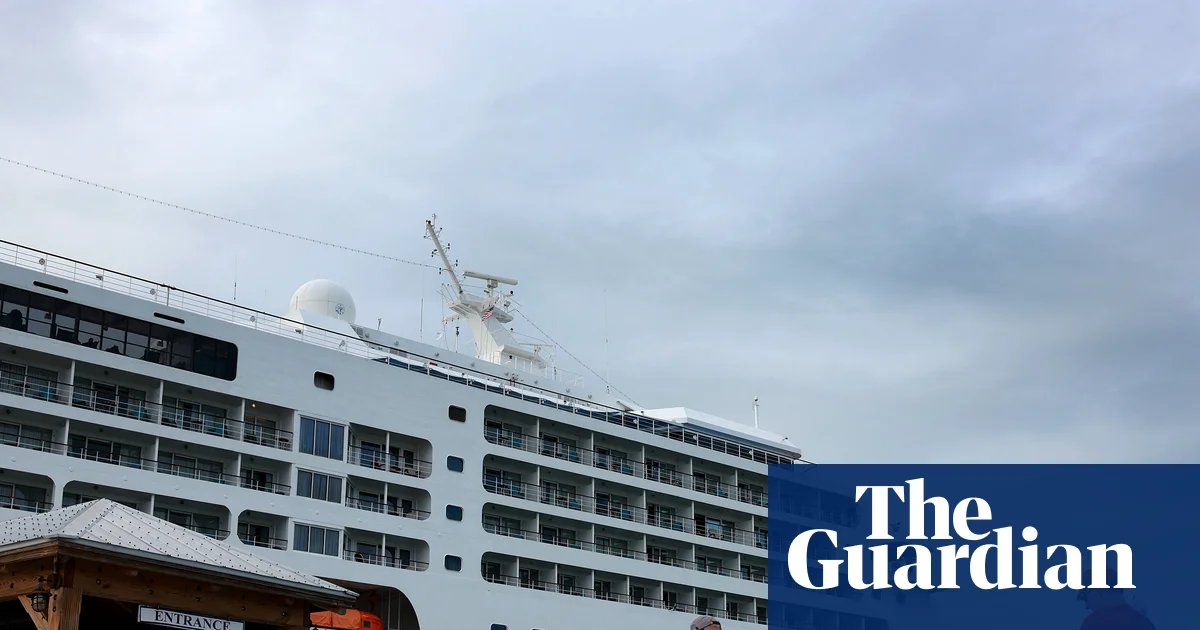
This month, there has been a swell of stories about things going wrong on cruises.
A man was arrested in Texas after he allegedly killed a woman during a voyage through the Caribbean. A pianist on a Royal Caribbean cruise from California was rescued by two fishers in the Pacific Ocean after he went overboard. And Singapore seized the MV Odyssey, a US-operated cruise ship that was supposed to offer retirees a “permanent” life at sea. The operator ran out of money because of increased fuel prices and dropped all its passengers off in Cambodia.
Such bizarre stories seem to always appear in the news cycle, and yet the number of people taking cruises increases each year.
That is because, unlike at White Lotus resorts, the setting for the HBO dark comedy, where you know that by the end of the week at least one guest will die, fatal misadventures and disease outbreaks on cruises are actually very rare.
Fun is much more common, according to cruise fans. And so people keep coming onboard, and the industry continues to plow ahead at 25 knots.
“You’re not packing and unpacking; you’re not checking in and out of hotels; and you’re not waking up in the same boring place each day,” said Stewart Chiron, who is known as “the Cruise Guy” due to his expertise on the industry. “You don’t like a port? Get back on the ship, and you’re off to the next one and waking up in a new place with new adventures.”
From 2010 to 2019, the number of people who took cruises around the world more than doubled, according to the Cruise Lines International Association, the industry’s largest trade group. In 2010, there were 14.8 million passengers; in 2019, there were 29.7 million.
Then, in early 2020, Covid-19 spread among passengers on cruise ships around the world. The Diamond Princess, owned by Carnival, was sailing around Asia in January with about 3,700 passengers and crew members when the captain learned that a passenger who disembarked in Hong Kong had tested positive for the virus. Two days later, he informed the crew and passengers of the situation, and they ultimately had to spend two weeks quarantined in their cabins. Fourteen people died, and 712 were confirmed to have the virus.
Deadly Covid outbreaks occurred on other ships too. Cruise operators wondered whether the industry could recover.
As noted, there have been unfortunate events on cruises before and after the pandemic. In April, the MV Hondius departed from Ushuaia, Argentina, a city nicknamed “the End of the World”, with plans to visit Antarctica, but the hantavirus started to spread among passengers. Three people died.
Last year, Netflix released a documentary, Trainwreck: Poop Cruise, about a 2013 voyage on the Carnival Triumph, where a fire started, causing the power to fail and sewage to flood the ship.
But the cruise industry remains flush with cash. In 2025, 37.2 million people took cruises, the trade group reported.
That is because that while such incidents capture media attention, they are in fact outliers, Chiron said.
From 2010 to 2019, there were 439 reported deaths on 78 river and ocean cruise lines, according to a study from the International Journal of Travel Medicine and Global Health. During that time, more than 215 million people took cruises, according to the trade group, meaning the fatalities were unusual events.
“The confidence that consumers have in cruising is extraordinarily high. They know these one-off situations are meaningless. Accidents are accidents,” Chiron said.
As to whether cruises serve as incubators for infectious diseases, traveling on one of the vessels is not riskier than taking a bus tour, flying or “just being in crowds”, said Cindy Prins, an epidemiologist and associate professor in population health sciences at the University of Central Florida.
In 2024, 19 million US guests took ocean cruises, according to the trade group. The Centers for Disease Control and Prevention (CDC) reported that on voyages including both US and foreign ports in 2024, there were 18 outbreaks of acute gastroenteritis illness – when 3% or more of passengers or crew report symptoms such as diarrhea or vomiting to medical staff – in which a total of 2,041 people became ill, meaning they made up a minuscule proportion of US cruise ship passengers. Also, because crew members are required to immediately report symptoms to medical staff, outbreaks are detected quicker when at sea than when on land, the CDC states.
Still, to keep passengers safe, Disney cruise staff distributes sanitizing wipes to guests when they enter a restaurant, said Brooke Rodriguez, a mother of three who has gone on two Disney cruises in the last two years and is now planning a third. If a traveler enters a buffet area, staff directs the person to a sink to wash their hands.
When Rodriguez’s daughter, Isla, who is “princess obsessed”, wore a gown to meals, the servers and hosts also said to her, “‘Hi, princess,’ or ‘Welcome, princess,’ which for a five-year-old girl wearing a princess dress was just peak enjoyment,” said Rodriguez, who lives outside Denver.
Rodriguez contrasted the effort to promote good hygiene on the open seas to a restaurant on land, where you don’t know what others have done.
“But I know on that ship the number of people that have washed their hands as they walk in,” said Rodriguez, a freelance communications consultant, who also made sure her family got Covid and flu vaccines before leaving shore.
The two Disney cruises cost Rodriguez, her husband and their three children an average of $8,500, she said.
“Planning a week with a hotel and flights and park tickets and passes and all of that for a Disney park experience, to me, that would be more expensive,” Rodriguez, 39, said.
Joyce Lipkind, owner of A&R Block Travel, an agency in St Louis, sells 50 to 75 cruise vacations each year. About half travel through oceans; the other half are on rivers.
Most of the customers are seniors. One woman takes two to three Viking river cruises each year.
“You unpack once, and that is where you stay the whole time,” said Lipkind, whose mother started the agency in 1976. “It gets kind of strenuous when you have one night here and two nights there, and you have to keep packing up and moving either by bus or by airplane.”
Asked whether customers are apprehensive about a potential virus outbreak on board, Lipkind said no.
She added: “I think seniors have been there, done that, seen it all.”