
When I learned that Netflix planned to film the miniseries Below, about a sea monster terrorizing a Newfoundland outport, I thought to myself: “THIS I’ve gotta see!”
First, the series showcases coastal Newfoundland, where I was raised and live. Second, I have studied ocean life in the island’s waters for most of my career. Third, it features the marine lab where I work, the Oceans Sciences Centre. And fourth, it stars a giant squid(-ish) animal (sorry Josh Hartnett).
Giant squid have a special place in Newfoundland folklore and science, from early encounters with fishermen to some of the first scientific evidence of their existence.
Unveiling the giant squid
One key player in this history was the Irish clergyman Moses Harvey, who moved to Newfoundland in 1852 and undertook natural history research in what was then a British colony.
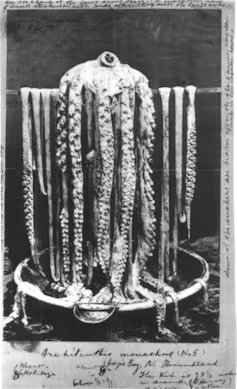
Harvey’s research included revealing the existence of giant squid to the world based on a specimen that washed ashore. Fishermen had brought it to him to photograph and communicate to the science community in London.

(Variously attributed to John Maunder, Moses Harvey and Messrs. McKenny and Parsons)
Fast forward to the 1960s, when the founding director of the Ocean Sciences Centre, Fred Aldrich, joined the faculty at Memorial University and soon focused his career on pursuing giant squid.
Although Aldrich tried to catch a living specimen, he only obtained squid that washed up on beaches.
Newfoundland is one of the global hotspots where giant squid appear more frequently, every 30 years or so (New Zealand is another, attesting to giant squid affinity for cooler waters). Below‘s arrival roughly coincides with one of those cycles.
The Rooms provincial museum in St. John’s displays a preserved version of one of these amazing animals.
Giant squid: Not known to be vindictive
Early in the series, we meet an (oddly) barefooted marine biologist walking through the hallways of the marine lab. This scene earned a loud “ewww” from my graduate students on the grounds of hygiene as well as occupational health and safety.
The biologist turns out to be the expert on giant squid and the voice of sanity when fishermen, the military and a local developer all pursue the creature (nicknamed “Mudder” by the locals, foreshadowing why she is attacking the community) with bloodlust.
This marine biologist also provides impromptu medical expertise when residents fall ill from drinking ice water tainted by the animal. (Side note, DO NOT entrust your local marine biologist with urgent medical needs — we are not that type of doctor!)
I could join the Facebook crowd quibbling about who got the Newfoundland accents right and who missed the mark. Or I could ask why the Coast Guard would fully abandon people living on a small, isolated island in crisis.
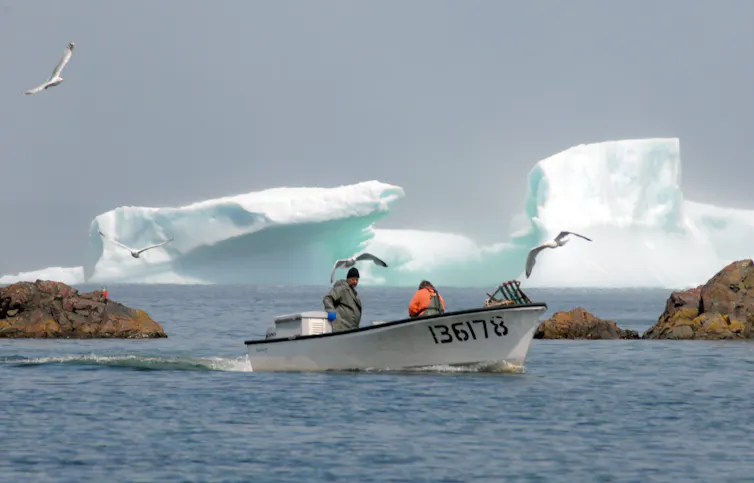
(THE CANADIAN PRESS/Lynn Ball)
But Below generally did a good job on the science. The biology of the animal was reasonably plausible, including its swimming skills and even its ability to survive in ice.
As a (likely necessary) stretch, I thought the intellectual prowess and directed vindictiveness of the squid in the series pushed the limits of credibility, although researchers have documented some impressive abilities in cephalopods (of which giant squid are members). Still, it was a good effort to maintain scientific plausibility and fun to see marine biota as the star attraction.
Historical accuracy
I took a course in marine invertebrates from Aldrich when I was an undergraduate in the early 1980s. Although he was in the late stages of his career, his enthusiasm for giant squid was still evident in his lectures.
He would have loved to have seen the first live footage of giant squid in the wild collected just 20 years ago by Japanese scientists, and I think he would have enjoyed watching Below and he’d be happy I’m writing about it.

(AP Photo/Itsuo Inouye)
I certainly enjoyed watching Below, not just because of the Newfoundland setting but because it seemed entirely appropriate for the story, which was in some ways a homage to Newfoundland and its ocean history.
The plot weaved in the innate capacity of local fishers to adapt and work together to solve challenges (who can “put the arse back in a cat,” as locals would say).
It addressed the collapse of the northern cod fishery that threw some 37,000 Newfoundlanders out of work. And it began with a striking scene about the government’s resettlement of more than 28,000 residents of many small coastal communities to larger centres in the 1950s and ’60s.
It also captured the general mistrust of government in outport communities. My CFA (come from away) graduate students also appreciated seeing the “Screeching In” ceremony, and the real sense of Newfoundland conveyed by the series.
Read more:
The trauma caused by resettlement in Newfoundland and Labrador must be acknowledged
Stoking interest in the ocean
I am not a particular fan of the horror genre, though I recognize its nod to productions from decades earlier when creatures emerged from the ocean depths to wreak havoc on an unsuspecting humanity (think Godzilla, Jaws, and Orca).
Though the genre isn’t for everyone, most people I asked said they enjoyed the series, and particularly the Newfoundland ambience. I also applaud the Below team for communicating the complexity of the ocean, and their efforts to capture the imagination and interest of the public with its many unknowns.
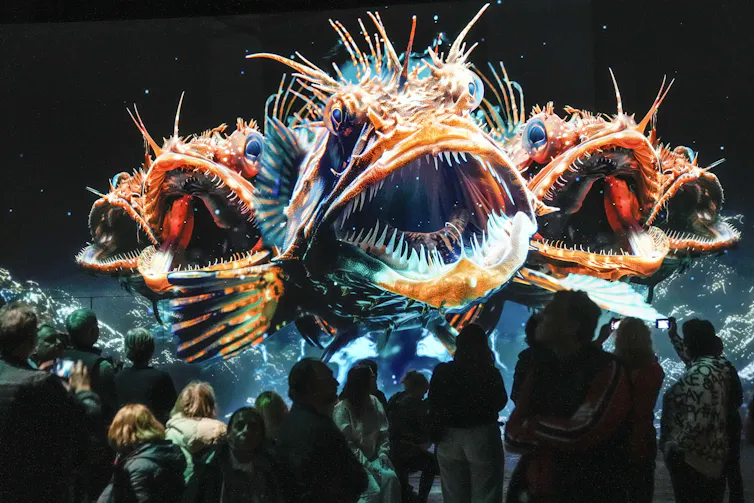
(AP Photo/Martin Meissner)
The series also underscored the ongoing potential for ocean exploration. Scientists discover thousands of new marine species every year and could discover many more if there were more of us. Many of these discoveries come from the deep sea, where giant squid spend most of their time.
Most new marine species are small animals, but, as scientists sample more ocean, a surprise discovery occasionally emerges not unlike the giant squid in Below.
Perhaps given Below’s success (the No. 1 ranked show in Canada on Netflix the week after its release, with an 87 per cent Tomatometer on Rotten Tomatoes), Hollywood might see some potential in telling exciting stories that bring the ocean into our living rooms.
That focus could inspire a new generation of scientists. I can’t help thinking that watching Jaws and Orca when I was an impressionable teen helped to push my career interests towards the ocean, where my ancestors had also earned their living.









Leave a Reply