









Beril Canakci
18 November 2026•Update: 18 November 2026
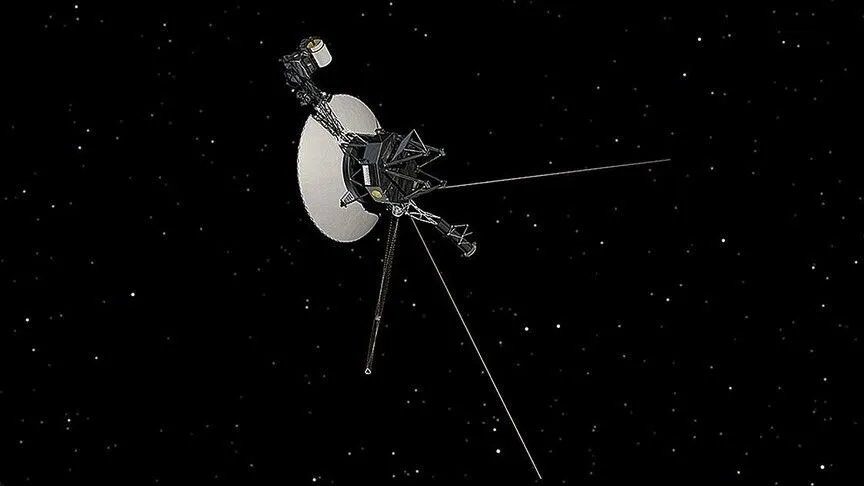
NASA’s Voyager 1 spacecraft on Wednesday became the first object built by humans to reach one light-day from Earth, a distance so vast that its radio signals take 24 hours to reach home.
According to NASA’s calculations, the probe crossed the one-light-day mark at 5.16 a.m. EST (1016 GMT). That puts it about 25.9 billion kilometers (16.1 billion miles) from Earth.
A light-day is the distance light travels in 24 hours. At that range, a command sent from Earth takes a day to reach the spacecraft, and its reply needs another day to return.
Because of that delay, flight controllers at NASA’s Jet Propulsion Laboratory in California will not receive the first signal Voyager 1 sent from beyond the milestone until Thursday.
Voyager 1 launched on Sept. 5, 1977 to study Jupiter and Saturn. It flew past Jupiter in 1979 and Saturn in 1980, sending back detailed images of the two giant planets and many of their moons.
After finishing its planetary work, the probe kept heading outward.
In 1998, it overtook NASA’s Pioneer 10 to become the most distant human-made object. In 2012, it became the first spacecraft to enter interstellar space, the region beyond the protective bubble that the sun creates around the solar system.
Traveling at about 61,000 kilometers (38,000 miles) per hour, Voyager 1 is now roughly 173 times the Earth-sun distance from home.
Its nuclear power supply has weakened steadily over the decades. Only two of its 10 science instruments remain operational, measuring magnetic fields and plasma waves in the space between stars.
Engineers hope to keep data flowing for several more years before its power runs out.
Its twin, Voyager 2, launched 16 days earlier and followed a different route. It is not expected to reach the same distance until 2035.
Both probes carry a gold-plated record with sounds, music and pictures from Earth, intended as a message for any intelligent life that might one day find them.
Even after nearly five decades of travel, the distance remains small on a cosmic scale. A light-year is about 365 light-days, and the nearest star beyond the sun is more than four light-years away.
NASA marked the milestone Tuesday by inviting people around the world to flash “VGR,” Voyager’s call sign, in Morse code using their phone lights after sunset. Mission scientists and agency officials are scheduled to discuss the twin probes at a public event at JPL on Thursday.