








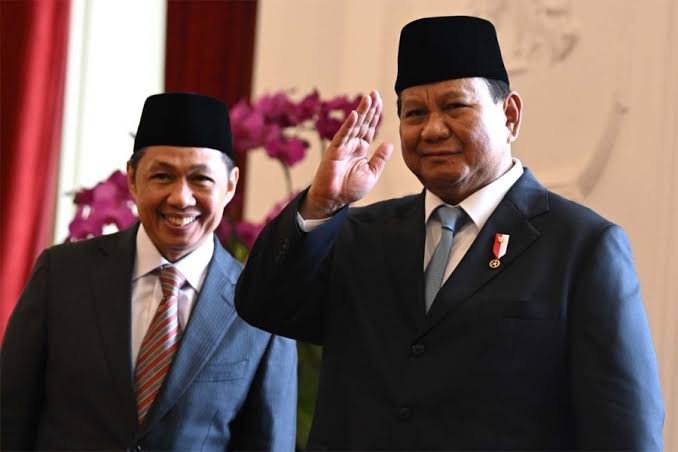
Indonesia’s foreign policy under President Prabowo Subianto shows a growing ambition to expand Indonesia’s influence in the international arena. Since his inauguration in October 2024, Prabowo has shown a fairly active approach to diplomacy through various state visits, strengthening strategic partnerships, and involvement in a number of international forums.
The government also seeks to maintain the principle of a free and active foreign policy while expanding relations with various world powers. In his inauguration speech, Prabowo also emphasized the importance of the principle of good neighbour policy, emphasizing that Indonesia wants to have a thousand friends and not have enemies.
Conceptually, this approach is not something new in Indonesia’s tradition of diplomacy. As a country with a strategic geographical position in Southeast Asia, good relations with neighboring countries are a fundamental necessity to maintain regional stability, maritime security, and national economic interests.
However, the question is not just whether Indonesia is able to establish good relations with as many countries as possible. The more important question is the extent to which these commitments translate into a consistent, measurable, and clear strategic foreign policy.
Almost two years into the Prabowo administration, Indonesia’s diplomatic activities have indeed become increasingly visible on the international stage. However, the intensity of diplomacy is not always directly proportional to the clarity of policy priorities.
A number of government decisions and diplomatic statements have raised questions about Indonesia’s consistency in maintaining its strategic position, especially when dealing with the interests of neighboring countries and major powers. This situation does not necessarily indicate that Indonesia has abandoned the principle of free and active or ignored its regional relations.
However, there is a tendency that the expansion of global diplomacy has not been fully balanced with consistency in managing its immediate strategic environment. Therefore, it is time for Indonesia to recalibrate its good neighbor policy. Not by limiting international ambitions, but by ensuring that the expansion of global influence does not sacrifice diplomatic trust and certainty in the region.
Active Diplomacy, But Not Necessarily Consistent
One of the characteristics of Prabowo’s foreign policy is an active approach to diplomacy that strongly emphasizes the role of the president. Indonesia seeks to expand relations with various centers of power, ranging from the United States, China, Russia, to involvement in groups of developing countries such as BRICS.
This diversification can basically be understood as an effort to increase Indonesia’s room for maneuver in the midst of an increasingly competitive and fragmented international order. However, diversification of foreign relations still requires careful strategic calculation.
Without a clear framework of interests, diplomacy activities risk becoming just a series of bilateral and multilateral initiatives without strong interconnectedness with each other. In this context, the government needs to ensure that any international partnership not only generates short-term economic or political benefits, but also is in line with Indonesia’s national interests and regional commitments.
One example that shows this problem is the joint statement between Indonesia and China in November 2024 regarding maritime cooperation in the region involving overlapping claims. The use of the formulation regarding overlapping claims in the statement raises questions because Indonesia has consistently stated that it does not have territorial sovereignty disputes with China in the North Natuna Sea.
Indonesia cannot ignore the importance of economic and diplomatic relations with Beijing. However, such cooperation needs to be carried out without creating ambiguity on Indonesia’s position regarding its sovereign rights under international maritime law.
The government then emphasized that the understanding did not change Indonesia’s sovereignty or sovereign rights. Nevertheless, the controversy shows that diplomatic language is not just a technical issue of communication between countries. The formulation in a joint statement can have political and strategic implications, especially when in this context it concerns issues of sovereignty and maritime interests.
The problem lies not in Indonesia’s decision to cooperate with China, but in how the cooperation is communicated and formulated so as not to create uncertainty about the national position that has been maintained for a long time.
Nearest Strategic Environment Must be the Priority
Indonesia’s geographical position makes Southeast Asia more than just one of the regions on the foreign policy agenda. This region is the closest strategic environment that directly affects Indonesia’s national security, economic resilience, and geopolitical interests. Indonesia’s relations with Malaysia, Singapore, and other ASEAN countries, even like Australia, involve various interrelated interests.
These complexities require continuous diplomatic communication, not just an approach that depends on the intensity of meetings between the leaders of countries. The relationship between Indonesia and Malaysia, for example, shows that geographical and historical proximity does not automatically eliminate potential differences of interest.
The issues of migrant worker protection, border management, and maritime issues still require consistent diplomatic attention. These issues may not always have as much international appeal as Indonesia’s relationship with major powers, but their impact is felt directly by the people in both countries.
The same is true in relations with Singapore and Australia. Singapore is an important partner in Indonesia’s trade, investment, and economic connectivity. Meanwhile, Australia has strategic relevance in defense cooperation, maritime security, and regional stability.
The sustainability of these relations is highly dependent on the ability of both parties to build predictable expectations and commitments. Indonesia certainly cannot allocate the same attention to all its international partners.
However, this is not a reason to place neighboring countries as a secondary agenda. It is precisely because of geographical proximity and interconnectedness of their interests, that relations with neighboring countries require more serious and sustainable management. And this is where the Good Neighbor Policy must be translated more substantively.
A recalibration of the good neighbor policy needs to begin by re-strengthening Indonesia’s commitment to ASEAN. For Indonesia, ASEAN is not just a diplomatic forum to attend high-level meetings or issue joint declarations.
ASEAN is an important instrument for managing great power competition, maintaining regional stability, and maintaining Southeast Asia’s ability to set its own strategic agenda. The increasingly complex competition between the United States and China makes this function even more relevant.
Southeast Asian countries have different levels of economic dependence, security interests, and diplomatic preferences. In such a situation, Indonesia cannot assume that each of its diplomatic decisions automatically represents the collective interests of the region. Indonesia does have an interest in expanding diplomatic space beyond Southeast Asia.
In fact, the ambition to play a greater role in resolving international conflicts is part of Indonesia’s aspirations as a country that wants to increase its global influence. However, this ambition also requires the allocation of diplomatic resources, political attention, and adequate policy consistency.
Participation in various international forums should complement, not diminish, Indonesia’s commitment to ASEAN. Centrality to ASEAN does not mean that Indonesia must always agree on all member states’ positions or avoid taking independent stances.
Rather, the principle should serve as a framework for Indonesia to coordinate regional interests, convey strategic concerns, and prevent Southeast Asia from becoming a mere arena for external power competition.
Recalibrating: From Diplomatic Gestures to Strategic Priorities
Instead, the government needs to improve the relationship between diplomatic rhetoric and policy implementation through at least three priorities. First, the government needs to establish a clearer hierarchy of foreign policy interests.
Relations with major powers remain important, but they should not obscure the strategic positions of neighboring countries. Indonesia needs to understand that the regional environment directly affects its economic resilience, maritime security, and geopolitical position.
Therefore, any cooperation with external powers needs to consider its implications for regional stability and relations with neighboring countries.
Second, institutional coordination in foreign policy decision-making needs to be strengthened. A president-centered approach to diplomacy can indeed provide political speed and visibility. However, this should not reduce the role of diplomatic institutions and inter-ministerial coordination.
Indonesia’s Ministry of Foreign Affairs, relevant ministries, and diplomatic representatives need to have adequate space to ensure that any international commitments are in line with the national position that has been set. Diplomatic initiatives related to sovereignty, defense, and long-term regional commitments also need to be accompanied by adequate consultation.
Third, Indonesia needs to restore the substance of its regional engagement through ASEAN. This means that it is not enough to just attend meetings or express support for ASEAN centrality rhetorically. Indonesia needs to contribute more actively to discussions on maritime security, regional economic integration, transnational crime, and the dynamics of the South China Sea.
In addition, bilateral consultation mechanisms with neighboring countries need to be strengthened so that differences of interest do not develop into greater diplomatic tensions. These three priorities are not intended to limit Prabowo’s ambition to improve Indonesia’s position in the international world.
Rather, they are the foundation for these ambitions to be carried out in a sustainable manner. Indonesia cannot expect strong international influence if its closest countries still question the consistency and certainty of Indonesia’s diplomatic commitments.
*The views presented in this article are the authors’ own and do not necessarily reflect the views of The Diplomatic Insight.*