








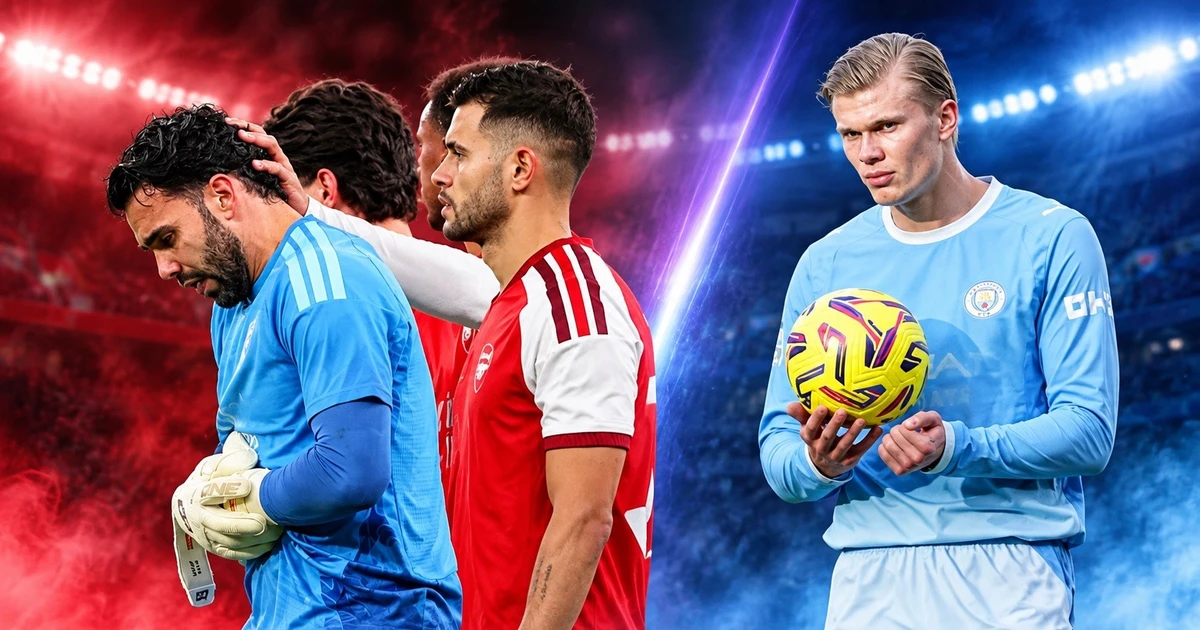

The weakness of the championship contenders.
Manchester City kicked off a disastrous matchday. Playing at home at the Etihad Stadium against familiar opponents Fulham, the blue half of Manchester displayed an incredibly lackluster performance. Man City conceded a goal to Rodrigo Muniz in the 16th minute. After that, they were overwhelmed by their opponents’ high-intensity pressing style of play.
Despite controlling 59% of the ball and taking 15 shots, the team was ineffective throughout the first half. Their lack of finishing and ideas meant they only managed three shots on target. Elliot Anderson’s equalizer in the 57th minute only secured a point for Man City, not a victory, despite Man City dominating possession for over half an hour.
The 1-1 draw meant Man City went four consecutive Premier League games without a win, and also ended a 14-year streak of 20 consecutive wins against Fulham. The image of Erling Haaland sitting dejectedly on the pitch perfectly reflected the frustration of a machine known for its coolness.

It seemed as though Man City’s slip-up would be a golden opportunity for Arsenal to pull ahead, but the Gunners shot themselves in the foot at Newcastle. The North London side started well with Eberechi Eze’s opening goal in the 33rd minute. However, complacency and laxness in the second half cost them dearly. Martin Odegaard made a disastrous mistake, allowing Harvey Barnes to equalize in the 49th minute, before Arsenal’s usually solid defense became chaotic during a corner kick, allowing Malick Thiaw to put them 2-1 up.
It was only thanks to a moment of brilliance from Noni Madueke in the 78th minute that Arsenal managed to salvage a point. Not only did their Premier League clean sheet streak, which had lasted since October 10th, come to an end, but they also suffered a major blow when goalkeeper David Raya sustained a shoulder injury and had to leave the field.
While Man City and Arsenal only suffered disappointment, Chelsea truly created a disaster. In their match against Leeds United, Xabi Alonso’s side opened the scoring through Emmanuel Emegha in the 25th minute. However, the joy was short-lived. Just three minutes later, Noah Okafor equalized, marking the beginning of a chain reaction of collapses for the home team. Chelsea’s defense played as if they were asleep, completely disoriented by the opponent’s fast-paced attacks.
Dominic Calvert-Lewin, Okafor, and Brenden Aaronson each scored three more goals to beat goalkeeper Emi Martinez, securing a 4-1 victory. This was Leeds’ first win at Stamford Bridge in England’s top flight since 1999. The 1-4 defeat also became a stain that would be difficult to erase from Chelsea’s ambitions.

Victims of the ‘FIFA virus’
The simultaneous decline of all three major clubs is not a coincidence, but a direct consequence of the negative impacts following the FIFA Days break. Teams competing for the championship always provide the largest number of national team players. While many players from mid-table teams get a rest, the key players of Man City, Arsenal, and Chelsea have to play continuously at high intensity, coupled with long transcontinental flights and sudden time zone changes.
More than two-thirds of the Arsenal, Man City, and Chelsea squads were away on international duty during the recent international break. A few young players who weren’t called up to their national teams were training with the U21s. Heavy legs caused Man City to lose their usual speed in ball circulation, while Arsenal completely struggled under Newcastle’s overwhelming pressure in the second half. For Chelsea, simply put, after the injury to Caicedo, who had been playing for Ecuador, their midfield crumbled, leading to a chain reaction of failures.
Two weeks of break was long enough to disrupt the tactical rhythm at the club. Returning from international duty, the players only had one or two light training sessions to reassemble the team before entering Round 11. The disarray in ball control and systemic thinking was evident in individual mistakes – typified by Odegaard’s mishandling of the ball or the way Chelsea’s defense left huge gaps in front of Leeds’s feet.

In contrast to the fatigue of the title contenders, teams like Fulham, Newcastle, and Leeds made excellent use of the two-week break. They had less than 50% of their players on international duty. For example, Fulham had 11 out of 25 players called up during this period, while Leeds had 12. And not all of their players called up played as much as the stars of Arsenal, Man City, or Chelsea.
With less strain on their squad, their coaches have ample time to study their opponents, refine their high-pressure tactics, and fully exploit the physical weaknesses of the top teams. Entering the match with superior fitness and a nothing-to-lose mentality, they easily turn the slowness of the big teams into opportunities to decide the game.
Matchday 11 served as a stark warning for the Premier League title race this season. In a league where the gap between the top teams and the rest is narrowing, any delay in recovering fitness and re-establishing rhythm after international breaks will cost teams crucial points in the race for the championship.