


We’re playing fast and loose with the time frame slightly, but it’s not too egregious to say that Rafael Camara’s debut race at Sao Paulo had been the first time in 10 years that more than one Brazilian driver lined up for a Formula 1 grand prix.
When Felipe Massa and Felipe Nasr competed together in the 2016 Abu Dhabi finale, it very nearly marked a hiatus for Brazilian interest altogether; Massa was due to retire from F1 but, when Nico Rosberg called it quits and Valtteri Bottas was signed in his place at Mercedes, Williams persuaded Massa to stay on for one more year.
Brazil was then sans drivers for a barren spell, that period between Massa and 2025 newcomer Gabriel Bortoleto only interrupted briefly by Pietro Fittipaldi’s pair of outings for Haas as a substitute for Romain Grosjean in late 2020. This was after the Frenchman’s horrific fireball accident in Bahrain, as he recovered from the burns experienced when miraculously extricating himself from the car, but it took another four years before Bortoleto properly broke the streak. So for a nation that spawned the likes of Emerson Fittipaldi, Carlos Pace, Nelson Piquet, Ayrton Senna, Rubens Barrichello and, erm, Ricardo Rosset, it was a conspicuously long period for Interlagos to be without a home driver to cheer on. Unless, of course, you count Lewis Hamilton’s honorary citizenship…
Like London buses, one bides their time for almost a decade, then two arrive in swift succession: Camara – another case of Brazilian replacing Frenchman at Haas – was signed for 2027, and then got an early debut as Esteban Ocon’s ties to the American squad were formally severed following the as-yet-undisclosed circumstances in Mexico. Two drivers? The crowd at Interlagos were truly spoiled for choice.
But the weekend wasn’t easy for either Bortoleto or Camara; both experienced mistakes in qualifying and, although Bortoleto at least moved up in the race, Camara was forced to contend with rain and shine in his debut outing . Decent spurts of dry-tyre pace demonstrated that he could at least adapt, and Las Vegas will present another opportunity for the Pernambucano to demonstrate his racing chops. Regardless, this felt like the beginning of something in Brazil: a new generation, a decade on from where the previous one had started to fade.
10 years ago at Interlagos, the Brazilian contingent had again endured mixed fortunes: in what was supposed to be his final home race, Massa crashed out on the 47th lap after aquaplaning up the hill out of Turn 13. Massa had even gone as far as a final sign-off in front of his home crowd at the preceding Brazilian Grand Prix, returning to the pitlane with a Brazilian flag draped over his shoulders. Eight years ago, this had been the venue of – simultaneously – his greatest victory and his most crushing defeat, a battle won but a championship lost as Hamilton crept into fifth place at the death of the race. It was an emotional roll-back of the clock.
Yet, Massa’s farewell tour was premature. He was soon back in the car for 2017, wheeled out for one more lap around the sun before closing the door on F1 for good. (And if anyone’s wondering, Massa’s claim for damages over the 2008 championship outcome is set for a hearing in February 2027.)
Nasr, meanwhile, did not get such a send-off for his final F1 grand prix at Interlagos – after all, there was no indication that this would be his last one. He was only in his sophomore season, too, and had gathered a reputation as something of a ‘steady Eddie’ in the midfield – unlike Massa, who’d been a race winner and a championship contender.

Nasr enjoyed a strong 2015, but his second season was a tougher ask with an uncompetitive Sauber
Photo by: Getty Images
Nasr’s Sauber career had been relatively solid, and he’d outscored Marcus Ericsson 27-9 over the 2015 season. Both drivers were in the car primarily due to their backing and the Swiss team’s precarious financial state, one worsened when Giedo van der Garde received a significant settlement from Sauber at the start of that year, as an Australian court found that the Dutchman had a valid race contract with the team for that year – and his sponsors had also advanced some of their payments to the team over 2014.
Helpfully, Sauber was bought out in mid-2016 by Longbow Finance, which eased the financial strain somewhat. Nonetheless, it was staring at a prize-money hole of around $13.5m* as it was scoreless over the first 19 races of 2016 and sitting 11th in the constructors’ standings. Only the top 10 teams were entitled to “Column 2” payments, on a sliding scale based on final championship position, and the Manor team had bagged a single point at that year’s Austrian Grand Prix courtesy of Pascal Wehrlein and sat in that much-coveted 10th place. Coincidently, the German would be racing for Sauber in lieu of Nasr for 2017.
* Some figures at the time suggest this was worth around $30m-40m, but this isn’t entirely consistent with the generally understood allocation in prize money across the grid. Manor was entitled to its Column 1 payment of circa $36m, given it finished in the top 10 across the two previous seasons. Manor had received $13.5m from Column 2 payments for finishing 10th overall in 2015, so it stands to reason that this would be the figure in question.
For Manor, the circa-$14m it was set to receive was huge, as it was operating with incredibly shallow pockets and reliant on drivers bringing money to the table. Wehrlein was effectively bundled in with a cheaper Mercedes deal, and Rio Haryanto arrived with cash from Indonesian state oil giant Pertamina – but its government was not necessarily keen to continue backing a driver largely consigned to the back of the grid, and only paid for him to race up until Hungary. Although Haryanto’s manager Piers Hunnisett had later gathered enough interest and sponsorship to keep Haryanto on the grid beyond that, Mercedes had already swooped to place Esteban Ocon into the line-up (and, as emerged recently, Fred Vasseur put some of his own money into helping Ocon get the Manor drive) from 2016’s Belgian GP and beyond.
“When I took over the team in 2015, the challenge was clear; it was imperative that the team finish in 10th place or better in 2016. For much of the season we were on track” Stephen Fitzpatrick
And yes, it’s an interesting coincidence that Ocon is a cog at either side of this Brazil-themed story, especially as he was so close to helping Manor lock down that vital sum of prize money.
The fortunes of Ocon and Nasr were almost linked throughout the duration of the 2016 race in Sao Paulo. Both started the race at the back on the wet tyre, and then vaulted into the top 10 a few laps in when half the field decided to try pitting for an intermediate. But Nasr was a step ahead, running as high as sixth at one stage having conveniently timed all of his stops with safety cars. As it stood, this would have been more than enough for Sauber to reclaim 10th in the constructors’ championship , even when both Manor cars were circulating in eighth and ninth at that point.
But as the multi-stopping Red Bulls worked their way back past, plus the Force India of Nico Hulkenberg, this put Nasr and Ocon ninth and 10th – and thus began the 13.5-million-dollar showdown over a single point. For Sauber, this was important but not a game-changer; for Manor, this was a life-or-death scenario.
Manor, one of the 2010 contingent sold an F1 dream on the promise of a £40m budget cap before the subsequent rug-pull, had only been rescued from receivership at the start of 2015. Main backer Marussia pulled its funding out of the squad, the team had gone into administration as a result, and Jules Bianchi’s ultimately fatal crash in 2014’s Japanese Grand Prix was one of the catalysts for Marussia’s withdrawal.

Both Manors were in points contention in Brazil, hoping to secure the prize money on offer for finishing in the championship’s top 10
Photo by: Charles Coates / LAT Images via Getty Images
Businessman Stephen Fitzpatrick purchased the team on the eve of the 2015 season, got it through the campaign with year-old Ferrari powertrains and a modified 2014 chassis, and then invested to ensure 2016 was more successful. Securing Mercedes engines and the services of Dave Ryan, Pat Fry, Nikolas Tombazis, and Luca Furbatto was key to this, and Manor had showed intent to break into the midfield on a more regular basis. Wehrlein’s performance in Austria had got the team that all-important point, and the prize money on offer was cited as a key ingredient in ensuring the team’s survival.
In that Brazil race, one characterised by horrible conditions, myriad delays, and Max Verstappen’s dazzling drive en route to third place, Manor’s own race against survival came down to the final act of the race. Once the cycle of red flags and safety cars had finally ended following Massa’s shunt, Nasr homed into view of Ocon once Daniel Ricciardo had moved past the Sauber driver for eighth.
With eight laps left, the Sauber and the Manor were separated by just 1.5 seconds but, try as Ocon might, he was unable to bridge the gap. Nasr tacked a couple of tenths onto his advantage over the succeeding laps, while the Frenchman’s hold over the final point was finally loosened by Fernando Alonso with just two laps remaining. Manor scored nothing, Sauber scored two points, and the prize money was diverted back to Switzerland.
Fitzpatrick later stated that the loss in prize money was terminal for Manor; the Northern Irishman was not keen to invest any further into the team and, in the absence of a buyer (imagine that scenario today!), he ultimately elected to shutter the team ahead of 2017. It is known that the sudden deletion of a $13.5m stipend in its favour would not have patched the holes at the team, nor would it have convinced Fitzpatrick to keep investing, but it might have kept the lights on for a smidgen longer and bought Manor more time in finding investment. For reference, this was around a sixth of the team’s budget, and Fitzpatrick was putting in what the rest of the prize money didn’t cover.
The team had been subject to bids from American businessman Tavo Hellmund – involved in the United States GP’s revival at the Circuit of the Americas – and KFC Indonesia CEO Ricardo Gelael (father of WEC racer Sean), but neither managed to make it over the line.
“When I took over the team in 2015, the challenge was clear; it was imperative that the team finish in 10th place or better in 2016,” Fitzpatrick said at the time. “For much of the season we were on track. But the dramatic race in Brazil ended our hopes of this result and ultimately brought into doubt the team’s ability to race in 2017.
“Over much of [2016] we have been in discussions with several investor groups, and had finally agreed terms of a sale to an Asian investment consortium in December. This would have provided the team with a strong platform for continued growth and development. Unfortunately time ran out before they could complete the transaction.”

Nasr put together an excellent defensive effort in Brazil, keeping Ocon at bay
Photo by: Sutton Images via Getty Images
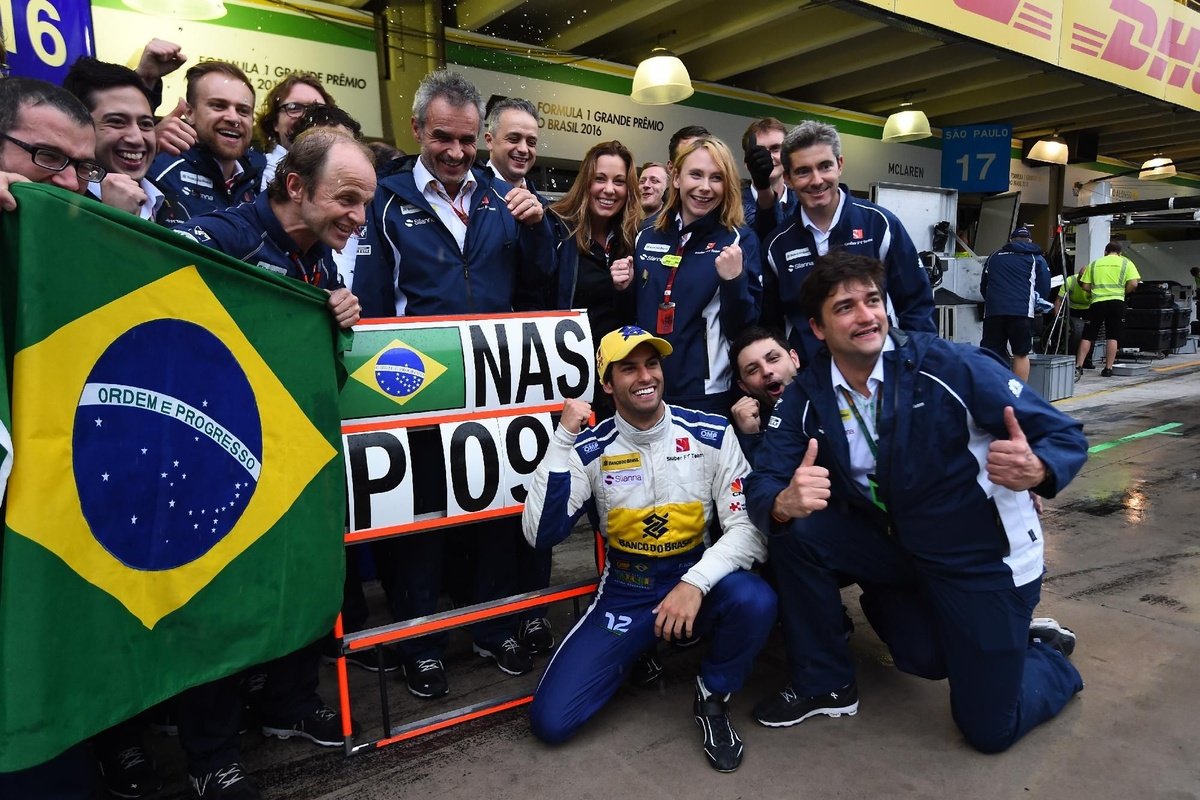
It’s also worth noting that Nasr’s drive was exceptional; in its driver ratings from 2016’s Brazil race, Autosport awarded him a 9/10, noting his ability to keep the Manors behind him amid the conditions and the pressure involved. “It tastes like a victory,” Nasr said at the time, having endured a scoreless season as Sauber had been outdeveloped as a result of its financial issues.
But Nasr’s drive, perhaps one of the best in his F1 career, was a Pyrrhic victory. He was rumoured to be one of the drivers in contention for a Manor drive after losing his Sauber seat to Wehrlein, and his Banco do Brasil backing would have been a welcome source of funding had the team been able to survive. Perhaps he’d expected to be the Felipe to make it to 2017, not Massa, but his own excellent performance in the wet at Interlagos had left him stinging in the rain.
One can argue that the Two Brazilians ‘phenomenon’ ended, then started with Ocon – a meaningless statistic, yes, but an interesting time capsule of a past era in F1’s history. Interlagos has been the constant and, amid the wane and wax of Brazilian driving talent, South America’s largest nation has retained the fervor and investment to ensure its race did not ever look at risk of fading. That the Brazilian Grand Prix will remain on the bill until at least 2035 is a very real demonstration of Brazil’s passion and love for F1 – with or without a home driver.
And with F1’s rude financial health, we hopefully won’t ever have to deal with a similar case of prize money allocations effectively governing whether a team survives the off-season…

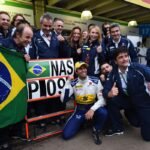
Sauber celebrated its only points of 2016 – but Nasr was out at the end of the year
Photo by: Sutton Images via Getty Images
We want to hear from you!
Let us know what you would like to see from us in the future.
– The Autosport.com Team