








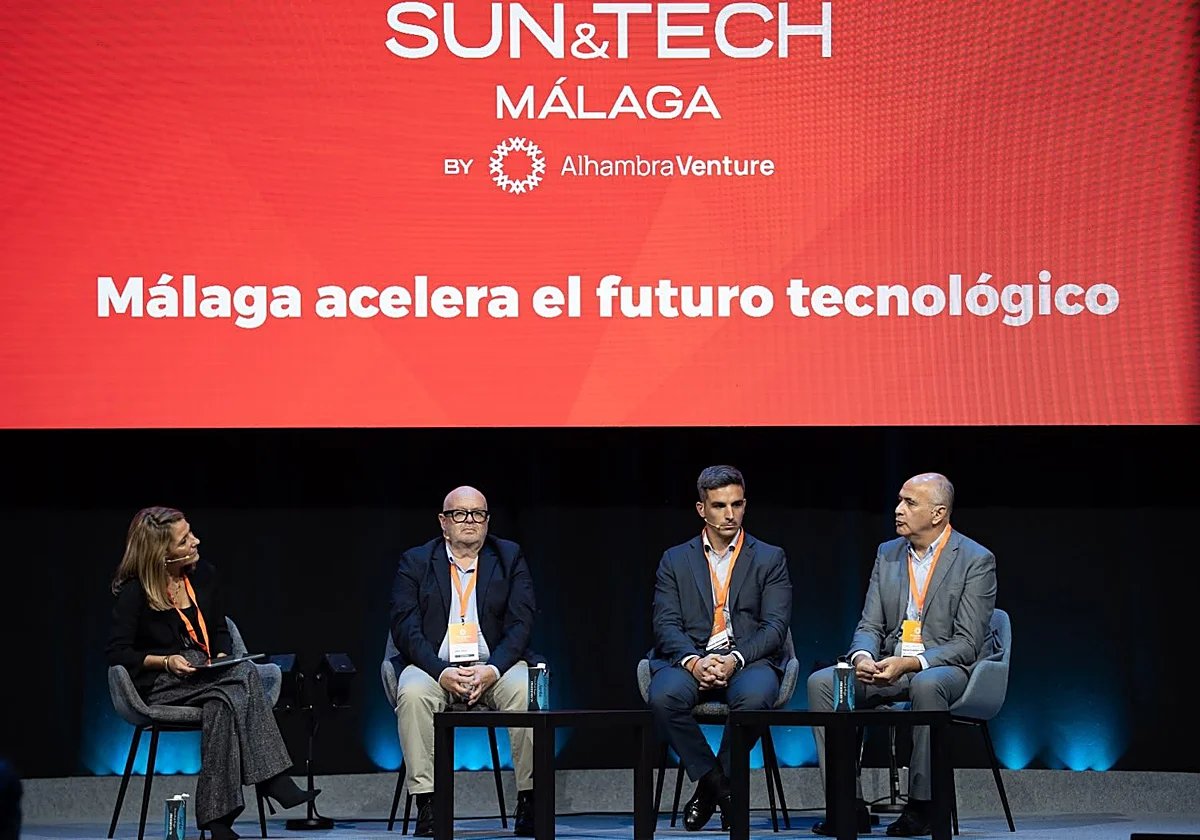
Experts in the biotech and health fields held a talk at the Sun&Tech Málaga by Alhambra Venture event on Thursday, where they discussed how … AI can benefit their sectors.
Dean of the faculty of health and sport at UAX Mare Nostrum Rafael Ceballos gave the British NHS as an example. He said that there, particularly in child and adolescent psychiatry, technology transcribes all consultations, which has made it possible to reduce consultation times per patient from 27 to ten minutes.
“For me, that’s not the key point. That 30 per cent reduction in consultation times is important because it shortens waiting lists. But the real key is that when patients and their families are asked, 97 per cent say that what makes the difference is that the doctor now looks them in the eye. The patient feels that the doctor is really listening to them. We have returned to humane medicine,” he explained.
“Paradoxically, AI makes us more human. That could be a slogan,” director of biotech association Asebio Elena Rivas said.
Founder of Next Health Consulting Julio Lorca said that this is precisely where AI is currently making the greatest contribution to day-to-day medical practice: to summarise, synthesise, transcribe reports, which “allows us to look the patient in the eyes again rather than having a computer in the way”.
“It is the doctor who ultimately has to validate that draft report. Never can an automated system or an AI agent make the final decision in a patient’s medical record, as stipulated by European law,” Lorca stated.
According to him, “an algorithm will never be able to make a clinical decision autonomously” and “the doctor must always have the final say”.
The use of AI can help to humanise the care a doctor provides to a patient by freeing them from routine tasks.
There is another human aspect on which the conversation focused: what role should healthcare workers play in the development of these technologies? “I would advocate listening to specialists, because whether it’s research projects or grant applications we submit to public authorities, the first thing we need to do is identify a need, and what better way to do that than by listening to those on the front line,” PNO Consulting’s Fernández de Peñaranda said.
Ceballos expressed a similar view: for technology to be truly integrated, “we must rely on the worker who will be applying it”. “Often we do not ask the doctor, the nurse or the physiotherapist whether they really have the time, knowledge or motivation to put it into practice. We must involve them from the outset, make them a part of the process and ask for their opinion on the real needs,” he stated.
Ceballos said that his university places its students in hospitals or pharmacies so that they can tackle real needs and demands.
Another point raised during the talk was how companies, particularly small ones and start-ups, can go about selling their technology to the healthcare sector. Julio Lorca explained the process: “A start-up may have an idea. It may design an algorithm. But who is the contact person at the hospital? Who is the decision-maker? This isn’t clearly defined. When it comes to centralised procurement, a start-up lacks reach because it doesn’t have economies of scale. The way to tackle this is through innovative public procurement, which involves the institution setting out a requirement, launching a tender and the winning bidder developing a solution in collaboration with the institution, which it then contracts. What is lacking in Spain is the subsequent contracting process.”