










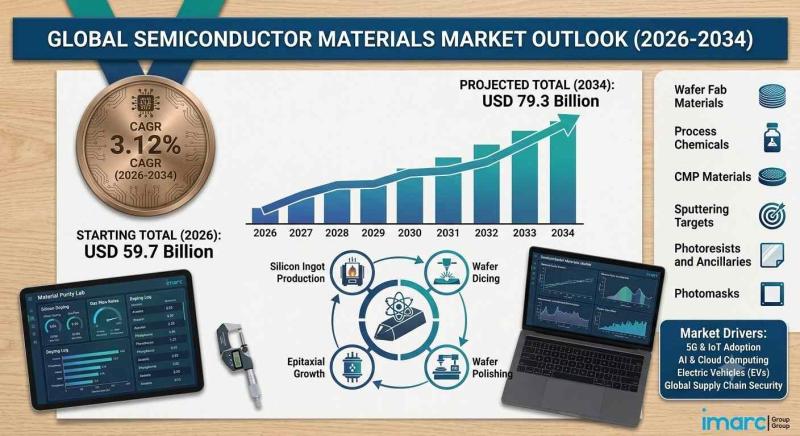
According to IMARC Group, the global semiconductor materials market size reached USD 59.7 Billion in 2025 and is projected to reach USD 79.3 Billion by 2034, expanding at a CAGR of 3.12% during 2026-2034. This steady semiconductor materials market growth is being driven by rising demand for smartphones, tablets, wearables, and smart home appliances, the rollout of 5G networks, the rapid growth of electric vehicles, and continuous innovation in semiconductor manufacturing.
Semiconductor Materials Industry Overview
Semiconductor materials are the specialized substances used to fabricate and package integrated circuits and other electronic components. They include silicon wafers, electronic gases, photomasks, photoresists, chemical mechanical planarization (CMP) materials, and wet chemicals used in fabrication, along with leadframes, organic substrates, ceramic packages, encapsulation resins, bonding wires, and die-attach materials used in packaging. Compound and advanced materials such as silicon carbide, copper indium gallium selenide, molybdenum disulfide, and bismuth telluride are also gaining relevance in power electronics, solar photovoltaics, and thermoelectric applications.
The semiconductor materials industry serves a broad continuum of use cases:
• Consumer electronics: Smartphones, tablets, wearables, and smart home appliances that depend on high-performance chips
• Telecommunications and 5G: Materials that support higher frequencies, faster data rates, and lower latency
• Automotive: Electric vehicles and increasingly automated vehicles that use more advanced semiconductor content
• Energy and utility: Solar photovoltaics and battery-based energy storage systems
• Manufacturing: Industrial automation and connected equipment that rely on dependable electronic components
Global Semiconductor Materials Market Size & Key Statistics
Below are the key semiconductor materials market statistics drawn from IMARC Group’s comprehensive market analysis:
Base Year – 2025
Historical Period – 2020-2025
Forecast Period – 2026-2034
Semiconductor Materials Market Size in 2025 – USD 59.7 Billion
Market Forecast in 2034 – USD 79.3 Billion
Market Growth Rate (2026-2034) – 3.12% CAGR
Largest Region – Asia Pacific
Leading Material Segment – Silicon Carbide
Leading Application Segment – Fabrication
Leading End-Use Segment – Consumer Electronics
Request for a Sample Report for Detailed Semiconductor Materials Market Share Evaluation: https://www.imarcgroup.com/semiconductor-materials-market/requestsample
Key Market Drivers & Semiconductor Materials Market Trends in 2026
Several powerful forces are shaping semiconductor materials market trends and fuelling sustained growth expectations across the global electronics value chain:
1. Rising Demand for Consumer Electronics
Growing demand for smartphones, tablets, wearables, and smart home appliances is increasing the consumption of semiconductor materials in electronic component manufacturing. Worldwide smartphone subscriptions were about 6.6 billion in 2022 and are expected to exceed 7.8 billion by 2028, according to Ericsson, while connected wearable devices in China reached nearly 439 million in 2022, up from 378.8 million in 2021, according to Cisco.
2. Expansion of 5G Networks
The rollout of 5G requires advanced materials that can support higher frequencies, faster data rates, and lower latency. 5G mobile subscriptions were 664.18 million in 2021 and are expected to reach 4,389.77 million by 2027, according to Ericsson, while the global 5G services market is projected to grow at a CAGR of 44.1% during 2024-2032.
3. Growth of Electric and Automated Vehicles
The automotive sector is a fast-growing source of demand as electric and automated vehicles use more advanced semiconductor content. About 31 million cars had some automation in 2019, a figure expected to surpass 54 million in 2024, and the autonomous vehicle market is projected to grow at a CAGR of 33.5% during 2024-2032.
4. Continuous Semiconductor Manufacturing Innovation
Ongoing advances in fabrication and packaging processes are expanding the range of materials required, strengthening the Semiconductor Materials Market Size and encouraging suppliers to develop higher-purity, higher-performance solutions.
5. Renewable Energy and Energy Storage
Rising adoption of solar photovoltaics and energy storage (batteries) is creating additional demand for specialized semiconductor materials, broadening the addressable Semiconductor Materials Market Share beyond traditional electronics.
6. Government and Regional Investment in Chip Manufacturing
Rising chip demand, growing investment in manufacturing facilities and equipment, and national initiatives such as China’s Made in China 2025 plan are supporting regional production capacity and materials consumption, particularly across Asia Pacific.
Checkout Now: https://www.imarcgroup.com/checkout?id=1420&method=5011
Key Market Segmentation
By Material
Silicon Carbide – Largest Segment: Silicon carbide holds the majority share of the material segment, supported by its suitability for high-power, high-temperature, and high-efficiency applications such as electric vehicles and power transmission.
Gallium Manganese Arsenide: Specialized compound semiconductor material used in advanced and emerging electronic applications.
Copper Indium Gallium Selenide: Thin-film material widely associated with solar photovoltaic applications.
Molybdenum Disulfide: Advanced two-dimensional material of growing interest for next-generation electronic components.
Bismuth Telluride: Material used in thermoelectric applications that convert heat into electricity and vice versa.
By Application
Fabrication – Largest Segment: Fabrication is the clearly dominant application and covers silicon wafers, electronic gases, photomasks, photoresist ancillaries, CMP materials, photoresists, wet chemicals, and other materials consumed during chip manufacturing.
Packaging: Packaging covers leadframes, organic substrates, ceramic packages, encapsulation resins, bonding wires, die-attach materials, and other materials that protect and connect finished semiconductor devices.
By End Use Industry
Consumer Electronics – Largest Segment: Consumer electronics accounts for the largest Semiconductor Materials Market Share, driven by sustained demand for smartphones, tablets, wearables, and smart home appliances.
Manufacturing: Industrial and manufacturing applications that rely on semiconductor-based electronic components.
Automotive: Electric and automated vehicles that increase semiconductor content per vehicle.
Energy and Utility: Solar photovoltaic, energy storage, and power infrastructure applications.
Others: Additional specialized end uses that depend on semiconductor materials.
Regional Semiconductor Materials Market Analysis
Asia Pacific – Largest: Rising chip demand, increasing investment in manufacturing facilities and equipment, and supportive national initiatives such as China’s Made in China 2025 plan.
North America: Strong consumer electronics demand and a technologically advanced electronics ecosystem.
Europe: Established automotive and industrial electronics base supporting semiconductor materials demand.
Latin America: Growing electronics consumption supporting gradual adoption
Middle East and Africa Expanding digital infrastructure and rising electronics demand
Asia Pacific accounted for the largest semiconductor materials market share, driven by rising demand for chips, growing investment in manufacturing facilities and equipment, and government initiatives such as China’s Made in China 2025 plan.
Connect for Detailed Semiconductor Materials Market Share Segmentation Analysis – Speak to an Analyst: https://www.imarcgroup.com/request?type=report&id=1420&flag=C
Market Challenges & Opportunities
Despite its steady outlook, the semiconductor materials industry faces several challenges, including supply chain disruptions, geopolitical uncertainties, and increasingly strict environmental regulations. COVID-19 lockdowns also temporarily shut down many materials manufacturing units, highlighting the importance of resilient supply chains.
At the same time, significant opportunities are emerging in advanced materials for 5G, electric vehicles, and renewable energy, as well as in sustainable materials and manufacturing processes that help producers meet evolving environmental expectations.
Leading Players in the Global Semiconductor Materials Industry
The global semiconductor materials market features a mix of diversified chemical majors and specialized electronic-materials suppliers. Key companies covered in the IMARC Group report include:
• BASF SE
• Air Liquide Electronics
• Avantor Inc.
• DuPont de Nemours, Inc.
• Entegris, Inc.
• Hemlock Semiconductor Operations LLC
• Henkel Adhesive
• JSR Corporation
• LG Chem Ltd.
• Sumco Corporation
• Tokyo Ohka Kogyo Co., Ltd.
Latest Semiconductor Materials Industry Developments:
June 2024 – G-7 Leaders
G-7 leaders announced a semiconductor supply chain coordination group focused on subsea cable connectivity and resilience amid chip shortages.
February 2024 – IIT Guwahati, IIT Mandi, and TU Wien
Researchers from IIT Guwahati, IIT Mandi, and TU Wien developed a low-cost method to grow a special semiconductor for high-power electronics such as electric vehicles and power transmission.
About Us
IMARC Group is a leading global market research company providing data-driven insights and expert consulting services to businesses seeking to achieve their strategic objectives. With a multi-disciplinary team of industry experts, IMARC delivers thorough, reliable market intelligence across sectors including Technology, Construction, Healthcare, Energy, Food & Beverages, and more.
Contact Us
IMARC Group
United States: +1-201-971-6302
India: +91-120-433-0800
United Kingdom: +44-753-714-6104
This release was published on openPR.