







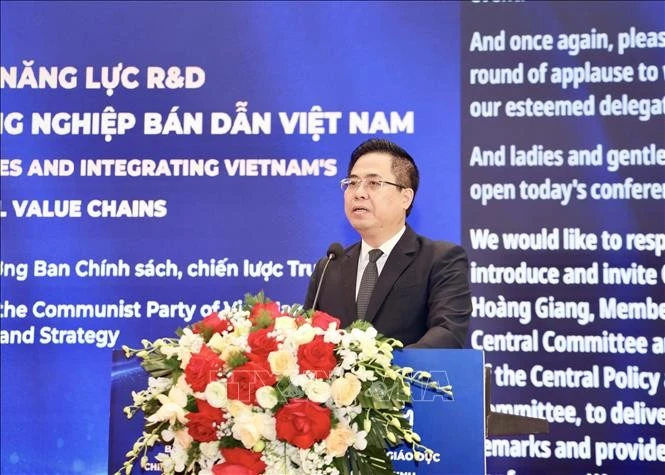

In his opening remarks, Deputy Head of the Central Policy and Strategy Committee Nguyen Hoang Giang stated that, in the context of rapid scientific and technological development and increasingly intense strategic competition among nations, the semiconductor industry has become one of the foundational industries, playing a particularly important role in economic development, technological self-reliance, competitiveness, and national standing. For Vietnam, developing the semiconductor industry not only opens opportunities for deeper participation in the global value chain but also has strategic significance in reforming the growth model, developing high-tech industries, and enhancing the productivity and competitiveness of the economy.
According to the Deputy Head of the Central Policy and Strategy Committee, Vietnam has made initial progress in developing the semiconductor industry, gradually forming a team of integrated circuit design engineers, research and training facilities, enterprises, and investment projects in the semiconductor sector. However, R&D capacity, the ability to develop technological products, the scale of domestic enterprises, and the level of participation in high value-added stages still have limitations and challenges that need to be fully identified. “To make appropriate strategic choices, it is first necessary to realistically assess existing capabilities, correctly identify advantages, technological gaps, and opportunities for Vietnam in the global semiconductor value chain,” Mr. Nguyen Hoang Giang emphasized.
In that spirit, the Deputy Head of the Central Policy and Strategy Committee suggested that delegates focus their discussions on four major issues: assessing the current state, R&D capacity, and position of Vietnam in the global semiconductor industry value chain; concretizing policies and improving the effectiveness of implementing the strategy for the development of Vietnam’s semiconductor industry; the strategic model for building R&D capacity and developing a national semiconductor innovation ecosystem; and the strategic vision, roadmap, and selection of priority areas for the development of Vietnam’s semiconductor industry over the next 5, 10, and 20 years.

Speaking at the conference, Deputy Minister of Science and Technology Le Xuan Dinh assessed that in Vietnam, research and development capabilities in semiconductors have made remarkable progress. Several digital technology companies have participated in designing integrated circuits and developing 5G chips and IoT chips, notably Viettel Group andFPT .
However, transitioning from initial results to mastering core technologies and developing commercial products, Vietnam still faces many challenges. These include the high cost of investing in R&D infrastructure and pilot production; a shortage of highly skilled personnel, especially experienced chief engineers and supervisors with practical experience across multiple manufacturing and product development cycles; and insufficient flexibility in financing for core technology R&D.
To address these bottlenecks, the Deputy Minister of Science and Technology proposed three key groups of solutions.
First and foremost, Vietnam needs to intelligently position itself, focusing R&D resources on niche semiconductor segments linked to strategic technologies. According to the Deputy Minister, Vietnam should not compete directly in the advanced general-purpose chip segment but should concentrate its efforts on specialized chips such as edge AI chips, IoT chips, power semiconductor chips, composite semiconductors for green energy, and 5G/6G telecommunications equipment. These segments have added value in optimized algorithms, intelligent design architecture, and the ability to customize to specific application problems. Vietnam has advantages and opportunities to participate more deeply in these fields.
The second set of solutions involves fundamentally reforming the science and technology financing mechanism towards a system of commissioning research based on practical problems, while simultaneously accepting research risks; shifting strongly from a system of allocation and assignment to a system of commissioning key projects stemming from the technological needs of businesses. Alongside this, it is necessary to promote co-financing mechanisms from funds such as the National Science and Technology Development Fund, the Innovation Fund, and venture capital funds for strategic technologies; and exempting from liability those cases where core technology research, despite adhering to proper procedures, fails to achieve results due to objective technological risks.

The third set of solutions involves developing high-quality R&D human resources linked to practical projects; attracting Vietnamese chief engineers and experts from abroad to take on key positions and lead R&D centers and research groups in the country.
According to Associate Professor, Dr. Nguyen Ai Viet, Director of the IGNITE Institute, the breakthrough strategy for the semiconductor industry needs to focus on two key capabilities: R&D capabilities and the ability to participate in the global value chain.
This includes building R&D capacity, encompassing human resource training, technology creation, intellectual property (IP), and product development. In particular, a new strategy is needed for laboratory investment and the development of shared laboratories.
Opinions expressed at the workshop emphasized that the semiconductor industry is a foundational sector with strategic significance for technological self-reliance, competitiveness, and national standing. Given limited resources, it is necessary to prioritize key areas that align with Vietnam’s endogenous capabilities and comparative advantages, such as integrated circuit design, specialized chip development, advanced packaging and testing, and research on semiconductor materials and components; avoiding scattered and haphazard investment. Furthermore, R&D capacity development must be linked to the market and businesses. The “five-party” linkage model needs to be concretized through mechanisms such as: businesses commissioning research from institutes and universities; sharing R&D risks; effectively utilizing shared laboratory infrastructure invested by the state budget combined with socialized resources; and placing the development of high-quality human resources at a key position.
Delegates argued that international cooperation and technology diplomacy are important levers, but attracting foreign investment must be linked to enhancing endogenous technological capabilities and developing Vietnamese businesses; and leveraging the network of Vietnamese experts and intellectuals abroad.