






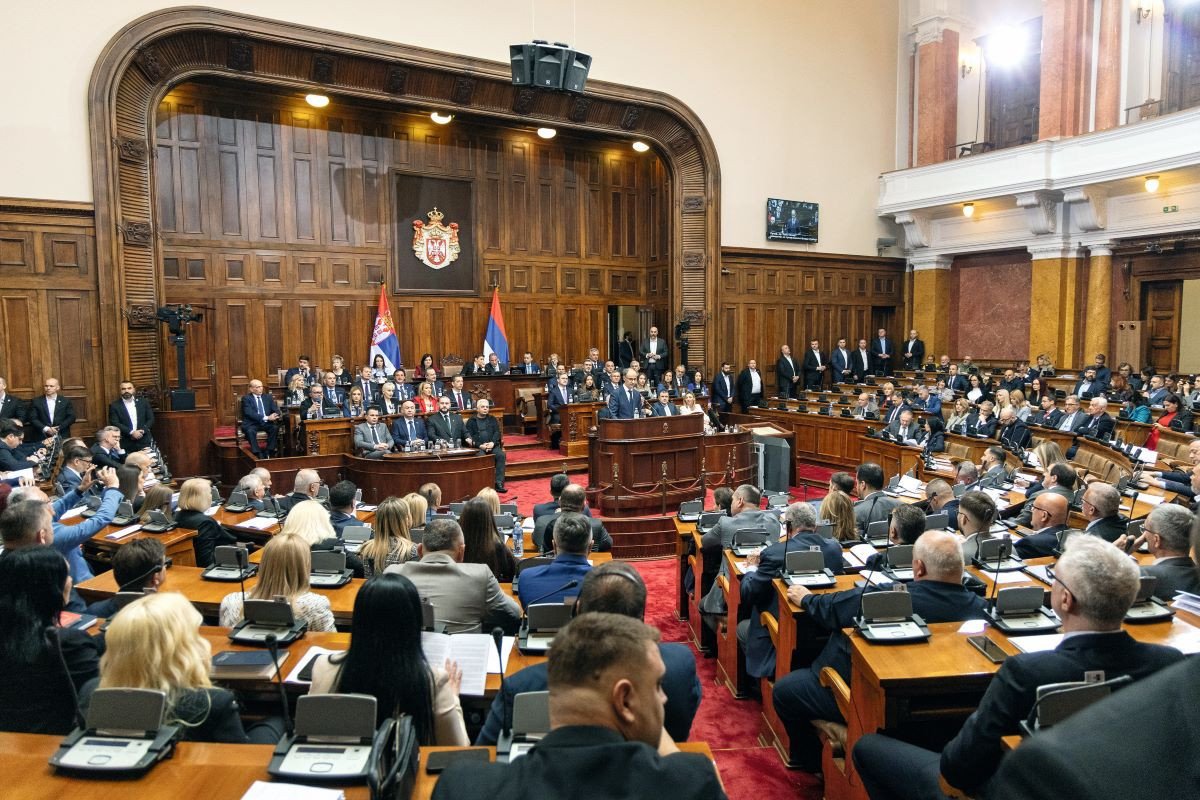
Acting Speaker of the National Assembly of Serbia Ana Brnabić has scheduled the constitutive session for Tuesday, 11/17, at 10:00. The agenda has six items: verification of MPs’ mandates, the election of the Speaker and Deputy Speakers of the Assembly, the appointment of the secretary-general, and the election of the Assembly’s working bodies and standing parliamentary delegations.
In addition to the constitution of parliament, Serbia is also facing the formation of a new government and a presidential election. From the resignation of Aleksandar Vučić on 09/27 until the end of December, three names appear in connection with the presidency: former president Vučić, the current acting office-holder Ana Brnabić, and the new Speaker of parliament, who will also assume that role.
Between the 140 mandates held by the Student List, the 103 MPs of United Serbia, and the seven mandates of national minorities, a new political architecture is emerging — from the parliamentary leadership to committees and international delegations.
When Vučić resigned, he handed over the duty to Ana Brnabić the following day. Under Article 120 of the Constitution, when a president’s term ends before the expiry of the period for which they were elected, they are replaced by the Speaker of parliament. Brnabić will perform that role until the election of the new Speaker of the Assembly, who will also become acting President of the Republic.
That is where the institutional merry-go-round begins. If Ana Brnabić does not call the presidential election before the election of the new Speaker of the Assembly on 11/17, that authority will pass to her successor, who at the same time becomes acting President of Serbia. The law stipulates that at least 30 days, and no more than 60 days, must pass between the calling of the election and polling day. Since the election must be held no later than 12/27, the decision to call it must be made no later than 11/27.
Before the new parliamentary convocation can be constituted, MPs’ mandates must be verified. Until the election of the new Speaker of the Assembly, the session will be chaired by the oldest MP, assisted by the youngest MPs from the four most successful lists and by the secretary-general of parliament.
After their mandates are verified, MPs take the oath. To constitute parliament, at least 167 of the total 250 mandates must be verified. Parliamentary groups are formed by submitting a list of members with signatures, along with the name of the chair and deputy chair. At least five MPs are required to form a parliamentary group.
The election of the Speaker will be the first major political test of the balance of power. A candidate may be proposed by at least 30 MPs, and 126 votes — a majority of the total number of MPs — are needed for election. The vote may be public or secret.
Deputy speakers — agreement or majority
With 140 mandates, the Student List can elect the Speaker of parliament on its own. United Serbia, with 103 MPs, can nominate a candidate, but cannot elect one without additional support. The Speaker represents parliament, convenes and presides over sessions, ensures the implementation of the Rules of Procedure, and coordinates the work of parliamentary bodies. This time, the post also carries the role of acting President of the Republic.
The number of deputy speakers is determined by the Assembly on the proposal of the Speaker of parliament. The election of each requires 126 votes. The Student List can secure the election of all of its candidates. Even so, it will be politically significant whether some of the posts go to United Serbia or to minority parliamentary groups. The Rules of Procedure do not guarantee the opposition a set number of places, so its representation will depend on political agreement. This is followed by the appointment of the secretary-general on the proposal of the Speaker of parliament, which also requires a majority of 126 MPs.
The distribution of parliamentary influence does not end with the election of the Speaker and deputy speakers. What follows is the formation of 19 standing committees and the Committee on the Rights of the Child, which examine laws, oversee the work of the government and ministries, and organise public hearings.
Seats are allocated in proportion to the number of MPs, with the rule that the parliamentary majority also has a majority in the committees. In that way, the Student List secures dominant influence, while United Serbia gains room for opposition activity.
It will be especially important who leads the committees for finance, oversight of the security services, defence and internal affairs, the judiciary, and constitutional matters. Through them, the executive, the security sector, the judiciary, and public spending are overseen. Committee chairs are elected by the committees themselves at their first sessions.
MPs also face the allocation of seats in Serbia’s standing delegations to international institutions, including the Parliamentary Assembly of the Council of Europe, the OSCE Parliamentary Assembly (Organization for Security and Co-operation in Europe), the NATO Parliamentary Assembly, and the Inter-Parliamentary Union. Their composition is decided by the Assembly on the proposal of the Speaker of parliament, in consultation with the chairs of parliamentary groups and with respect for proportional and gender representation.
A further seven MPs from minority lists are entering parliament. The Hungarian Alliance of Vojvodina (Savez vojvođanskih Mađara) and the Albanian Coalition won two mandates each, while the lists of Rasim Ljajić, the Party of Democratic Action of Sandžak (SDA Sandžaka), and Usame Zukorlić have one MP each. It remains to be seen whether they will form a joint parliamentary group or act separately. They can take part in committee work and represent the interests of their communities, but with seven mandates they are unlikely to decide the election of the government.
90 days to elect a new government
The election of the parliamentary bodies starts the countdown to the formation of a new government. The deadline is 90 days from the constitution of parliament. The President of the Republic, or the acting office-holder, holds consultations with representatives of the electoral lists and proposes a prime minister-designate, who presents the government’s programme and composition to MPs.
At least 126 votes are required for election. With 140 mandates, the Student List can elect the government on its own, provided all of its MPs support the proposal. United Serbia moves into opposition, where through debate and oversight of the executive it will challenge the decisions of the new majority. If the government is not elected within 90 days, the Constitution provides for the dissolution of parliament and the calling of new elections.
The constitution of the new convocation is much more than the first gathering of MPs. The Student List will have to show how it can turn electoral mandates into a parliamentary majority, personnel appointments, institutions, and the running of the state. United Serbia will have to find an answer to the new political reality and organise the opposition in a parliament in which it no longer decides the leadership and the majority.
The celebration over the election victory will soon be replaced by political reality. The new authorities are about to face a test of their ability to govern the state, once the formation of institutions is complete.