








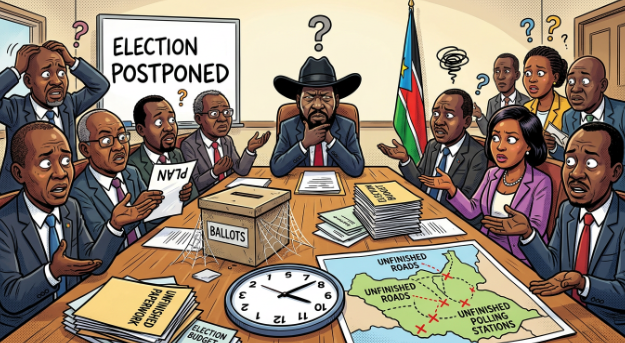
The National Elections Commission’s (NEC) decision to move polling day from 22 December 2026 to 11 February 2027 has once again raised a central question about South Sudan’s transition. Is this a practical adjustment intended to give the electoral process more time, or another postponement in a cycle that has kept the country from holding a nationwide general election since independence in 2011?
The significance of the decision lies not simply in the addition of 51 days to the electoral calendar, but in its timing and institutional context. The national and state legislative bodies have been dissolved, the previous transitional executive arrangements have been replaced, and a caretaker administration has been appointed pending the completion of the elections. The country is therefore entering an electoral period in which the executive operates without a sitting parliament exercising its ordinary legislative oversight.
Three distinct matters must not be conflated: The Commission’s revision of polling day; the extension of the transitional period, which under the previous political arrangements is due to end on 22 February 2027; and the continued exercise of presidential and executive authority under the relevant constitutional and transitional provisions.
Changing the election date does not, by itself, amount to a new constitutional extension of the President’s or government’s tenure. The continuation of the President in office until an elected successor is sworn in, and the continuation of a caretaker administration, are separate questions that must be assessed against the amended Transitional Constitution and applicable legislation.
In public statements, the Commission has reportedly relied on Article 57(1)(c) of the National Elections Act 2012, as amended, as the basis for revising the timetable. At the same time, the new polling date has raised questions about its relationship with the deadline set in the wider legal framework. It would therefore be premature to declare the decision unlawful—or to assume that it automatically resolves the question of the transitional mandate—without a substantiated legal opinion or a determination by a competent authority. The authorities should publish the full legal basis for the decision and explain how the Elections Act, the Transitional Constitution and the peace agreement are being reconciled.
The revised calendar places polling day on 11 February 2027, just 11 days before the transitional period is due to end on 22 February. This is an extremely narrow window, particularly because the announcement of results and the resolution of election petitions may continue beyond polling day. Holding the vote on schedule would therefore not automatically mean that the political transition has been completed or that power can be transferred on the same day.
This is the most desirable outcome, but it requires much more than keeping the announced date. Voter registration, publication of the final register, candidate nominations and appeals, ballot-paper production and distribution, funding, logistics and security arrangements must all be completed. There must also be minimum guarantees for political and media freedoms, allowing parties and candidates to organize and campaign, and ensuring the participation of women, young people and communities in conflict-affected areas.
If credible general elections are held and the results are accepted through lawful procedures, the country could begin a transition to elected institutions. Success, however, cannot be measured by polling day alone. It depends on transparent counting and results management, independent dispute-resolution mechanisms, acceptance of the outcome by political actors, and clear arrangements for the transfer of authority and the swearing-in of elected officials. An election that is not institutionally completed may simply move the crisis from the pre-election period to the post-election period.
This remains a practical possibility if a critical stage of the timetable is delayed by inadequate or late funding, limited technical capacity, problems with registration or the voters’ roll, ballot-paper printing and transportation challenges, or deteriorating security. The Commission may then be forced to revise the calendar again. Funding, however, should not be presented as the confirmed reason for the latest postponement. The published timetable did not provide a detailed explanation, while Commission statements referred to insufficient time to complete nominations, candidate lists and ballot-paper printing. Broader concerns about funding and readiness have also been reported.
The danger is that a limited postponement becomes a recurring pattern, leaving the caretaker administration in place, parliament absent, and public, political and international confidence weakened. If another postponement becomes unavoidable, it should be publicly justified, limited to a clearly defined period, supported by a published financing plan and measurable milestones, and subject to independent scrutiny.
Security, access, funding, or registration constraints could make it impossible to hold the vote in some areas, or to complete all electoral levels at the same time. This could produce geographically or institutionally uneven results and disputes over the representation of areas unable to participate. A presidential-only election or partial elections should not be treated as a simple administrative compromise. Such an arrangement would require a clear legal basis, an explanation of whether the law permits it, safeguards for equality of voting and representation, and a binding timetable for completing the postponed electoral contests.
A phased electoral process could be considered only as an exceptional arrangement if it is authorized by law, agreed through an inclusive process, and accompanied by a binding schedule for completing the polls in areas or at levels that were deferred. Without these safeguards, a fragmented election could produce institutions whose legitimacy is contested and deepen divisions rather than resolve them.
This is the most dangerous scenario over the medium term. Elections may fail to take place on schedule, while political forces remain unable to agree on a credible alternative. Caretaker arrangements could then continue without a reliable time limit, parliament would remain absent, and public accountability would weaken. A temporary arrangement could gradually become a prolonged political condition, eroding confidence in state institutions, the electoral process and the peace agreement.
This would not necessarily mean immediate state collapse or an inevitable return to war. It would, however, increase the risks of political and security tensions, weaken the prospects for national consensus, and make major decisions increasingly dependent on elite bargaining rather than public institutions. The continued absence of a legislature also raises fundamental questions about oversight of public expenditure, executive decisions and the limits of a caretaker government’s authority.
If acceptable elections prove impossible, the crisis could push political actors towards a new negotiation on time-bound transitional arrangements, a reconstituted government, or an alternative electoral and constitutional roadmap. Inclusive dialogue could help reduce tensions and address disagreements over participation, security and electoral rules. But announcing a new government or redistributing positions among political actors would not, by itself, constitute a solution.
Any alternative arrangement must specify its legal basis, duration, powers, oversight mechanisms, implementation deadlines and safeguards against another cycle of postponement. Without these conditions, the outcome would reproduce the same political formula: an unelected government, absent legislative institutions and elections deferred once again.
The information currently available does not justify claiming that any one scenario is certain. However, continuing challenges involving technical readiness, security, financing and political consensus mean that delays in implementing parts of the calendar remain possible. At the same time, the start of voter registration and the publication of a detailed timetable offer a real opportunity that should not be wasted. The central test in the coming weeks and months will be whether the Commission, the government and political parties can turn the published calendar into transparent, verifiable action.
First, the Commission should publish the full legal basis for changing the date. The government should formally clarify the relationship between polling day and the end of the transitional period on 22 February 2027, including how results, election petitions and the swearing-in of elected institutions will be handled. Second, the authorities should publish a realistic financing plan, clarify institutional responsibilities, provide the Commission with the resources it needs, and announce registration and polling-center locations in good time. Access for observers, freedom to campaign, the safety of candidates and voters, and timely public information must also be guaranteed.
Political parties must treat the election as a national process, not merely a contest among elites, and agree on clear procedures for resolving disputes and accepting results. Security or technical concerns must not become an open-ended justification for postponement; equally, elections should not be forced through under conditions that fail to meet minimum standards of credibility and inclusion.
The 11 February 2027 date is not simply another entry in the Commission’s calendar. It is a political, legal and institutional test of South Sudan’s commitment to completing the transition. A limited postponement may be justified if it is lawful and tied to an implementable plan. It becomes dangerous when it is used to prolong temporary rule and the absence of oversight. The question facing the country’s leaders is not only whether elections will take place in February, but whether they will produce free and credible outcomes and institutions capable of ending the transitional period—or open the door to yet another extension. Citizens do not need another date on paper. They need a clear, lawful and transparent process that ends with institutions accountable to them.
The writer is a researcher and policy analyst and Director, Nexus Institute for Inclusive Development and Research (NIDR) in Juba. He can be reached via sebiternest@gmail.com.
The views expressed in ‘opinion’ articles published by Radio Tamazuj are solely those of the writer. The veracity of any claims made is the responsibility of the author, not Radio Tamazuj.