
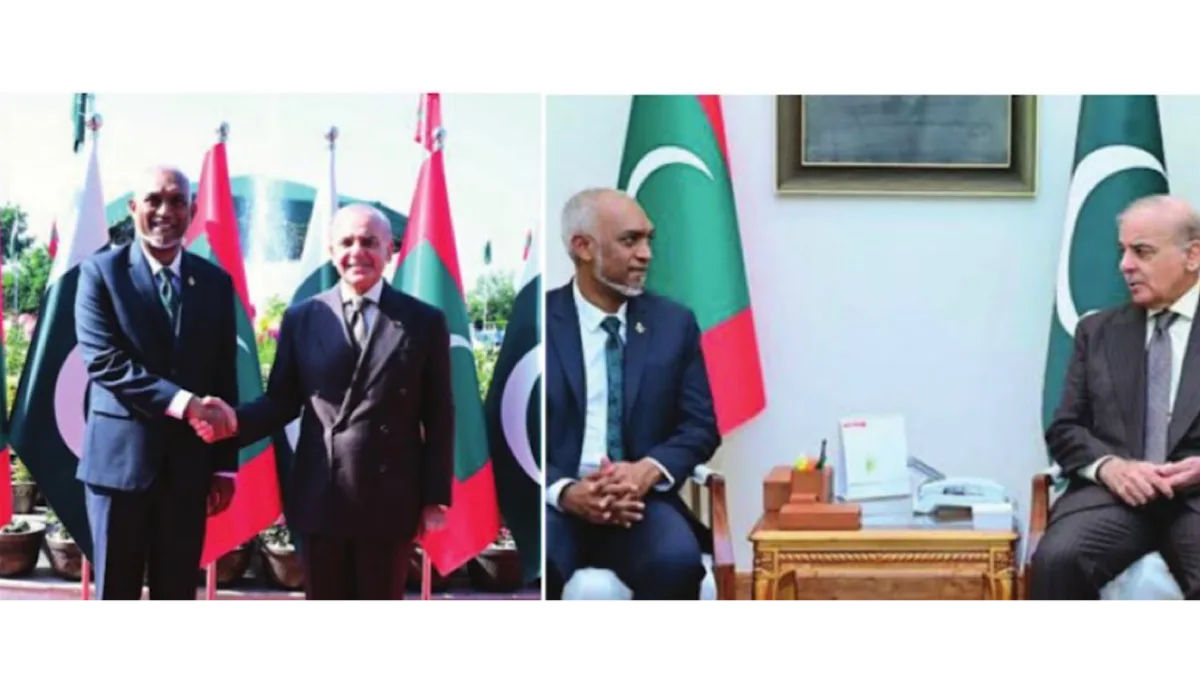
Maldivian President Mohamed Muizzu’s three-day visit to Pakistan has brought questions of regional cooperation, security and diplomatic priorities in South Asia back into focus. The first visit by a Maldivian president to Pakistan in 11 years was aimed at strengthening bilateral relations and expanding cooperation across several sectors. During the visit, the two countries signed 20 memoranda of understanding (MoUs).
However, beyond these bilateral agreements, Muizzu’s call to revive the South Asian Association for Regional Cooperation (SAARC) and his emphasis on regional partnership gave the visit wider geopolitical significance. While the desire to revitalise regional cooperation is welcome, it is equally important to acknowledge the political and security challenges that have kept South Asia’s regional institutions from functioning effectively.
Advertisement
During the visit, the two countries agreed to raise bilateral trade from $13.9 million to $200 million within two years. The target reflects their ambition to expand commercial ties and explore new opportunities for mutual benefit. The 20 MoUs cover a range of areas, including health, education, information technology, agriculture, tourism, training and other sectors. If implemented effectively, these agreements could strengthen economic links and institutional exchanges between the two countries.
However, the real measure of success will not be the number of agreements signed but the extent to which they translate into tangible outcomes. One of the most significant aspects of the visit was the desire to strengthen defence and security cooperation. The Maldives occupies a strategically important position in the Indian Ocean, close to major international shipping and energy routes. Maritime security, surveillance, law enforcement and the prevention of maritime crime are therefore important elements of its national security. Pakistan’s efforts to expand defence and maritime cooperation with the Maldives must be understood in this context. At the same time, the regional implications of these initiatives cannot be assessed without considering India’s longstanding role as a key security partner of the Maldives.
India and the Maldives share geographical proximity and important strategic interests in the Indian Ocean. India has assisted the Maldives in defence training, capacity-building, maritime surveillance and disaster response. The stability and security of the Maldives are closely connected to India’s wider maritime interests. It is therefore natural that New Delhi will pay attention to the expansion of Pakistan’s defence and maritime cooperation with Male. However, it would be premature to conclude that the Maldives is moving away from India merely because it has signed agreements with Pakistan.
A country’s foreign policy must be assessed in terms of its broader interests, concrete actions and long-term strategic priorities. Another important aspect of Muizzu’s visit was his desire to revive SAARC. Established in 1985, the organisation was intended to promote economic cooperation, social development and regional integration in South Asia. Its eight members ~ India, Pakistan, Bangladesh, Nepal, Bhutan, Sri Lanka, the Maldives and Afghanistan ~ share geographical proximity and several common developmental challenges. Poverty, unemployment, public health, education, climate change, energy security and disaster management are issues that could benefit from greater regional coordination.
Cooperation in these areas could produce significant benefits for the people of South Asia. Despite this potential, SAARC has remained largely inactive for years. Its last summit was held in Kathmandu in November 2014. The next summit, scheduled to take place in Islamabad in 2016, could not be held amid rising tensions between India and Pakistan. No summit has taken place since then. This prolonged paralysis demonstrates that regional institutions cannot function effectively through diplomatic declarations alone. They require a minimum level of political understanding among member states and a willingness to address one another’s security concerns.
A major obstacle to SAARC’s revival has been Pakistansponsored cross-border terrorism and the deep mistrust between India and Pakistan. India has consistently maintained that terrorist activities originating across its borders undermine the trust required for normal political and economic cooperation. Bilateral relations have also been affected by wider political and security disputes. Under these circumstances, responsibility for restoring regional cooperation cannot be placed entirely on one country. Nevertheless, Pakistan must recognise that cross-border terrorism and its adversarial approach towards India have significantly hindered the effective functioning of SAARC.
Muizzu’s call to revive SAARC is therefore relevant, but it would have carried greater weight had it also explicitly addressed the security challenges that have held the organisation hostage. Advocating regional partnership requires more than urging all countries to return to the negotiating table. It also requires acknowledging the conditions that repeatedly obstruct dialogue. Without addressing cross-border terrorism and the security-related differences between India and Pakistan, any attempt to reactivate SAARC is likely to encounter the same difficulties that have prevented it from functioning for nearly a decade. At the same time, the future of SAARC should not be allowed to depend entirely on the ups and downs of India-Pakistan relations.
Practical cooperation can still be explored in areas such as public health, climate change, education, disaster management and regional connectivity. Other regional arrangements, including the Bay of Bengal Initiative for Multi-Sectoral Technical and Economic Cooperation (BIMSTEC) and the Bangladesh-Bhutan-India-Nepal (BBIN) initiative, can also facilitate economic integration and connectivity. However, these platforms do not fully replace SAARC’s broader regional scope. The organisation can still serve a useful purpose if its members demonstrate a genuine commitment to making it effective. Muizzu’s visit to Pakistan has brought two interconnected issues into focus: the expansion of bilateral relations and the revival of regional cooperation.
The success of his initiatives will ultimately depend on whether the trade target is achieved, the security agreements produce practical results and his appeal for SAARC leads to sustained diplomatic engagement. The Maldives needs to pursue its diplomatic independence while maintaining balanced relations with its key partners and supporting regional stability. Pakistan, for its part, must demonstrate a willingness to contribute to the trust and security environment necessary for regional cooperation.
A meaningful revival of SAARC will require the participation of all member states, including India and Pakistan. Regional partnership cannot be built merely through declarations of goodwill or the signing of agreements. It requires a serious effort to address terrorism, political mistrust and persistent security disputes. Muizzu’s initiative could provide an opportunity to reopen the debate on South Asian cooperation, but its ultimate value will depend on whether the region’s leaders are prepared to confront the obstacles that have prevented SAARC from fulfilling its original promise.
(The writer is an analyst on Strategic Affairs and South Asian geopolitics)






Leave a Reply