

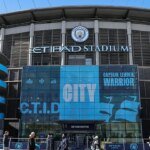




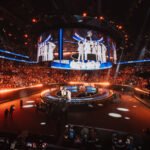

The players and a sold-out crowd were in Brooklyn, but the broadcast was produced out of facilities and control rooms in Seattle and Los Angeles
The 2026 League of Legends World Championship is in the books after Bilibili Gaming (BLG) took down Gen.G 3-1 in the Grand Final at Barclays Center on Saturday. The deciding series, which drew 3.9 million peak viewers (excluding mainland China), brings to a close another edition of one of esports’ biggest annual tournaments — and one of its most complex live productions.
Although the players and sold-out crowd onsite were in Brooklyn, the broadcast was largely produced remotely through Riot Games’ Remote Broadcast Center (RBC) powered by Amazon Web Services (AWS) in Seattle, as well as from control rooms in Los Angeles. Despite the massive size and scope of the event at Barclays Center, Riot needed only a lean flypack-based footprint, a single NEP mobile unit (A and B trucks) dedicated to the Opening Ceremony (OC), and a small setup for its tier-one partners and co-streamers.
“This is honestly a fraction of the [onsite] footprint most productions of this size would have,” says Alex Rybalko, senior manager, broadcast engineering, Riot Games. “Only the OC truck is a true truck setup; everything else we have here is just workstations for producers. We have made remote- and distributed-production [workflows] a priority, so, at this point, all our global shows are fully remotely produced out of one of our remote broadcast centers.”
One Show, Three Locations: Brooklyn, Seattle, L.A.
Riot’s distributed footprint for the LoL Worlds Final spread across three cities spanning the entire country. Its custom flypack contribution kit at Barclays fed the remote productions in Seattle and Los Angeles.

As has become standard for Riot’s major North American events, the Seattle RBC was the axis on which the entire show spun. All of Riot’s hardware is located at the Seattle RBC, which also housed graphics, replay, a couple of producers, and the observers (in-game virtual-camera operators). Riot ran two production-control rooms in Seattle: one for the world feed and one for its own English-language broadcast. In L.A., the technical director for the English feed cut the show on a Sony MLS-X1 switcher panel, but the underlying switcher node was located in Seattle. A couple of producers and graphics operators worked from L.A. as well.
“We have now gotten to the point where you can sit in L.A. or Seattle, work on the same show, and not know you’re in different locations,” says Rybalko. “Because everything is meshed together, we can even have a TD in L.A. cutting the show, controlling equipment that is located in Seattle. This is something we’re starting to roll out globally: the principle that it doesn’t matter where the operator is. We’re using a centralized-technology approach to erase the boundaries.”
Riot Games Senior Manager, Broadcast Production, Samuel Kordower Chaimson describes the English feed as a bench in Brooklyn, a bench in Los Angeles, and the switcher, playback, and graphics in Seattle, all on the same comms trunks. “It works out really well from a production perspective. This also enables Riot to make centralized-equipment upgrades, rather than every region having to choose to budget for a major [equipment] upgrade, since every office can utilize hardware back in Seattle.”
Onsite at Barclays: Streamlining the Load-In
The distributed-production model allowed Riot to deploy a limited onsite production in Brooklyn, which made hosting the final at an ultra busy venue like Barclays possible in the first place. Riot normally needs a full week to set up a Worlds Grand Final; but, in Brooklyn, it had just one day before rehearsals began on Thursday. However, since Riot has reduced load-in of the flypack and transmission operations from days to hours, the massive scale of the show did not have to change.
“Technology should never stand in the way of fan experience,” says Rybalko. “If we can load-in in a day, we can go to venues like this and provide a better experience for our fans. It wouldn’t have even been considered previously because, logistically, it would not have been possible, but, today, we are able to deploy nearly the exact same show with significantly less [setup time].”
The venue helped, too. Riot typically deploys around 300 screens on its own IPTV-style setup. At Barclays, it integrated with the arena’s existing IPTV system and deployed almost none.

As for cameras, Riot’s complement of 41 included Sony Venice systems, a dual-head Agito Sport, a 3D cablecam, two Ropeclimber cams (45 ft. and 75 ft.), an Arri Trinity, a Steadicam, a 30-ft. tower cam, and Waterbird railcam in the caster booth. Four track cams ran on 130 ft. of track surrounding the bowl. A Riot-standardized small-form-factor, broadcast-quality PTZ face cam was deployed on each player.
The lone mobile unit in the compound — NEP Supershooter 33 A and B — handled the Opening Ceremony, which was a standalone production (as is the case at all of Riot’s major finals) run through the same technical core as the rest of the show. All gameplay, studio programming, and other live action was backhauled to the Seattle RBC for show integration and global distribution.
Riot’s North American and international co-streamers were also onsite and operated as full-fledged productions with a dedicated engineering team, and Riot’s tier-one partners from China and Korea were equipped with their own small control rooms, cameras, and talent.
Also on hand at Barclays Center was a small PCR for world-feed executive producers — although the world-feed production itself was distributed across Brooklyn, Seattle, and L.A. — and the technical director for the in-venue experience (which was tied into the overall show).

The compound at Barclays was also home to two portable trailers dedicated to transmission and onsite production operations. The transmission trailer managed every inbound and outbound feed and all signal distribution in the venue, including some 300 displays and the in-venue IMAG. Round-trip latency from Brooklyn to Seattle and back was just 200 ms.
“That round trip matters because much of what fans see in the arena originates in Seattle,” says James Wyld, principal infrastructure engineer, esports event tech, Riot Games. “A lot of the time, you think about latency as one-way, but, for us, because everything’s integrated, it goes back and forth.”
Contribution 2.0: No Single Point of Failure
Riot’s custom contribution flypack racks were also located in the Barclays compound and were responsible for all signal distribution, encoding, and in-venue broadcast functions.
Contribution from Barclays ran on Sony NXL-ME80 media edge processors, part of what Riot calls its Contribution 2.0 strategy. The company previously relied on JPEG XS over dual 10-Gbps last-mile circuits, but, because the ME80’s low-latency HEVC encoding lets it run encoders active-active, a path failure no longer means a broadcast hit.
“The visual quality of the ME80 codec that Sony has developed is phenomenal,” says Wyld. “They get that level of compression in basically a frame of latency. You go from, in our case, a 3G SDI signal or 2110 signal into the ME80, and, a frame later, you get 25 Mb of 1080 HEVC video.”

Riot got in early with Sony on the ME80’s development and tested it head-to-head before committing, comparing JPEG XS, the ME80, and traditional SRT at different bitrates. “That way,” says Wyld, “we could dial in, look at our game in action in those formats, and see where each would sit on the quality ladder for us. And the difference was negligible.”
For the final, Riot ran 91 contribution video paths with full active-active redundancy, using about 1 Gbps of bandwidth per circuit.
The backbone is Riot Direct, the global network the company originally built for its online-gaming needs. One leg of each active pair rides Riot Direct, and the other can run over the open internet through a VPN.
“Technically,” says Rybalko, “Riot Direct wasn’t built for broadcast; it was built for our games. But the network is so big, so resilient, and has points of presence literally everywhere that, when we started the remote-broadcast-center projects, it was perfect for broadcast. With [Contribution 2.0], we’re fully active-active across all our paths. The only time you notice that a link is down is when an alarm shows up. There’s no impact to viewers at all.”
Distribution and Versioning: Many Feeds, One Production
As host broadcaster, Riot delivered the world feed in 24 languages to 19 language partners who build their own regional shows. Onsite tier-one partners for China and Korea were also provided the full set of venue inputs, so that they could cut their own shows from their onsite facilities instead of taking the world feed.
Versioning added even more layers, with Sony switchers producing multiple versions of the show for broadcasters with different sponsor obligations, including a China-specific feed that met the nation’s strict content requirements. Riot also introduced “national feeds” that inserted regional sponsorships downstream into the already produced English feed.
Riot’s AWS cloud-based operation carried 121 live MediaConnect flows across eight regions, with 511 outputs and 16 MediaLive transcode channels. Seattle sent out 16 transmission feeds, including 9:16 vertical feeds, and cinema watch parties ran in nine languages. Heading into the final, the system had logged 42 days of continuous uptime.

The 9:16 vertical feed is Riot’s fastest-growing format, up 16-fold in its first full year as a product. It is a bespoke 9:16 show built automatically from the main production, with its own graphics, replays, and scenes, and the casters stay on screen throughout.
“It runs on a zero-operator model,” notes Rybalko. “It’s fully automated: we read the state of the show, create a logical representation of it, and use that as a trigger to rebuild an entire bespoke feed with zero operators. We’re also now offering a vertical world feed for our partners because, in certain regions, vertical is the primary format. And we offer it to all our co-streamers as well. If that’s where the audience is, we’re going to go meet them there.”
That automation makes vertical nearly free to add. “Activating vertical for a production that comes to our RBC becomes ‘Do you want vertical? Tick, yes. We’ll turn it on,’” says Wyld. “It doesn’t become a whole thing. We don’t have to source another switcher or operators or make it a huge part of the process.”
Co-streamers are a big part of the show, with Riot supporting eight onsite productions through four mix-minus feeds, with a dedicated technical and influencer-management team onsite. This year, a new NDI routing layer let co-streamers bring each other into their shows, or join the main show, in split-screen.
A Level Playing Field: Protecting the Competition
As if the broadcast operation isn’t challenging enough, Riot’s team also runs the competition side of things at every event.

“We manage everything, including competitive integrity,” says Rybalko. “Everything is first-party, from the sport itself to the broadcast for fans. Wherever you play at a Riot event, there’s a very strict competitive standard. So any event we do is the same, and players always have the same experience.”
In the team room, the coaching station has its own game output, cameras, audio, and intercoms, and the coaches mix the players’ ears. Competitive rules bar players from talking to coaches during play.
On stage, players use machines from Riot’s global fleet of more than 800 competitive PCs, all running the same golden image. Every PC has NDI built into the image, enabling any validated spare to go straight onto the stage. If a player has a problem, the crew spends 30-60 seconds troubleshooting and then swaps the machine. The target for a swap is a few minutes.
“If it’s not resolved quickly — with millions of eyeballs on the screen — we’ll switch it out,” says Wyld. “This is part of the competitive playing field. We have to make sure there’s never the possibility for a player to say, ‘I was treated unfairly’ or ‘My PC wasn’t as good as the other one.’”
Remote From Start to Finish With a Crescendo in Brooklyn
The Grand Final capped a tournament produced fully remotely. Play-ins came from Riot’s L.A. studio. The Swiss Stage, quarterfinals, and semifinals ran three or four weeks from the CUTX Event Center in Allen, TX.

Last year’s final in Chengdu, China, was produced primarily onsite (because of in-country connectivity limitations) using eight mobile units, with Riot testing its new Contribution 2.0 model in parallel. Last month, in China, the VALORANT Champions 2026 Grand Final became Riot’s first fully remote global show from that country, removing the last holdout.
“Everything we do from now on is fully remote,” says Rybalko. “For the last five years or so, most of our global shows have been fully remotely produced out of one of our global remote-broadcast centers. One of the last holdouts was China. But VCT Champions changed that.”
For all the technology behind the show, Wyld says the goal is simple.
“We all have this common understanding and motivation to make things great for our players and our fans,” says Wyld. “That’s the driving philosophy for everything we do at Riot. We want fans to come into the arena here at Barclays and just have their minds blown. And we want fans all over the world who don’t have that opportunity to look at the broadcast to have that same experience.”