








IBTTA’s chief executive arrives at his first annual meeting with funding, AI and the connected car all on the table. He tells Tom Stone what he wants Arlington to achieve
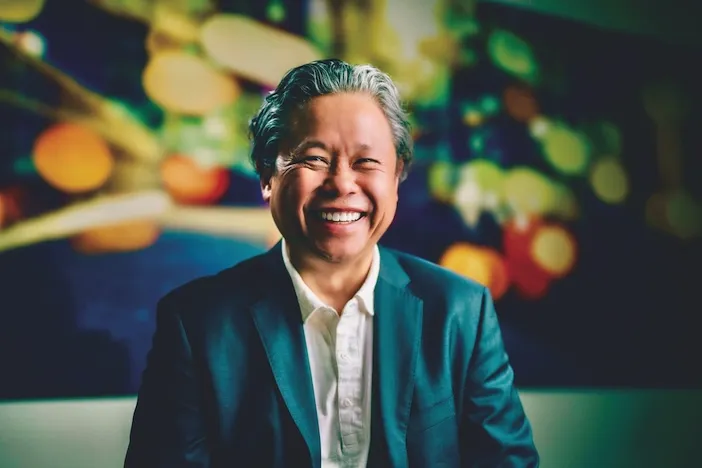
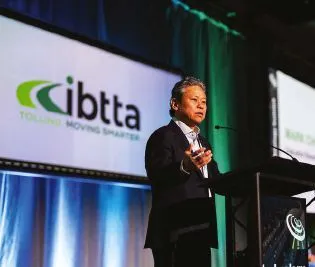
Mark Chung did not come up through tolling. He spent more than two decades in automotive and transportation, including years at Ford, and then ran roadway and workplace safety at the National Safety Council, before joining the International Bridge, Tunnel and Turnpike Association (IBTTA) as executive director and chief executive around the turn of the year. The 94th Annual Meeting & Exhibition, in Arlington, Texas, from 12 to 15 November, is his first as the association’s leader.
An outsider’s case for the job
“I’ve operated at the intersection of transportation, technology and safety,” Chung says of his career. What drew him to IBTTA was less the toll road itself than the chance to change how roads are paid for. “What really attracted me to this role is the ability to make an impact.”
From the outside he saw an industry facing a rising need for infrastructure, and a funding model under strain. “There’s also a very, very acute need to figure out different ways of funding infrastructure build outs and maintenance,” he says, “and I strongly believe that IBTTA has a seat at the table in terms of defining what the future could look like to deploy more of a user-based funding model.”
He is clear about what he wants to show for it. “If we do this right, we could definitely benefit the public in terms of delivering safer and more reliable roads.”
Why Arlington
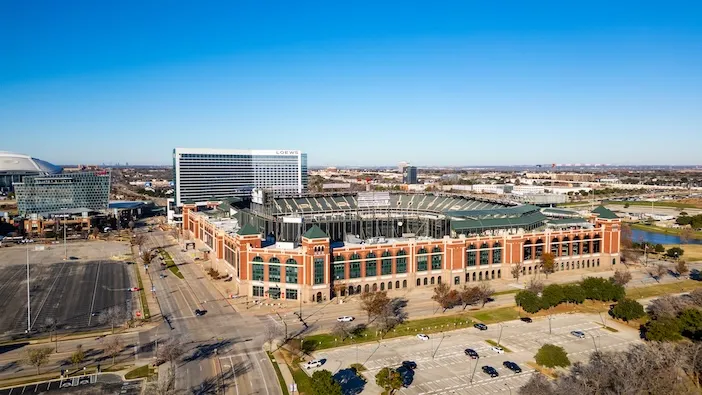
The meeting is later than usual this year, which Chung treats as a footnote. “It’s a little later than our typical timing, but nonetheless we expect a fantastic meeting.” The theme, ‘Driving what’s next: Investment. Impact. Influence.’, is one he thinks fits the moment. “Our theme this year is driving what’s next, and I think that’s exactly where the industry is at right now.”
For him, that is the job of the gathering. “The annual meeting is where leaders come together to talk about what’s next, and, more importantly, how we get there.”
The venue helps. The North Texas Tollway Authority is the host agency, and the technical tours on Friday include the LBJ Express managed lanes on I-635, which are already sold out. “Texas at large is one of the nation’s fastest growing states and transportation markets,” Chung says. “We’re going to be able to experience firsthand how innovation is happening, and how managed lanes are happening, and how we’re managing freight.” He adds that the result should be useful. “It’s going to be a really informative, as well as an eye-opening session for us.”
Everything under the sun
The agenda does not lack for subjects. “Of course everyone’s talking about AI, so we also talk about AI and applications of AI in our industry,” Chung says. Safety is one place he sees it already at work. “We have many operators that are deploying AI-powered incident detection and AI-powered data analysis to really help them get to a point where they could be more proactive and predictive about safety risks.”
He points to the Pennsylvania Turnpike, whose system uses real-time detection to spot stopped or slow-moving traffic and warn approaching drivers, particularly in work zones. On the Arlington programme, AI gets its own invitation-only roundtable on Thursday for IBTTA’s platinum sponsors, asking what changes in the toll agency and what stays human, and a slot in Friday’s innovation track.
Connected infrastructure is the other big theme. “We’re going to be focusing quite a bit on connected infrastructure as well,” Chung says, and he is quick to add the caveat. “With connected infrastructure we have to talk about cyber security, and they go hand in hand.”
The list does not stop there. “Of course other issues that confront the tolling industry, like workforce development, customer experience, everything under the sun, I think will be discussed,” he says. Both have their moment in Arlington. The Pennsylvania Turnpike Commission collects an award for its workforce development programme, and a Sunday afternoon panel takes on the gap between the transaction and the customer’s experience of it.
The car as a giant credit card
Chung is at his most animated when the conversation turns to road user charging and the connected vehicle. The night before the interview, he says, he had dinner in Washington with a group of transportation leaders, among them people from the autonomous vehicle industry. The prevailing view was that autonomous vehicles will be more payment ready than any vehicle before, for coffee and parking as much as for road use.
“The vehicle itself is going to be a giant credit card,” he says. He expects that convenience to make tolling and road user charging easier to accept, and easier to legislate for. “I think we’re getting closer to being more precise about how to charge for road usage.”
He sees North Carolina as the proof. “I think the experiment that JJ Eden and team have done in North Carolina is a really good proof of concept that it can work, and that we could get the key players together, the OEMs, the payment systems with Mastercard and of course other tech solution providers to make this work.”
Asked whether the future lies in dedicated roadside infrastructure or in mobile and third-party data, he declines to pick a side. “My personal viewpoint is that I am agnostic,” Chung says. “As long as it produces safe outcomes for road users, whatever solution works best and in the most efficient way is the one that we ought to utilize.” The direction of travel, though, is plain. “The modern vehicle is becoming more and more connected and is more V2X ready than ever.”
That conversation moves from the interview to the stage on Friday, when carmakers and toll operators share a session billed as ‘OEMs: what you always wanted to know but were afraid to ask’. It follows IBTTA’s May memorandum of understanding with the 5G Automotive Association on V2X-enabled tolling.
Money, Washington and influence
The third word of the theme is influence, and for Chung it is bound up with funding. Before joining IBTTA he served on USDOT’s Transforming Transportation Advisory Committee, which looked at how AI and autonomous vehicles would affect transport policy and the labour market. The current administration has put it on hold.
“I hope that they will revive it, because I think having the industry voice included in the federal policy thinking is an important and a very integral part,” he says. “It should be an integral part to how the federal government operates, and I hope someday that we will do that again.”
Arlington offers a chance to speak directly. On Saturday, Federal Highway Administration administrator Sean McMaster joins IBTTA president Joi Taylor Dean for a fireside chat on federal priorities and what they mean for tolling. The timing is notable, since Congress has extended surface transportation programmes only as far as 11 December.
Chung’s own measure of success is long term. IBTTA’s five-year strategic plan has advocacy, knowledge and innovation, workforce development and membership as its pillars. “The priority is execution,” he says. “At the end of our plan period, there’s going to be a stronger global network of tolling experts, and we’re going to have the opportunity to have even greater influence on legislation and to help the general public understand the benefits of tolling.”
A family with a global reach
Asked what has surprised him most about tolling, Chung does not hesitate. “The tolling industry is extremely tight. They’re like family.” His first board meeting, two or three weeks into the job, set the tone. “It really felt like a family reunion.”
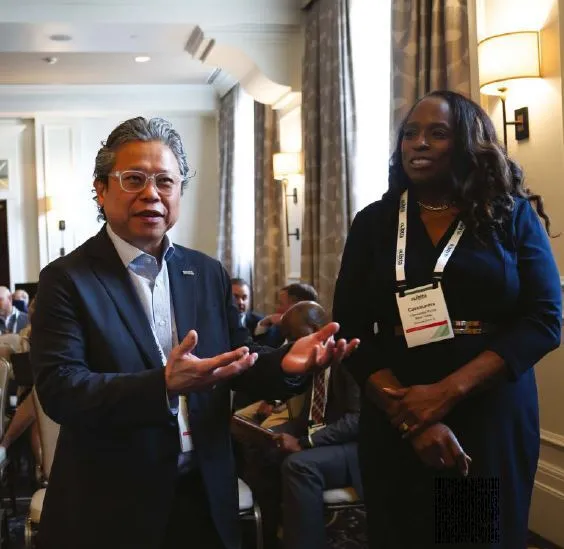
What impressed him was what that family chooses not to fight over. At Ford, he says, safety was one of the attributes that carmakers competed on. Tolling is different. “Safety and other sort of basic attributes of the services that we provide are at a pre-competitive level. We collaborate, we try to get together and enhance everyone’s ability to improve safety and offer safer and more reliable roads.”
He expects Arlington to show it. “Our members will be able to share their learnings and their knowledge with each other at this particular meeting.” The family is also meant to be an international one. On Sunday morning, a session moderated by María Moreno of Spanish concessionaires’ association SEOPAN takes a tour of tolling around the world, with speakers from France, India, Chile and beyond. “Like all other annual meetings, we’re going to have a global attendance, so we’re going to have a tremendous amount of global perspective as well,” Chung says.
Growing that international side is part of the plan. “Part of our strategic plan is focused on expanding our membership base outside of the United States, and we are actively pursuing that activity as well.”
Safety stays at the centre
Safety, the subject he knows best, will not be far from the stage. Saturday’s ‘Safer roads by design’ track covers average-speed enforcement, active traffic management and digital twins. IBTTA’s ‘Be Safe Together’ campaign took distracted driving as its focus this year, and Chung puts the problem in numbers. “It contributes in the United States to about an estimated 30% of all US crashes and fatalities, which is equivalent to about 1,000 people per month that are losing their lives because of distraction.”
It is, he says, a risk that can be tackled. For a first-year chief executive heading into his first annual meeting, he sounds like someone who thinks the association is on the right road. “I think we’re making good progress thus far this year,” he says. Arlington is where the industry gets to judge that for itself.
The 94th IBTTA Annual Meeting & Exhibition runs from 12 to 15 November at the Loews Arlington Hotel & Convention Center, Arlington, Texas. For more information, visit ibtta.org
Related: IBTTA heads to Texas with Washington, AI and connected cars on the agenda