
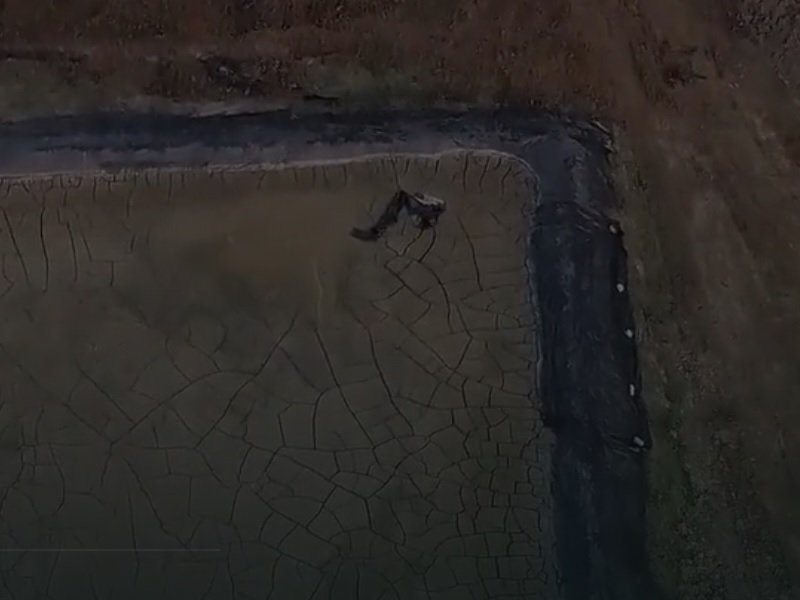
Photo by FEDERICO PARRA/AFP via Getty Images
Aerial view of an illegal mine located in Canaima National Park, Bolivar State, Gran Sabana Region, South-Eastern Venezuela.
Men and boys working in the mines are not the only ones who have been exploited due to illegal mining. Sex trafficking of women and girls has become a major issue. Victims are either forced into sex work or find it is their only employment option. Children are especially at risk for being trafficked in the area. There are reports that the average age of sex trafficking victims is 13-14 years old. Sexually transmitted diseases, including HIV/AIDS, have spiked in the region because of sexual exploitation.
Standing water and unsanitary conditions at mine sites have exponentially increased water- and mosquito-borne disease in the local population. Although Venezuela was the first country in Latin America to eradicate malaria, the disease has returned at an astonishing rate. The WHO reported 323,392 cases of malaria in Venezuela between January and October 2019, and 10 percent of the population in Bolivar state has tested positive for the disease. Malaria causes 21 percent of deaths in Amazonas state and 25 percent of deaths in Bolivar state; medication is often difficult to procure, although it is available for purchase with gold on the black market. Conditions near the mines have also contributed to spikes of diphtheria, yellow fever, dengue, and chikungunya. Moreover, as mercury from mining has seeped into the soil and water systems, local indigenous populations have been exposed at dangerous levels. In the Caura river basin, a tributary to the Orinoco, 92 percent of indigenous women had elevated levels of mercury, which could damage the kidney and brain and impedes fetal development.
RECOMMENDATIONS FOR VENEZUELA AND THE INTERNATIONAL COMMUNITY
The Maduro regime benefits from illegal mining and will not take any steps to stop it. However, though illegal mining has proliferated under the Maduro regime, the issue is likely to continue even after a change of government. A post-Maduro, or Day After, government will need to come to terms with the fact that the Venezuelan state has never had a strong presence in the country’s south. For many in this region, sindicatos, the ELN, the FARC, and other gangs are the closest thing to “governance” that they have ever experienced. The international community will play a vital role in supporting a Day After government to build state capacity and re-establish trust with communities in Southern Venezuela. The United States, European Union, and multilateral organizations can provide financial resources aimed at expanding the state’s capabilities in the region, while other countries, including Colombia, can share lessons gleaned in their own efforts to build state capacity.
Ending illegal mining will be an expensive, challenging process. These mines are remote and closely guarded by armed groups. To the extent possible, the interim government led by Juan Guaido and a Day After government need to locate and halt illegal mining operations, confiscate or destroy illegal mining equipment, block transport routes, and work with Colombia, Brazil, and Guyana to secure borders, all without jeopardizing the safety of local indigenous communities. Doing this will require resources and technical capacity that the Venezuelan state does not have. It will also entail demobilizing or driving out the ELN and FARC dissidents, two groups that have historically been successful in protracted low-intensity conflict. These tactical efforts must be complemented by a peaceful campaign to establish justice and the rule of law in Venezuela, as well as to reform and professionalize the country’s corrupt military.
In addition, a truth and reconciliation commission and a transitional system of justice will need to seek a fair and balanced accountability for past crimes, backed by international assistance and international law. The acute human rights abuses and environmental crimes that have resulted from illegal mining need to be addressed immediately. Moreover, a Day After government must ensure immediate protection and humanitarian aid to indigenous communities currently trapped by the illegal mining system. Mining communities must be included in truth and reconciliation efforts, and victims of human rights abuses should be given access to a fair justice system and reparations.
A Day After government will be desperate for revenue as it responds to an acute humanitarian crisis and attempts to rebuild the country. Venezuela has vast mineral wealth, and these minerals may be the best opportunity for the country to fund recovery. However, when a Day After government seeks foreign investment in Southern Venezuela’s mineral resources, it must do so properly. First, a Day After government must repeal the Arco Minero decree while advancing existing legislation from the National Assembly, such as the Organic Law of the Freshwater Mega Reserve & Biodiversity of the South of the Orinoco & Amazona, that is in line with international standards for environemntal protection. A democratic government must prioritize sustainability, obtain consent from local indigenous communities, and ensure that profits are directly invested in the historically underdeveloped rural south.
STEPS THE INTERNATIONAL COMMUNITY CAN TAKE IMMEDIATELY
While a Day After government will need to enact several policies to combat illegal mining in Venezuela, the international community can make a difference now to mitigate the scope of the devastation in the meantime. The United States and other countries have imposed individual and sectoral sanctions against the Maduro regime, giving the interim government led by Juan Guaidó more leverage. However, illegal mining exposes a key flaw in the United States’ sectoral sanctions program. As the official oil sector continues to be sanctioned, the Maduro regime has been able to adapt and turn to illicit activity. The illegal mining crisis should therefore serve as a reminder to U.S. policymakers that they must think beyond sanctions and use other tools—including indictments and expanded due diligence regulations—to shift global perception, dismantle Maduro’s regime of organized crime, and prevent further illegal mining.
The United States and European Union can pressure countries against getting involved in Venezuela’s illegal gold trade. The United Arab Emirates and Turkey, which continue to import Venezuelan gold, should be among the first to be engaged. Even more importantly, the United States and Europe should take steps to pressure and provide technical assistance to those places that are being used as stopovers for Venezuelan gold, such as Colombia and the Dutch islands of Aruba, Bonaire, and Curaçao.
In the cases of Colombia and Brazil, more secure borders are needed. Venezuela’s borders with both countries are notoriously porous; contraband and people have long flowed between those countries with little challenge. Given the size of these borders and the volume of goods being smuggled, both countries will need technical support from the international community to prevent Venezuelan gold from being smuggled. A major way to stop the smuggling of gold from Venezuela would be to enhance security at the borders, and this is something that Colombia and Brazil could begin to do in collaboration with the interim government and the National Assembly. This would stop at least some of the flows of illegal gold and other minerals from Venezuela and would complicate supply chains for machinery and mining chemicals such as mercury.
The international community must also emphasize the environmental factor of this crisis. For countries that have been working to address manmade impact on the environment, Venezuela’s illegal mining represents a critical threat. Norway, for example, has long been an advocate for the environment and has been a neutral mediator between the international community and the Maduro regime. Given its role as a mediator, Norway should respond to the devastation of the Venezuelan Amazon and its local communities during talks with the Maduro regime.
Moreover, though it is impossible to truly know the extent of the devastation in the Venezuelan Amazon without an environmental impact assessment, this is another opportunity for the international community to engage with this crisis. Venezuela’s Amazon should not be ignored, even if protecting it is more difficult than protecting the Amazon in other countries. Environmental NGOs must seek to understand the scope of environmental degradation in the Venezuelan Amazon, for example, by working with local civil society groups who have taken on this task. Organizations such as environmental NGOs can play a crucial role in collecting reliable data and research and raising global awareness. This would help not just in sounding the alarm in the international community but in guiding a Day After government’s efforts to restore the areas of the Amazon that have been lost or are in serious jeopardy.
Finally, multilateral organizations must also play a role in ending Venezuela’s illegal mining crisis. UN branches such as UNEP, UN Women, and UNESCO can raise global awareness about this crisis and stimulate investment from environmental and human rights NGOs.
Moises Rendon is director of the Future of Venezuela Initiative and a fellow with the Americas Program at the Center for Strategic and International Studies (CSIS) in Washington, D.C. Linnea Sandin is the associate director and an associate fellow for the Americas Program at CSIS. Claudia Fernandez is an intern with the CSIS Future of Venezuela Initiative.
The authors are grateful to Cristina Burelli, Advisor & International Liaison at SOS Orinoco and Juan Cruz, CSIS Senior Advisor, for providing valuable insights and reviewing previous drafts of this brief. The authors are thankful to Bram Ebus, Consultant at the International Crisis Group, for adding new insights and complexity to these issues, and to Margarita R. Seminario, Deputy Director and Senior Fellow of the Americas Program, for reviewing a previous draft of this brief. The authors would like to thank the iDeas Lab for their work on this brief, especially Jeeah Lee, Elizabeth Richardson, Joseph Bermudez, and Bonny Lee.
This brief is made possible thanks to the collaboration of Freedom House.
CSIS Briefs are produced by the Center for Strategic and International Studies (CSIS), a private, tax-exempt institution focusing on international public policy issues. Its research is nonpartisan and nonproprietary. CSIS does not take specific policy positions. Accordingly, all views, positions, and conclusions expressed in this publication should be understood to be solely those of the author(s).
© 2020 by the Center for Strategic and International Studies. All rights reserved
1 1 For the purpose of this brief, recommendations are directed at both the Interim Government, led by Juan Guaidó, and a democratically elected Day After government. While most recommendations can and should start immediately, others cannot be fully implemented until a Day After scenario.



Leave a Reply