









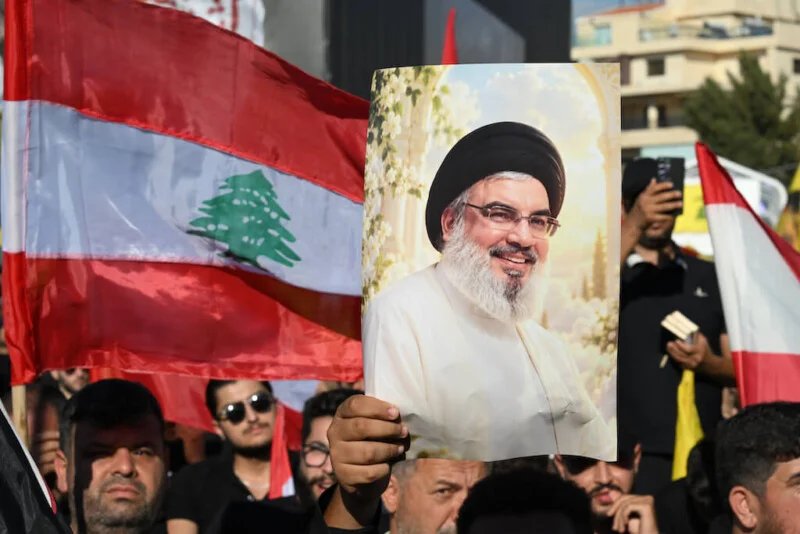
The resistance front in Lebanon
One of the most notable developments in the process of disarming Hezbollah has been the group’s growing use of the rhetoric of “resistance” not only in reference to its struggle against Israel, but also against the Lebanese government. Although Hezbollah continues to defend its weapons as a necessity in the face of Israeli occupation, it has increasingly directed its rhetoric toward the Lebanese front. By warning that any pressure aimed at disarming the group could lead to a political crisis or civil war, Hezbollah has made its opposition to the process unmistakably clear. This has also contributed to a growing emphasis on the dangers of internal discord and civil conflict.
Such rhetoric was frequently used during Hassan Nasrallah’s leadership. Although it took on a softer tone under Naim Qassem, it hardened again following the agreement with Israel, partly in response to public reaction. It has since become one of the main instruments through which Hezbollah exerts pressure on the Lebanese government.
In this context, reactions from the Shiite political camp to the Lebanon-Israel agreement emerged shortly after it was announced in Washington, with the Lebanese government directly targeted and social dynamics brought into play. Parliament Speaker Nabih Berri’s negative stance toward the agreement was reflected in his statement: “My people in Lebanon, all of Lebanon. This is sedition.” Hezbollah Secretary-General Naim Qassem, meanwhile, described the agreement as “humiliation, shame, and a surrender of sovereignty.” By placing the political crisis with the Lebanese government at the center of the debate, these statements transformed the issue into one affecting the country’s internal political balance and social cohesion.
Another factor deepening tensions between Hezbollah and the Lebanese government is that some criticism directed at Hezbollah has overlapped with Israel’s security rhetoric. Foreign Minister Youssef Rajji’s statement that Hezbollah’s weapons legitimize the Israeli occupation was a particularly notable development, as it framed the group’s armed presence as a factor providing justification for the continuation of the occupation.
In a similar vein, US Ambassador to Lebanon Michel Issa, commenting on Israeli attacks, said that a distinction must be made between the party launching an attack and the party responding to it. “We cannot simply say that Israel is attacking without remembering who started it,” he said. His remarks reopened debate over how responsibility for the Israeli occupation should be addressed. His further statement that “If you do not attack, Israel will not respond. But if you attack, Israel will respond forcefully” also risked provoking stronger reactions from Hezbollah and political circles close to the group.
This situation, in which criticism of Hezbollah’s armed presence has become intertwined with Israel’s occupation and military policies, has encouraged the group to portray itself not merely as the military representative of resistance to Israel, but also as the country’s foremost political representative in the defense of national sovereignty.
Another dimension of Hezbollah’s resistance to the Lebanese government is the country’s political fragmentation. Although there is a degree of consensus within Lebanese politics on the need to surrender weapons, differences have emerged over the methods to be used and the extent of pressure that should be applied.
In this regard, Gebran Bassil, leader of the Free Patriotic Movement, and Druze leader Walid Jumblatt favor negotiations and political compromise in the disarmament process. By contrast, Samir Geagea, leader of the Lebanese Forces, argues that dialogue with Hezbollah is a waste of time and insists that political leaders should use pressure to achieve results.
Consequently, the atmosphere of agreement around the goal of disarmament has not translated into a unified political position on how to achieve it. The agreement with Israel has proved insufficient to establish the conditions for peace, while divisions within Lebanese domestic politics have made it easier for Hezbollah to maintain its uncompromising stance.