






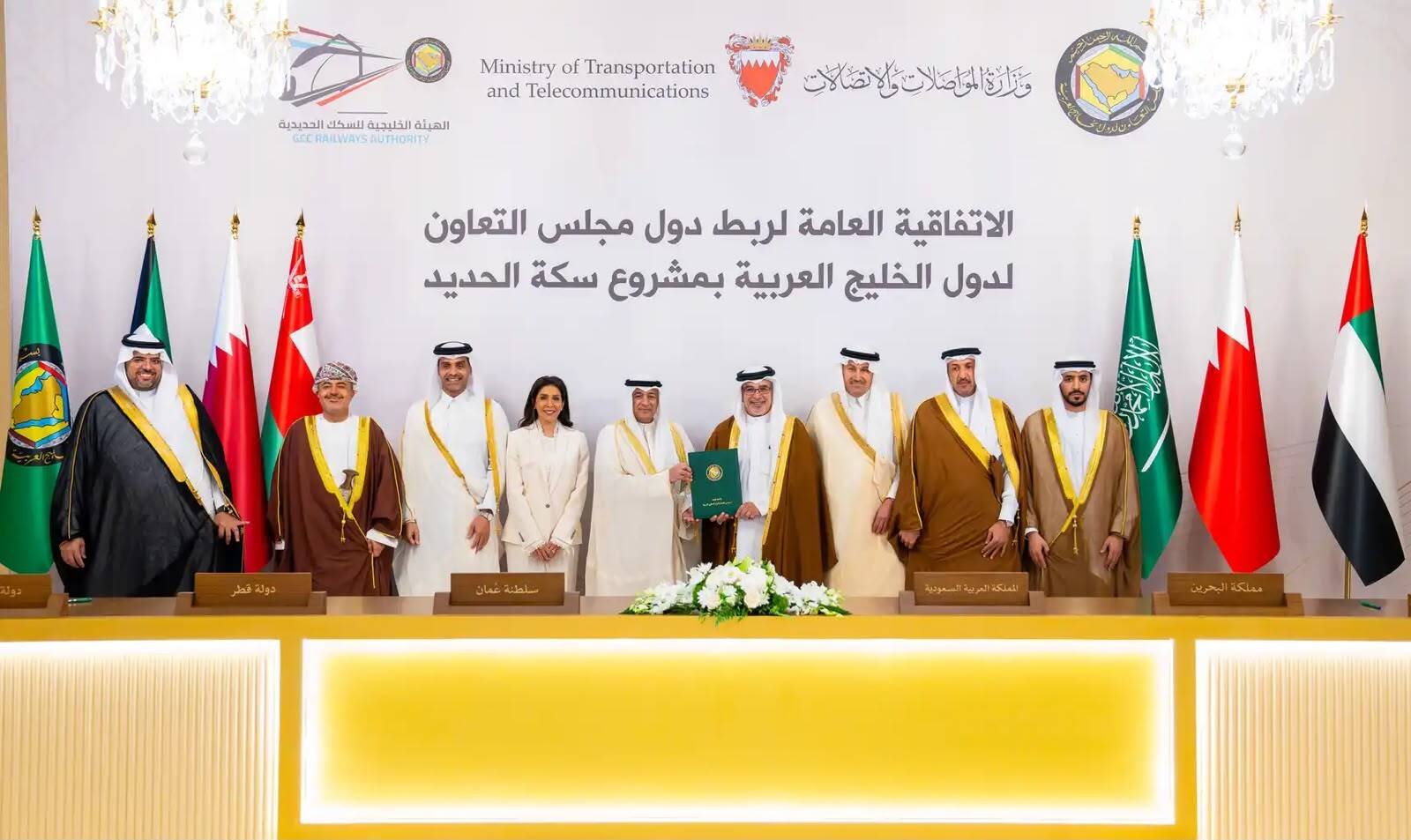
ASIA: A ‘general agreement’ to progress the long-discussed Gulf Co-operation Council Railway project to link GCC member states Bahrain, Kuwait, Oman, Qatar, Saudi Arabia and the UAE has been signed by the transport ministers of the six countries.
The agreement was signed at the 30th meeting of the Committee of Ministers of Transport & Communications of the GCC states which was held in the Bahraini capital Manama on November 8.
It establishes a framework for co-ordination between the member states and the GCC Railways Authority, with the aim of overcoming obstacles and ensuring technical and operational integration of the future network. The agreement also defines the responsibilities of each country within the project and includes a timeline for execution and operation, in addition to standardising technical and operational criteria, safety requirements, and interoperability among member states’ existing or future railway networks.
GCC Railway project
In 2009, the Supreme Council of the GCC approved the establishment of a railway network connecting its six member states, and in December 2021 it decided to establish the GCC Railways Authority to co-ordinate implementation and ensure compatibility with member states’ national railway networks. Around 56% of the planned 2 100 km GCC Railway is now reported to be in place, and completion is envisaged by December 2030.
Saudi Arabia and the UAE currently have main line railway networks, and the UAE network is being extended to Oman. Qatar has metro and tram networks, while Bahrain and Kuwait lack railways.
‘Integrated and interoperable regional network’
‘The general agreement for the GCC Railway project represents a significant step in bolstering Gulf integration in the transport sector and regulating the railway transport system within the GCC states’, said GCC Secretary General Jasem Mohamed Albudaiwi. ‘This supports the operation of a railway project linking all the GCC states as a single, integrated and interoperable regional network, thereby contributing to cementing interconnectedness and facilitating transport movement among the member states.’
The Secretary General said cementing connections between transport networks in the GCC states and diversifying supply routes are fundamental pillars of plans to protect regional economic security and ensure the continuity of trade movement and the flow of goods.
Qatar’s Minister of Transport Sheikh Mohammed bin Abdulla bin Mohammed Al Thani said the agreement reflects the commitment of the GCC countries to strengthening their historic fraternal ties and consolidating co-operation in vital industries to serve the aspirations of their peoples and support sustainable development.
Kuwait’s Minister of Public Works Dr Noura Al-Mashaan told national news agency KUNA that the agreement marked a historic milestone in joint Gulf action, and affirmed Kuwait’s commitment to implementing its 111 km section from rom the Al-Shadadiya area of Kuwait City to Nuwaiseeb on the southern border with Saudi Arabia.
Other agreements
On the sidelines of the event, the transport ministers of Bahrain and Saudi Arabia signed a memorandum of understanding establishing a framework for technical and institutional co-operation on future rail projects.
Bahrain’s Dr Shaikh Abdulla bin Ahmed Al Khalifa said developing railway connectivity with Saudi Arabia would enhance the region’s competitiveness as a hub for transport and trade.
Bahrain and Qatar also signed a MoU covering potential opportunities for co-operation in planning and developing public transport, metro and rail networks as well as logistics services. This includes exploring options for rail and road links between the countries and their integration with the GCC Railway project.
Subscribe to gain access to all news.
Already have a subscription? Log in.
Choose your subscription
Considering a corporate subscription? Contact us to find out more.