






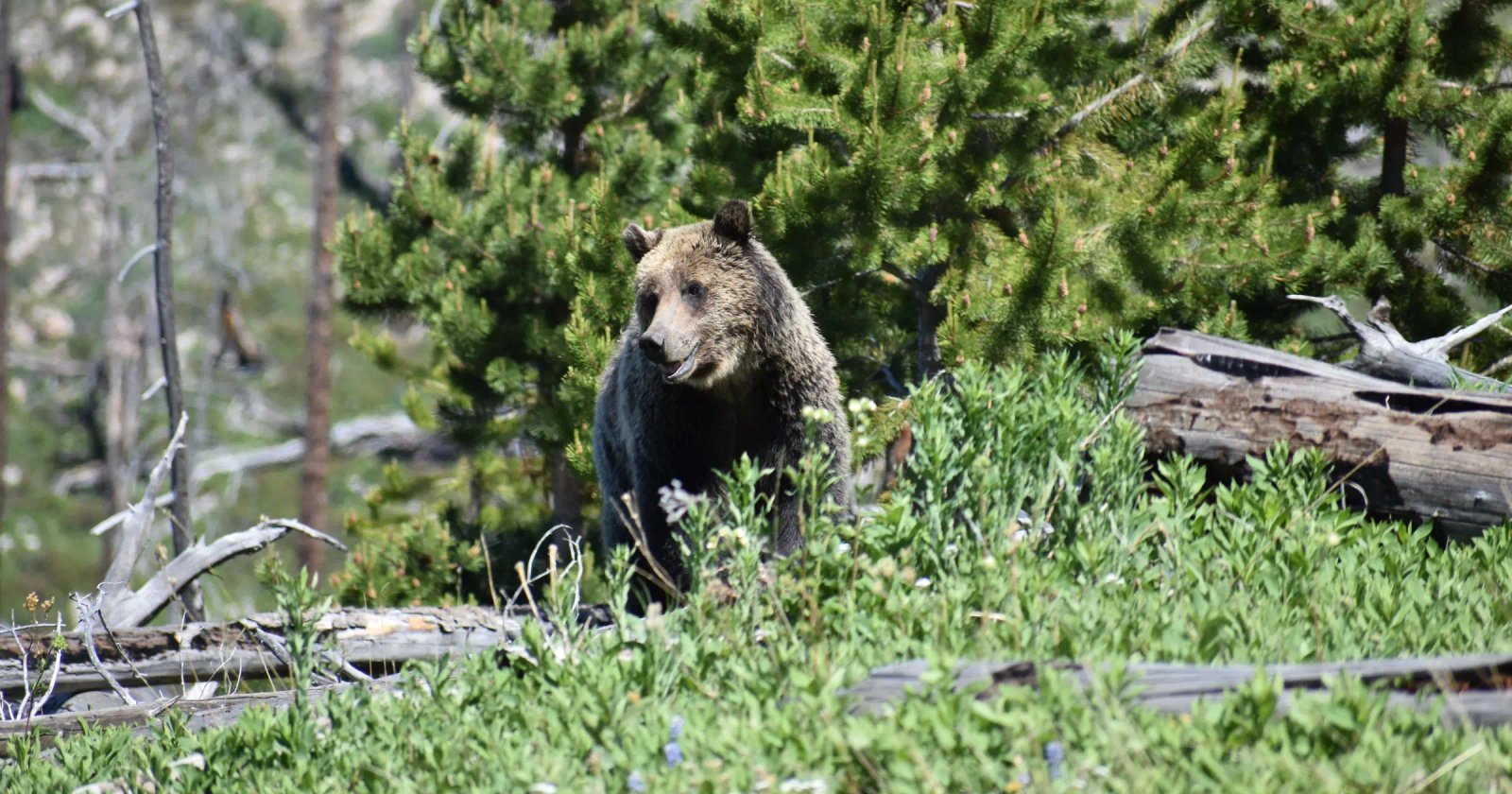
For the first time in nearly 17 months, a group of state and federal wildlife managers convened in Coeur d’Alene this week to talk about the smallest grizzly bear populations in the Lower 48 states.
The Selkirk-Cabinet-Yaak Ecosystem subcommittee of the Interagency Grizzly Bear Committee met Wednesday for the first time since May 2025 to discuss management of the federally protected bears in far northwest Montana, North Idaho and northeast Washington.
Despite the long gap between meetings – caused by a lapse in federal funding – the work of managing and monitoring bears in the region continued, and a signature achievement for the panel is marching toward the finish line.
A draft conservation strategy for grizzlies in the Selkirk-Cabinet-Yaak Ecosystem was released this summer. The feds took public comment on it, and now it is expected to be up for final approval in December.
The 76-page document put together by wildlife biologists from all three states is meant to guide grizzly management in the region long into the future, including after federal protections are removed.
It sets goals for population distribution and demographics. It also sets mortality thresholds – a maximum amount of deaths that are sustainable without harming bear numbers. The U.S. Fish and Wildlife Service estimates there are at least 120 grizzlies combined in the Selkirk and Cabinet-Yaak areas.
Mike Kuttel Jr., the eastern regional supervisor for the Washington Department of Fish and Wildlife, said the release of the draft strategy represents “significant progress.”
“To get to this point is an important milestone,” Kuttel Jr. said, adding that it would formalize the way wildlife officials across state and federal agencies work together on grizzlies.
Management changes
Similar strategies are in place for the much larger grizzly populations that live in and around Glacier and Yellowstone national parks. Work on the plan for the Selkirk and Cabinet-Yaak areas began in 2022. It was paused briefly in 2025 but ramped up again in December 2025.
The increased effort came ahead of the Department of the Interior’s announcement this summer that it was proposing a new rule to give states and tribes more flexibility in managing grizzlies.
Called the 4(d) rule, it would set up a tiered system for states and tribes to gain more power over decisions about dealing with problem bears. A prerequisite for giving those entities those powers would be having a conservation strategy in place for the grizzlies they’d be handling.
Hillary Cooley, the Fish and Wildlife Service’s grizzly bear recovery coordinator, said on Wednesday that the agency is working through more than 112,000 public comments it received on the rule. She wasn’t sure when it would be finalized, but hopes it will happen “in the next several months.”
The 4(d) proposal replaces one the Biden administration released in its final days in January 2025. It doesn’t replace the other part of that Biden proposal, which would reclassify Lower 48 grizzlies as a single distinct population segment rather than manage them as a handful of individual populations.
Changing that status was the Biden administration’s response to a court settlement with the state of Idaho. The status change hasn’t been finalized, however, and a court order calls for a final decision on reclassifying or removing protections for the bears by mid-December.
Boise State Public Radio reported last month that Karen Budd-Falen, a deputy director for the Fish and Wildlife Service, told Idaho lawmakers the administration would move toward de-listing after the final 4(d) rule is published.
The Fish and Wildlife Service has tried to de-list the Greater Yellowstone Ecosystem bears in the past. Those efforts were stopped by court challenges. A new de-listing proposal would surely draw another court challenge, and grizzly advocates see it as another fight they’d win.
Nick Gevock, a Northern Rockies campaign strategist for the Sierra Club, said the Trump administration’s pushes to increase logging, rescind the roadless rule and rewrite the travel management rule are all harmful to grizzly bear habitat, and that they’d doom any de-listing effort.
“The Trump administration has made it very clear that de-listing grizzly bears is one of their highest priorities in wildlife management,” Gevock said. “The reason they haven’t put that out is that they know all of the long-term conservation plans for grizzly bears are contingent on protecting the habitat they need to survive. Through numerous policies, they’re trashing that habitat.”
Monitoring
Once numbering an estimated 50,000, grizzly bear numbers in the West had dwindled to between 700 and 800 when they were first listed under the Endangered Species Act in 1975.
There were likely still a few bears around in the Selkirks and in the Cabinet-Yaak. But Morgan Pfander, an Idaho Fish and Game grizzly biologist, said Wednesday that there was no specific mention of bears being in the areas at the time of listing.
Since then, buoyed by conservation efforts and in part by an augmentation program in the Cabinet Mountains, numbers have increased. Minimum counts by the Fish and Wildlife Service put the Cabinet-Yaak number at over 70 bears and the Selkirk number at over 50.
The two areas were deemed separate recovery zones in the 1993 grizzly bear recovery plan. The new conservation strategy combines them into one demographic monitoring area – the zone in which biologists track bear distribution, mortality and genetic health.
The strategy identifies benchmarks that must be met within that area for the population to be considered healthy.
For bear distribution, it splits the ecosystems up into several units and sets goals for how many of them should be occupied by female bears with cubs within a six-year rolling window.
On mortality, it estimates the sustainable number of bear deaths at a percentage of the minimum counts of males and females in the same six-year rolling window. The rates were set at 9% for females and 12% for males.
Cecily Costello, a biologist with Montana Fish, Wildlife and Parks, said they want to be clear that they want to stay below those percentages, not try to meet them.
“This is considered a maximum,” Costello said. “We’re not trying to reach that value in any way.”
Those percentages would be based on reconstructed minimum counts of the population. The method combines deaths, capture data, DNA detections, sightings and trail camera photos to estimate the population’s size. Age information from bears that are counted can help them backdate some of the data to get a more accurate population number for past years.
Wayne Kasworm, a Libby-based Fish and Wildlife Service biologist who oversees grizzly monitoring in the area, said it takes a few years to get enough data to reconfigure a past population estimate. Estimated numbers he presented on Wednesday were for 2021 – 54 bears in the Selkirks, 71 in the Cabinet-Yaak.
Those estimates rely on a massive dataset Kasworm and his staff have been building for decades now. They track radio collared bears, and gather genetic data at rub sites and hair snag corrals.
It’s resulted in a massive library of information about the bears with an impressive level of detail. For example: Kasworm said this week that they have age information for more than 90% of the DNA samples they’ve gathered from bears.
Gathering the data takes a lot of work in the field. Kasworm manages crews that spend lots of time capturing and handling bears in the field. The level of effort varies from year to year, but he said it’s always going to be important.
“Keeping this kind of dataset going is going to be vital to the conservation strategy going forward,” Kasworm said.