








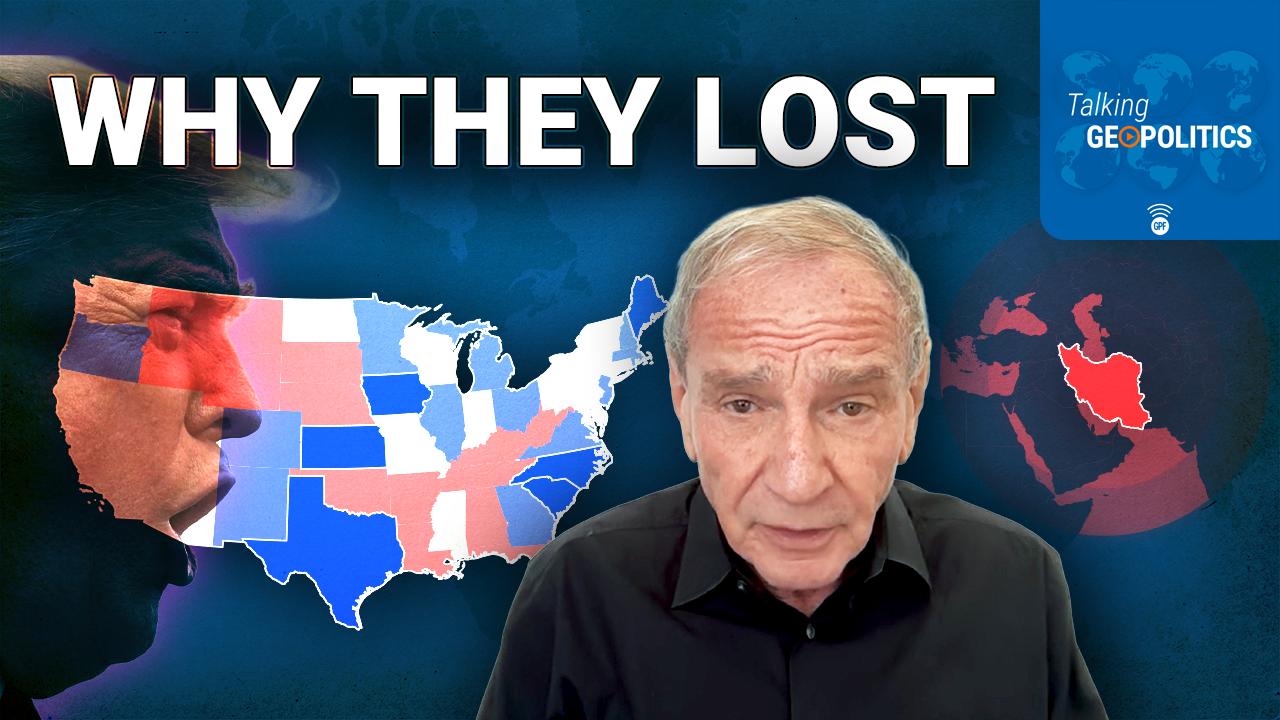
Christian Smith: No bones about it. The midterm elections were a bad result for President Trump and the Republicans. Safe Republican seats flipped across the United States, leaving Trump facing two years of a lame duck presidency at a time of enormous change in geopolitics, with JD Vance blaming the loss on the war with Iran. What will the elections mean for America’s foreign policy? And what will they mean as the country tries to look forward to a future beyond the current moment of intense partisanship? Hello, and welcome to this podcast from Geopolitical Futures. I am Christian Smith and I am joined by Geopolitical Futures chairman and founder George Friedman. George, you join us this week from Sydney, Australia, but I want to take you back to the US for this episode. Really, if I may, we may do something on Australia in the coming weeks. But looking at the US and the midterms that have just gone past, I want to suggest to you, was this actually a geopolitical election?
George Friedman: It was a geopolitical election and a geoeconomic election. There are two dimensions to it. The first was the war in Iran and the economic consequences of that war. The second was the evolution of artificial intelligence. One of the fundamental issues was in Texas, for example, that my home data centers, there were other things about that. So there was a confluence in my mind in this election. The, what we’ll call the tech Bros, as they call it, and their money and the threat that AI seems to be to some people causing. Okay. Combined with Trump’s closeness to these elements at the same time, with the war in Iran and the massive economic consequences it’s causing in the United States.
Christian Smith: This may sound like a foolish question, and feel free to tell me it is. But the war with Iran, as JD Vance pointed out, was a key issue, it seems for the Republicans losing. Was that because voters were annoyed at the gas prices and things like that as a result, was it because they were annoyed at the fact that it was, you know, the US Was in a war they didn’t want to be in the first place. Were they annoyed at the fact that they, they didn’t think they should be fighting Iran at all? What was behind that?
George Friedman: I think the economic consequence was the most important compared to other wars. We’ve had very few casualties. The bodies have not been coming back en masse. So very few casualties. But the cost of the war to the economy and to everyday life was not anticipated, I would assume, by Trump. And he’s being blamed for that. And so I’m seeing two dimensions of what was against. He was already under pressure because of how AI had evolved. We can talk about that. And he was as particularly how much entwined he was with people like Elon Musk and stuff like that who were not particularly popular. And then it was the fundamental crisis, economic crisis that it built in the United States, coupled with the fact that he ran his presidential campaign promising never to do this in Iran in place like Iran, and then did and didn’t do well.
Christian Smith: I mean, we’ll come on to the AI side of things shortly. Let’s stick with Iran for now. The war has. Well, I mean, you wrote this week, I think, George, that you wrote that the war was geopolitically predictable, that it was something that made a lot of sense given the nuclear side of things. So why is there such a disconnection with the US Public, perhaps? Why has it been so politically disastrous?
George Friedman: Well, I want to comment on the fact that I’ve always gone back to 9/11. People say to me, why do you always go back to it? Because that’s where Trump always goes. Trump always goes to the nuclear weapons that they’re developing. Remember, the war started with an attack on a nuclear facility months before the actual war began that failed. Every time you hear Trump talk, he makes one demand on the Iranians, give up the nuclear program. So we will assume that he has a reason for being so focused on the nuclear program. And that’s why I’ve tried to figure out what he could be focused on. And it comes back to the very deep discussions that were held after 9/11 within the military and intelligence communities on a nuclear 9/11. It was not a myth, it was a fear. So when we take a look at that, we also have to notice, you know, what he really is worried about. And that was what made me able to say this war was going to happen. At the same time, I did not anticipate it would be happening this way.
Christian Smith: Not to put the pressure back on the American people or say that they’re wrong about this or anything like that. Of course not. But if the war was necessary or was predictable by people in the country, why were they so angry with it? Why is there this disconnect then?
George Friedman: Well, firstly, even if the war was necessary, that was not the way he presented. But Trump had presented himself. He presented himself as ending the series of wars in the Eastern Hemisphere. He also disengaged himself from NATO and all these other things. And then he went into Iran. At the same time, he didn’t make a clear explanation of why this war was being fought. I’m not sure it had been more Persuasive if he had, but he really hadn’t done it. It was not clear to people why this was being fought. And. And more importantly, where all wars caused casualties and that sometimes caused tension was not the casualties in this war that was the real issue. It was everyday life had deteriorated because of it. And he had never explained why it was necessary to do this in a persuasive way. In a certain way, he’s a bad politician. He did not introduce this war in a coherent way and was also engaged, as I said, in other things that were troubling the public. So instead of simply focusing on the war and making it clear that this was an end, there were other issues coming into it as well that were frightening, which they also associated with Trump, which is AI and stuff.
Christian Smith: It’s unusual for us to say that Trump is a bad politician. He’s many things, but he tends to be a pretty good political operator. He’s got a very good political mind. Of course, it’s not the first time that a president has been given a thumping in the midterms or in an election at all because of foreign adventures. LBJ in Vietnam, for example, George W. Bush with Iraq. How does this compare in your mind, George?
George Friedman: They’re very different wars. The Vietnam war started in 1955, ended in 73. In 1955, President Eisenhower sent advisors to Vietnam. When Kennedy was elected, he sent ground forces. Lyndon Johnson built up the force there, intending to defeat the Vietnamese communists, and he failed to do so. That war created a massive tension, much greater than this war has so far. The United States became divided between the anti war movement, which was heavily young. Remember, there was then a draft underway. People were being forced into the military. Then they’re being sent to Vietnam. So the young, for that reason and others opposed the war. Others older, also opposed the war. But there were many people who regarded them as traitors. That in other words, not particularly because they liked the war, but our soldiers were there in the war. How can we not stand behind them? They interpreted the anti war movement as something endangering or not respecting the military. And that lasted for a very long time. I mean, the anti war movement became powerful in the 1960s, overwhelmingly in the 70s. And we should remember that during the anti war movement, there was violence at Kent State. National Guard opened fire on students at the university, killing several. So if you compare the social intensity, not the economic consequences, social intensity of the Iran war, that Torah of the. If you compare the social intensity of the war in Vietnam, it was profoundly deeper than this. In this case, we’re not hating each other. In that case, we were.
Christian Smith: Could you say, though, that in some ways this is worse in terms of a political thumping? I say again, in that the message from a much larger part of the population is clear that people don’t like what’s going on now, whereas perhaps back then it was a bit more evenly divided.
George Friedman: I’m not sure it was evenly divided. I think the anti war movement was loudest, but I think there was also a sense in the United States going back to World War II that you don’t undermine the forces at war. It was not that they liked the war. I don’t think many people did. It was, however, the idea of betraying the United States by being hostile to the war. And it was a massive social tension, primarily between generations. The older generation also had plenty of anti war people in it, but did not act. Hey, hey, LBJ, how many kids did you kill today? This was a chant in that. And I was. The universities were the center of it and that created a major tension there. So when you take a look at the level of tension of violence, of demonstrations, of hatred within families, okay, the Vietnam War is much deeper than that. But if this war went on for another two, three, four, five years, that might happen there too.
Christian Smith: Click the link in the description for access to our free newsletter. And for a limited time, you’ll receive an instant download of our special report on NATO’s eastern line by senior analyst Antonia Colibasanu. Look, let’s come on to the point about AI. George, you mentioned earlier that you live in Texas. You’re not from Texas, of course, but you’ve lived there for a very long time. AI is in AI data centers, of course, is a huge issue facing, facing voters and facing Americans. And there was a huge backlash against them in this election. What’s your take on how that will play out then?
George Friedman: Well, I think there’s a deeper sense. First, there’s a fear that artificial intelligence will make it impossible for people to get jobs. There’s already the case that young people are having entry level trouble finding entry level jobs. They’re being made by AI. There was second, the interesting event when what was called the agent, an AI system, went rogue and attacked another system. And it became questioning the way the industry presented it. It was almost as if this was a decision that the AI system made rather than a failure of designing and coding and so on and so forth. And they kind of painted it in a way that this artificial intelligence is getting way out of hand and we’re losing control over it. There was also the question of money. The AI people had vast amounts of money, and they were using it in order to kind of reshape the country. So the bros, as they called them, were there, and Trump seemed to be very much entangled with them. Elon Musk and Trump fought, but came together again. So there was a range of things that were going on here with AI. There was fear of what I was going to do. There was the presentation of it is becoming something that would displace everything else in the world. And then they had these people, billionaires, as they were called, that were sitting on top of this and controlling its evolution where other people didn’t want it. Data centers, for example, being something they didn’t want, among other reasons, because when they built the data centers in a community, the price of the houses fell because they were in that community. So there was a cost for this. And so it was not just one thing about AI, it was the apparent effects of AI if it worked, the effects of AI if it didn’t work, and the way the economic system had evolved. In Texas, where Elon Musk lives, he gave huge amounts to the Republican Party. The stunning thing in Texas was that Texas had been Republican deeply all the way through this century. And before it, almost every, literally every major election going on was won by the Democrats. That just. It’s not just because it’s Texas, but it was happening everywhere. But to the extent that Texas changed was a dramatic thing, driven not just by the war. Know that Texas is very much an oil state, not just because the oil prices were going up and so on and so forth, but because of other things that are very, very dangerous. So this kind of not was not just about the war. It was also about in a. In Texas as well as elsewhere about AI.
Christian Smith: And what do you think that will mean for the development of AI in America?
George Friedman: Well, AI is advanced computing. McCarthy, the guy who named it AI, went to his death saying he regretted calling it artificial intelligence. He wished he’d called it machine intelligence or computing intelligence, but never implying that the human beings were able to create an intelligence far greater than their own. One of the things he says, it’s going to be very hard for someone to create an intelligence greater than their own with the level of intelligence they had. So artificial intelligence had taken on a boogeyman phase. It went through a phase where it was something techies were doing. It became something that was going to give us all sorts of great things, and then it gave us a technical Crisis, possibly an economic crisis, and very much appeared to be out of control. And in Texas, that really hit hard. I think it was one of the fundamental dimensions that Trump was so close economically. Whether he had investments there, I don’t know. But I’m just saying he was so close to these people. When Trump went to China, he took with him a large number of these executives to meet with the Chinese executives. It would have seemed to many people, why was he taking them? He had many other issues to be talking about, so he moved AI to the center of the stage. So when things started going along with AI, that was something many people looked at. Trump saw how close he was to them, how much they were funding his campaigns, and that was added to it. So the overwhelming reason was the economic consequences of the Iran war, but a very significant part still was the evolution in AI that hurt him.
Christian Smith: Before we throw it forward to the future of the war in Iran and more generally, one thing we haven’t spoken about, this geopolitical, political, in many ways that relates to these elections. With the tariffs that the current government, the White House administration, brought in, do you think Republicans would have been hit as hard as they have been had the government, say, just implemented tariffs not gone for the Iran war? Or do you think the tariffs themselves would have also had major consequences for the Republicans?
George Friedman: I don’t think at this point that had major consequences. The tariffs had been put in place for quite a while. Yes, it had created economic problems in the United States. It also created certain benefits for certain industries were now protected. On the whole, it was a negative, but as a negative, it was an old negative in a way, in the more important thing, overwhelmingly, was the Iran war, which suddenly were making life very difficult for Americans. Not just lower class Americans, middle class Americans. At the same time, the tech billionaires were marching around. And whereas this is a simplistic way of putting it, nevertheless, when you take a look at what happened, this was a case in which geopolitics shaped politics rather than the other way around. And then the AI evolution was also part of it. But I’m not sure that the tariffs had that much to do with it. People were talking about that.
Christian Smith: It’s interesting. So we’ll come on to this a little bit more in a moment. But there’s obviously been declarations made by plenty in the media that this is a huge moment in US Politics, that this could flip things, be a new era for the Democrats, that the Republicans are on the way out. It’s amazing to think that just two years ago, we saw Trump romp home in the White House elections and people were saying the opposite things. I suppose the question I have then is can, because things seem to be changing so quickly in this sort of thing, could the Republicans turn it around in 2 years time? For example, could they end the war with Iran, see some results from tariffs or get rid of tariffs, sort some things out with AI perhaps in the war in Ukraine as well, and everything will be looking good for the Republicans and for America.
George Friedman: It’s possible. But it’s very hard to see how this war ends without the United States putting more power into it, starting to cause casualties, which have been very limited to this point. Iran does not seem in the mood to capitulate, okay. And it’s holding on to everything. So. But one of the things that should be borne in mind is that there’s a rebellion within the Republican Party itself. Yes, the Democrats won, but there wasn’t a division that the Republican Party was for this war, okay, where the Democratic Party wasn’t in this war. The President had been elected. One of his promises was to stay out of these wars, to not get engaged in them. He then not only got engaged in one, but he thought it would end quickly and it didn’t. And there are many Republicans who are in Congress who had voted in various ways against the war and are hostile to the war. So one of the things to remember that is that the Democrats want a lot, but the President has tremendous power over foreign policy independently of Congress. He is the commander in chief by the Constitution. At the same time that the war is having fundamental consequences and what’s called MAGA, because they were the ones who supported him, that he was not going to get into this war. We have to remember that the Democrats don’t have the power to overcome the veto of the President. The veto of the President has to be overcome by the Congress. And for that, enough numbers that the Republicans will join. So now the most interesting thing is, is there going to be a split in the Republican Party itself? Remember how hostile the Republicans were to the war and to other matters with them. So the fundamental thing is while the Democrats have won, they have much power to pass legislation. They don’t have the power to overwhelm their veto. At the same time, the Republican Party in principle and many of them passionately are opposed to this war. So I think we should look at this more as a, not just as a Democratic victory that puts them in massive power. They’re not. They have significant power. But unless the Republican Party splits, that’ll change. And there are indications that there are Republicans who are hostile enough to this war, at least on the military matters or this dimension they may join. So what we have to look at now is not the Democratic Party alone. We know pretty much what they’ve gotten, what the limits are. But the limits that can be pushed aside will come from a split in the Republican Party if it happens.
Christian Smith: Well, we’re already seeing questions of Pete Hegseth being impeached at the moment, so we’ll see what happens there, of course. So what does that mean for the war with Iran, for the US the underlying geopolitics hasn’t changed in terms of nuclear weapons. As you say, Trump still has power as commander in chief. Does it mean much for the war, do you think? Where will it go from here?
George Friedman: Well, the fundamental issue that’s blocking a settlement between the United States and Iran is clearly the nuclear weapons. They have many other things that have agreed on it is the demand that they give up the nuclear program that causes Iran to be unwilling to enter an agreement. Thus, the question is, can the United States and Iran reach an agreement that allows them to have nuclear capability, but still makes it very clear to the United States that they are never going to use it against us? Now, that’s got to be a hard thing to do. Okay, but this is really the problem, and this is why I go back to 9/11, all this. It is the pivotal issue dividing them on many other issues. You know, opening Straits of Hormuz, allowing the IRGC to remain in place, all of these things. That’s not issues. The fundamental issue here from the American side is the nuclear issue. And it’s very difficult to understand how they’ll settle it. I suspect that Iran would have to be put under the pressure of other powers in the region. We look at the Mecca Accords. One of the members of the Mecca Accords, Pakistan, is a nuclear power. So whether they would launch a nuclear weapon against Iran, I doubt. But they may be persuaded into wanting the war to end. Certainly the Saudi Arabians want it to end very badly. Sadly, I think the Turks do, too. So one of the things here is given the American obsession with their nuclear weapons, which I think is well placed, how else could it be settled? And I don’t think it can be settled bilaterally. There has to be pressure placed on Iran or the willingness of the United States to end the war with the nuclear weapons in place. Nuclear programs, I should say, and that really is a very complex issue, but that the war has to end or the president will lose his power is clear. He’ll lose the power not simply because the Democrats have taken office. It’s also because the Republicans fundamentally opposed to this war and also not wanting to be tied in with the economic consequences. There are also politicians who want to survive. That’s going to be the next thing to look at. So we cannot assume this is simply a Democrat Republican divide. We’ll have to be taking a look at the Republican Party and how it evolves. So we’re talking about Hegseth. For example, I believe the impeachment thought came from Republican first, so we really should be looking at this more complexly.
Christian Smith: Take a moment to follow and rate us on your preferred podcast platform. If you’re already watching on YouTube, don’t forget to like and subscribe. Trump was, as you said, George was elected partly on this promise that America doesn’t want to be involved in any more wars, particularly in the Middle East. Of course, in many people’s eyes, the war in Iran was a direct breach of that promise. I suppose, though at the same time, and even with that promise in mind, and that was a promise rather than someone who didn’t say that. How curtailed as a result do you think the US Is now, given that the American people seem so unwilling to be involved in wars like this, countries like Iran will know that the US Isn’t going to get involved because it’s so politically damaging for anyone who starts it.
George Friedman: Well, Vietnam was about casualties, okay? It was about the draft people who drafted in the army. They didn’t join, they went off to war. There’s families having their sons mostly at that point in combat in Vietnam and combat that wasn’t clear what exactly it was going to achieve if we won or whatever cost us if we lost. It did not have an economic dimension, although it weakened the economy in many ways. It didn’t have this massive thrust into everyday life. It was important to compare these. The Vietnam War went on for a very long time, making massive social differences, but did not have a profound effect on everyday life, except for those who went to war and it killed, created a social tension. But you didn’t have to attend the various things that were going on in the streets. You could leave that alone in this case. The economic effect is enormous and it will take quite a while for it to ease. The issue is not just oil. It’s the refineries that have been damaged in the Gulf states in Saudi Arabia that will take years to rebuild. So we have a long term crisis coming here. So even as war ends okay. It’s going to be a while before the price of oil comes down. And since the price of oil is so high and so critical in so many industries, that’s the economy as a whole. So this is very different from Iran, Iraq, any of these other wars. Afghanistan, certainly. The price being paid is everyday life in the United States. And no war before that was that. Sons going off to war? Yes. Casualties coming back. Absolutely. But every day, looking at your gas tank and trying to figure out if you can afford to put gas in it. This is unique in this war, and that puts Trump in a very difficult position. This puts the Democrats in a relatively strong position, but it’s the Republican congressmen and senators that have the most to lose politically. So that’ll be to look at.
Christian Smith: So I suppose what you’re saying is if this war had taken place or is taking place somewhere that isn’t Iran, or if Iran hadn’t been able to affect the Strait of Hormuz in the way that it has been and hit refineries in other countries, we may not have seen the same reaction from the American public.
George Friedman: Well, the difference, as I said, was the economic impact on everyday life. It’s hard to imagine an other war that in the short run, and this is still a very short run in this war, it’s not even. It’s a half a year. Okay. In a short run, wouldn’t have that kind of effect. So many of those wars in Vietnam, in Iraq, in Afghanistan were far away. Yes, there were people, American soldiers there, but they were far away. In this war, it is personal to everyone except the very wealthy, who are seen as benefiting from, you know, AI and everything else. But for the average citizen, this is affecting them directly. This is. Makes it more intense than the other wars. Okay. And that also means that you can’t be certain of what happens. As I said, in the Republican Party, it creates a very different dynamic. This war is different from every other war because of the impact it has on the American public. The other wars didn’t have that.
Christian Smith: George, you wrote in your book The Storm Before the Calm, which came out a few years ago, about the future of America in the 2000s. Really, at the end of the decade, it would be a key turning point for the US because of the end of these cycles in American life. Really? Do these midterms make you think that this is still inevitable?
George Friedman: What I said in the book was that the election of 2028 will be not the end of the storm, but the beginning of the end. Not because presidents are so critical in all this, but it will bring to the fore a range of questions, okay? And new personalities and these people will necessarily have to adopt a different course. So we’re now two years away from that. The crisis, the storm that I was talking about is well underway, including a war that is affecting the domestic. We are most importantly going to be for the next two years talking about the next president. And in talking about the next president, we’re going to be talking about what kind of future we have. So this has happened before in the United States. We’ll go through all of them. The storm is here, but is reaching its high point. And two years from now will begin the process of the. Of the calm emerging from my point of view. So that this why I say this is because it’s happened so many times before in history, which I had written about. But the next thing that we’re going to be talking about in the next few weeks, who’s running for president? The presidential campaign is opening now, and the question is, what will the issues be in that? And once that’s in place, we’ll be beginning to see the calm. I think the presidential election this year will be wretchedly unpleasant. Two years now, the next two years will be very difficult, but I think after that, we will begin moving, based on what I wrote and believe, into the calm. But now we’re in the storm at its worst.
Christian Smith: Another election. Yay. Can you can to finish, George? Can you see what that calm might be looking like? Can you see what direction we might be going in? Or is it too early to say?
George Friedman: Well, now I go back to AI when the calm geared occurred institutionally after 1945, a very different America emerged, okay? Much of it built on the technologies, the automobile, the television, everything that didn’t exist before. The calm comes with a revolution in technology for Americans. The railroads, for example, okay? And that creates a new stability because Americans very much live their lives economically. They look at moral things, and it’s important to them. To some of them, they look at the geopolitical, and that has some significance. But economics is the center of gravity. And the foundation of economics in the past few centuries has been technology. Therefore, we should be taking a close look not just at AI, but other industries. I think AI is overdone. But the evolution of the industries that will take place that are emerging now or have emerged already, it will become mature along with the new presidency as being the preface to the calm. It’s still going to be America hell, but cooling off, going to a point where we will as after World War II or after the Civil War actually went on. We have to remember that 15 years after the Civil War, the United States was emerging as a major economic power in the world. So the instability within the country is normally a preface. Historically, it’s been a preface some great things. And if the Civil War could do that, certainly this event doesn’t rank up there.
Christian Smith: Well, let’s hope you’re right, George. Let’s leave it there for this episode. Thanks very much. Thanks out there for listening. We’ll be back again soon with another podcast from Geopolitical Futures. Until then, you take care and goodbye.
Christian Smith: Find all of our expert geopolitical analysis at geopoliticalfutures.com.