


Formula 1 returns to Las Vegas this weekend for the fourth running of the race on the Strip, a glitzy, high-speed showcase built around the city’s famous boulevard.
But this is not the first time F1 has landed in Sin City, known as such for its casinos, nightlife and quickie weddings.
The previous attempt, more than four decades ago, is remembered for what is considered one of the worst circuits in the championship’s history.
Some venues earn their place on the calendar and stick around. Others never win hearts at all.
Modern tracks such as Miami, Madrid and Abu Dhabi draw plenty of criticism, but none of them come close to the lows Formula 1 reached in the past.
Zeltweg, AVUS, Dallas, Nivelles-Baulers, and Las Vegas all rank among F1’s least-loved layouts.
Not the Las Vegas Strip Circuit that has hosted the race since 2023, but its predecessor: the Caesars Palace Circuit.
Anyone familiar with Las Vegas will know Caesars Palace as a hotel and casino. It would be reasonable to assume the circuit wound through the streets around the building. It did not. The track was laid out entirely on the casino’s car park and an adjoining stretch of vacant land.
[Article continues below]
Money talks
How did Formula 1 end up racing around a car park? The answer lies in a mix of financial and political factors.
For years, Watkins Glen had hosted the season finale, but the circuit ran into money troubles and could no longer meet modern safety requirements. It dropped off the calendar after 1980.
A replacement was needed, ideally one with the financial muscle to cover the steep cost of staging a grand prix.
Caesars Palace saw an opportunity, partly to polish its image and partly to lure wealthy visitors to the resort and its casino floor.
The original plan was for cars to race along parts of the Strip itself, much as they do today. That idea was dropped because Caesars Palace did not want to hand a promotional boost to rival casinos nearby.
Instead, organisers settled on the large car park behind the hotel, together with some adjacent open ground. A layout was drawn up, and the temporary circuit was built.
[Article continues below]
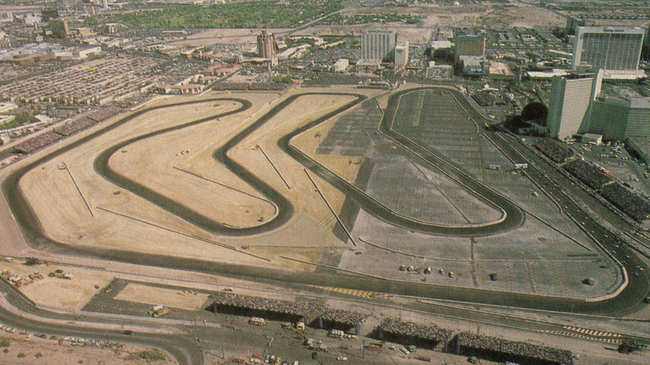
© Yoyodu10 via Wikimedia Commons
A grey, featureless loop
What could possibly go wrong? This was Las Vegas, after all, and the hosts were not shy about spending money to make a spectacle of it.
Yet the Caesars Palace Grand Prix was doomed almost from the start, and it duly flopped.
The first problem was the layout itself. A car park does not make an iconic circuit, and this one certainly was not.
The track was flat as a pancake and utterly uninspired, little more than a string of near-identical corners joined by two straights, all set against a grey concrete backdrop.
The races were also held in the early afternoon, in blistering heat. To make matters worse, the circuit ran anticlockwise, against the direction most tracks favoured at the time.
Drivers suffered badly for it, battling physical discomfort, nausea, and in some cases fainting behind the wheel.
[Article continues below]
Title deciders
Was there anything that made the race worth watching? As it happens, yes, though it had nothing to do with the circuit itself.
Both editions of the Caesars Palace Grand Prix doubled as the championship decider.
In 1981, it was a genuine three-way fight between Carlos Reutemann, Nelson Piquet and Jacques Laffite. With 49, 48 and 43 points respectively, all three still had a shot at the title.
Reutemann held the strongest hand, starting from pole, with Piquet fourth and Laffite down in eleventh.
But Reutemann’s Williams developed gearbox and handling problems during the race, and he slid steadily backwards through the field.
The Argentine finished eighth, outside the points. Piquet had no great race either, but a fifth place was just enough.
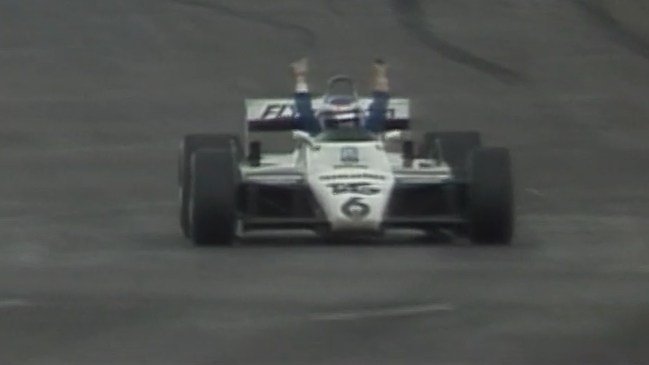
By a single point, 50 to 49, Max Verstappen’s father-in-law claimed the first of his three world championships.
[Article continues below]
The worst ever?
A year later, the title was settled in Las Vegas again. This time three drivers were still theoretically in contention: Keke Rosberg on 42 points, Didier Pironi on 39, and John Watson on 33.
Pironi was absent, having broken both legs in a horror crash earlier in the season that ended his career.
That left Rosberg and Watson to fight it out. Watson needed victory and a scoreless day for Rosberg. Neither happened.
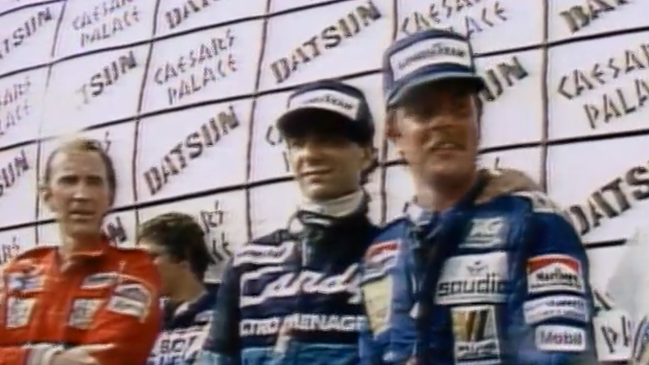
Watson finished second, Rosberg fifth, and the Finn became the first from his country to win the F1 drivers’ championship, arguably one of the most unexpected champions the sport has produced.
Those title fights were not enough to save the Caesars Palace Circuit’s reputation.
More than four decades on, it is still widely regarded as perhaps the worst circuit Formula 1 has ever used, a dubious distinction unlikely to be taken from it any time soon.
Thankfully, Formula 1 now races on the Strip itself. The current Las Vegas circuit is far from a textbook classic, but it remains a vast improvement on what came before.