









The Australian Defence Force is preparing for changes in how it develops and integrates space, cyber and joint warfighting capabilities, with increased emphasis on data-centric operations, hyperscale cloud infrastructure and greater industry involvement in solving technical challenges.
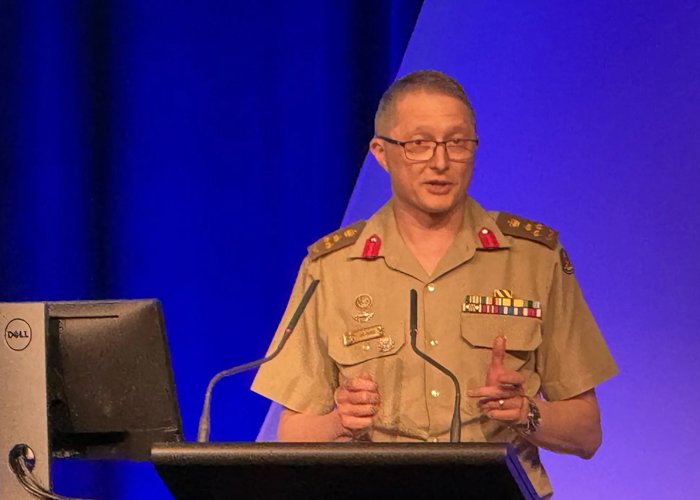
Speaking at MilCIS 2026 in Canberra, Brigadier Leslie Juckel, Acting Head of Space and Cyber Capabilities within Joint Capabilities Group (JCG), said “data centricity” could be a more fundamental development for Defence than artificial intelligence.
Juckel also confirmed organisational changes within JCG, including expansion of the Space and Cyber Capabilities Division to incorporate joint logistics projects from January 2027. The division will be renamed the Joint Capabilities Division, with Air Vice-Marshal Ben Sleiman, currently Deputy Chief of Joint Capabilities, to assume responsibility as Head Joint Capabilities.
The restructure brings space, cyber and joint logistics capability projects under a broader organisational framework, reflecting interdependencies between operational domains and supporting infrastructure.
Juckel said Defence’s approach to space and cyber is grounded in multi-domain warfare doctrine, which treats military operations as extending beyond traditional land, sea and air domains. He said cyberspace includes command and control systems and the electromagnetic spectrum, in addition to offensive cyber and defensive network protection.
Within this framework, JCG is responsible for delivering core cyber and communications infrastructure supporting the integrated joint force, while the individual services retain responsibility for their operational systems. Juckel described this as a “core and edge” approach, where JCG provides the central network environment for organisations such as Headquarters Joint Operations Command and joint task forces, with connectivity extending to operational systems across the services.
A central component of this architecture is Joint Project 9111, linked with Defence Project 2222, under which Defence is working with Google and Defence Digital Group to establish a hyperscale cloud network environment. Juckel said Google is supporting delivery of the underlying network infrastructure, but the operational applications that will run within the environment remain open for development by Defence and industry.
“Importantly, 9111 is providing the network environment, but not the application sets from Google,” he said. “We will look to industry and other parts of Defence as to how we will build that.”
Juckel said Defence would need to engage operational users and industry partners to determine application requirements across headquarters functions, including intelligence planning, operational planning and logistics support. He said the development of these application sets remained an open discussion and encouraged industry participation.
On future operations, Juckel described a data-centric architecture in which information is tagged with relevant security and access attributes, allowing data to move through networks according to the credentials of authorised users. He contrasted this with traditional network-centric architectures, where information movement is governed primarily by network classifications and gateways between separate environments.
“A lot of people go straight to AI, and certainly AI will be a game changer for us. But for me, the area that I’m really keen on developing, and an area that I think will change the way we do business, is data centricity,” he said.
Juckel said the shift would require policy settings and supporting technologies and could have operational implications for the movement of information between central command systems and forward-deployed platforms. He said effective data centricity could improve the speed at which information moves in support of command-and-control functions and targeted fires, but that work remained to determine how Defence and industry would collectively develop the technical and policy arrangements needed to operationalise the approach.
Juckel also highlighted challenges in Defence capability acquisition where rapidly evolving technologies are delivered through traditional procurement processes. He questioned whether conventional waterfall development models and rigid systems engineering requirements were appropriate for complex digital capabilities, noting technology can change substantially between initial requirements definition and delivery.
He also raised dependencies between projects and organisations as a factor that can delay delivery, and questioned whether firm fixed-price contracts provide sufficient flexibility for programmes requiring continuous development.
Another priority, Juckel said, is shifting focus from strict compliance with individual technical specifications towards achieving operational outcomes approved by government. He said Defence should consider alternative technical approaches where suppliers can demonstrate required outcomes would still be met.
“If my vendor can tell me that they can meet my end state and bypass 20, 30, 40 specs, great,” he said. “Give me the OQE, the objective quality evidence. I will waive and deviate those specs to meet my end state.”
Juckel identified workforce availability and technical specialisation as continuing challenges for Defence and industry, including competition for skills in cyber security, cloud infrastructure and advanced technologies. He said Defence needs to determine the balance between uniformed personnel, Australian Public Service employees and industry partners, particularly where specialised expertise is required.
He also distinguished programme and project integration—coordinating stakeholders, dependencies and organisational responsibilities—from the technical task of integrating individual platforms, and questioned whether these functions always need to be performed by Commonwealth personnel. He pointed to Joint Project 4140 as an initiative of interest as a potential model for programme integration partnerships.
Juckel said Defence increasingly recognises limitations in its internal technical expertise in specialised and fast-moving technology areas. “We in uniform, and I certainly do not know more than industry,” he said, adding that Defence should engage more openly with industry specialists during development of capability requirements.
“I would like to open our aperture to all of industry to help us solve problems,” Juckel said.
The presentation outlined an evolving approach to Australia’s joint space and cyber capability development, with emphasis on secure information movement, cloud-based infrastructure, flexible procurement and collaborative capability design. It also pointed to wider implications for Defence’s ability to resolve policy and technical challenges associated with data-centric operations, manage dependencies between major projects and develop procurement arrangements responsive to technological change.
Source: Brigadier Leslie Juckel, Acting Head of Space and Cyber Capabilities, Joint Capabilities Group, presentation at MilCIS 2026, Canberra, 18 November 2026.