









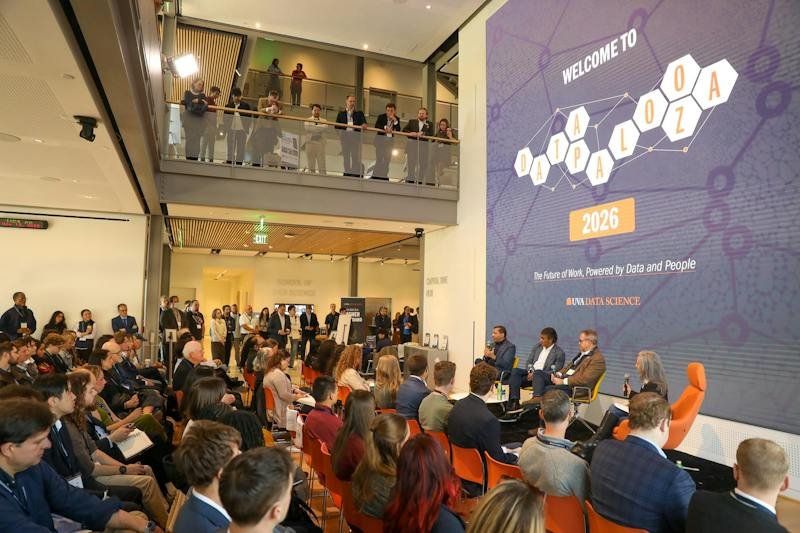
The School of Data Science hosted its 12th annual Datapalooza Friday, bringing together industry professionals and professors to share insights about the field of data science. Launched in 2015, the yearly event showcases research and industry trends and seeks to foster collaboration in data science. The event was open to students, staff and industry professionals.
Jeffrey D. Blume, interim dean of the School of Data Science, opened the event with a speech introducing the event’s theme — “The Future of Work, Powered by Data and People” — then moved to themed panels and breakout sessions with industry professionals discussing topics in their professional niche. The event had roughly 300 attendees, according to Emma Candelier, director of marketing and communications at the School of Data Science. The panels and breakout sessions offered attendees the opportunity to ask panelists and speakers questions.
In his opening speech, Blume discussed how the overall workforce is changing in the age of artificial intelligence. Broadly, he said that the workforce still demands individuals who have soft skills working with technology.
“We need people who can bring their creativity, their expertise and their sound judgment to bear on problems that technology can’t solve alone,” Blume said. “This is a responsibility that we take seriously here at the U.Va. School of Data Science. Our work is grounded in rigorous inquiry, thoughtful judgment and a commitment to making a meaningful difference in the world.”
The keynote panel featured Arun Gupta, chief executive officer of the NobleReach Foundation, Scott Stephenson, founder of SGS Capital and Class of 1979 alumnus, and Reggie Aggarwal, founder and CEO of Cvent and Class of 1991 alumnus.
Gupta said that AI is requiring workers to focus on critical thinking — he said that while schools teach students to find the right answer, the workforce wants people to ask the right questions. He also said that someone’s “EQ” — emotional intelligence — is what will differentiate them from other clients. He said AI can beat humans in expertise, but AI does not have the ability to influence others and understand power structures.
Agentic AI — AI agents that can make decisions in a way a human might and can help humans make better market decisions — is the future of corporate investment, according to Aggarwal, and knowing how to build an agent will be key to getting hired in the future.
“I was talking to a friend of mine who’s an investor in AI companies in [Silicon] Valley … and he told me, ‘When we hire people, we don’t just hire the person. We hire them and their agents,’” Aggarwal said. “[Firms are] not hiring [you]. They’re hiring [you] and the agents that [you] built.”
After the panel, attendees heard from speakers about leadership, careers in data science and innovation. Janaya Brown attended “How Do You Become a Data Science Leader?” — one of the breakout sessions. She said she heard about Lexi Reese, chief executive officer of Lanai and class of 1996 alumna, and that what stuck out to her was Reese’s company’s focus on integrating AI systems.
“It’s not just getting [AI] in [a] system, but it’s taking that time to step back and critique and make sure it’s working the way we want it to work. That inspired my focus with education … I want to make sure that we’re evaluating and doing it right,” Brown said. “[AI is] already [in education] to some extent. Students are already using it.”
According to Bogen, increased data collection and surveillance by the government is also putting a strain on civil liberties. She said that the government has access to more information and AI is able to aid in processing it, citing tools such as automated license plate readers and Flock cameras.
“The availability of data … makes it easier for governments to request information using a much lower threshold of justification, and these advanced AI tools that are available now make it easier for the government to process a huge amount of information,” Bogen said. “There’s a lot of information that’s been collected and is just sitting around [from] mobile device data.”
Datapalooza explored how AI is impacting the future of work, according to Sarah Rogis, co-chair of Datapalooza 2026 and director of career and professional development in the School of Data Science. She said she hoped that Datapalooza brings people in the field together to share industry trends and discuss where the data science field is going.
“We’re hoping [for] a little bit of inspiration. There’s sort of that elephant in the room [of] ‘will jobs be gone if I am a student because of AI?’” Rogis said. “We’re hoping to tackle that and remind students and practitioners why human [skill] still matters and [why human skills are] still a competitive and important factor in the future of jobs.”
Datapalooza brought in several from the field of data science, including online graduate Data Science students Alec Schenning and Michael Walker. Schenning said that Friday’s Datapalooza was his first time visiting Grounds and he was excited to meet others in the online Master’s in Data Science cohort. Walker echoed a similar sentiment, saying that in-person events bring people together, allowing them to discuss what they are learning in their coursework.
Blume concluded his introductory speech on a broader note, emphasizing that while the world is still changing, humanity still controls the future.
“I hope you’ll remember that in the future, work isn’t something technology should determine for us. It’s something we have a responsibility to shape,” Blume said.

Edward Christopher is a staff writer on the news desk as well as a member of the advertising team for The Cavalier Daily. He is a second-year Commerce student from Northern Virginia. Edward enjoys covering state politics and University developments.