







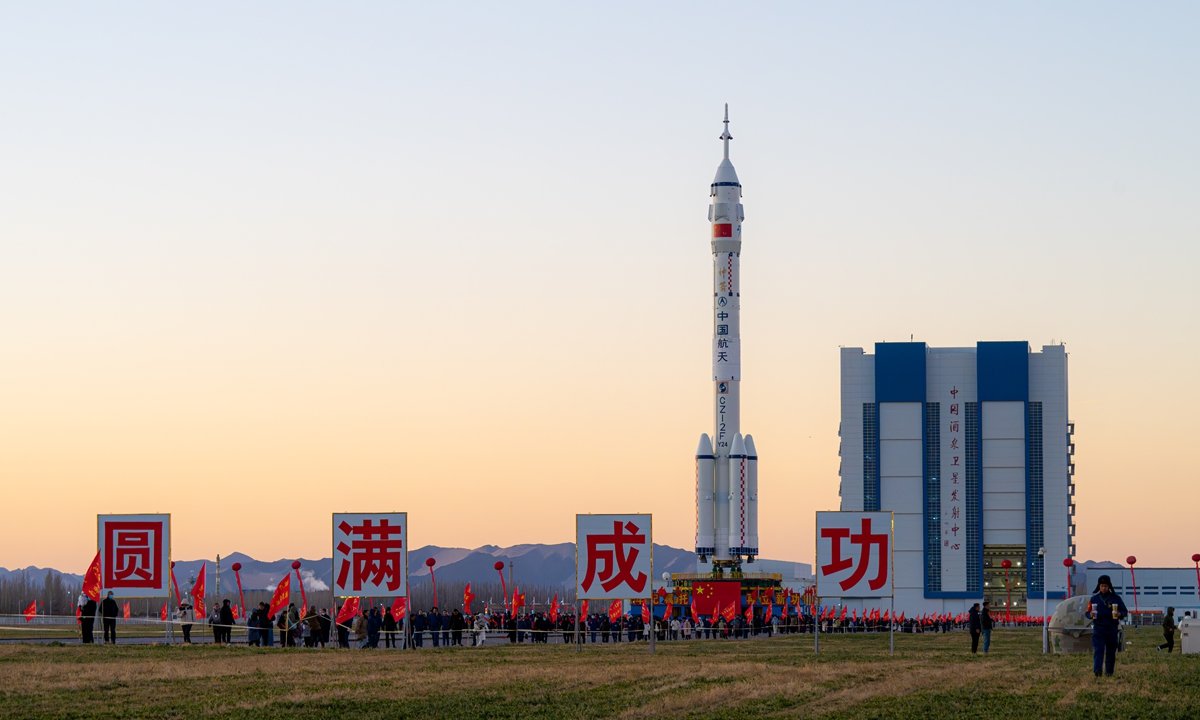
The Shenzhou-24 crewed spacecraft and its Long March-2F Y24 carrier rocket are transferred to the launch area at the Jiuquan Satellite Launch Center on November 17, 2026. The mission is scheduled to be launched in the coming days, following pre-launch checks and joint tests. Photo: VCG
Preparations for the upcoming Shenzhou-24 crewed mission are progressing smoothly, with winter-proofing measures, upgraded launch facilities and a backup rescue system in place as China readies for a historic joint spaceflight that will see a Pakistani astronaut become the first foreign national to visit the China Space Station.
The spacecraft and its Long March-2F carrier rocket are currently in good condition, and launch site facilities and equipment are operating normally, according to a release the China Manned Space Agency (CMSA) provided to the Global Times on Tuesday.
The spacecraft is scheduled for launch at an appropriate time, according to the CMSA release.
The nearly 60-meter-tall spacecraft-rocket combination traveled approximately 1.5 kilometers along a seamless railway track during a vertical transfer that lasted about 90 minutes, according to China Media Group (CMG).
As preparations enter their final stage, engineers at the Jiuquan Satellite Launch Center in Northwest China’s Gobi Desert are addressing the challenges posed by cold weather and conducting functional inspections and joint testing ahead of liftoff.
The launch center has also introduced equipment upgrades to improve operational reliability. Nearly 20 voltage stabilization devices have been installed on the launch tower to ensure a more stable electricity supply during propellant loading and launch operations, while propellant filling pumps that had been in service for more than two decades have been replaced, the state broadcaster revealed.
Meanwhile, a separate spacecraft-rocket combination is already standing by as part of China’s emergency rescue arrangements for crewed space missions. The Long March-2F Y25 rocket and Shenzhou-25 spacecraft have been placed on standby inside the vertical assembly building, space expert Yang Yuguang noted when interviewed by the state broadcaster.
Should an emergency arise involving the Shenzhou-24 crew in orbit, the backup system is designed to enable rapid testing and transfer of the rescue spacecraft and rocket, allowing China to launch an emergency rescue mission within a relatively short period, according to CMG.
Pang Zhihao, a Beijing-based senior space expert, told the Global Times on Wednesday that the preparations demonstrate the comprehensive safety measures supporting the mission, while the successful transfer of the spacecraft and rocket provides an important foundation for subsequent joint testing and functional checks.
The temperature at the launch site is expected to be around 1 C during the transfer, with northwesterly winds, according to the CMG report on Wednesday.
Pang said that the preparations are supported by a combination of passive thermal insulation and active heating measures designed to protect the rocket and spacecraft from low temperatures.
The launch tower is equipped with enclosed protective structures and heating systems that continuously supply temperature-controlled air to the rocket’s fairing and body, while insulation materials are applied to critical components, Pang explained.
Additional temperature-control systems are installed around propellant tanks and engine components to ensure that sensitive equipment remains within appropriate operating ranges.
“The launch procedures have also been optimized to delay the opening of the tower’s rotating platforms and minimize the time the rocket and spacecraft are exposed to low temperatures,” Pang told the Global Times.
These measures, along with real-time meteorological monitoring and contingency plans for extreme cold, are intended to prevent temperature-related abnormalities in electronic components and propellants, ensuring the safety and reliability of the launch, he said.
A Pakistani astronaut is expected to participate in the mission as a payload specialist and will return to Earth aboard the Shenzhou-23 spacecraft after completing a short-term stay in orbit.
The Pakistani astronaut will be the first foreign astronaut to step into China’s space station, Chinese Foreign Ministry spokesperson Guo Jiakun highlighted during a regular press conference on November 9. This marks yet another key outcome of bilateral cooperation as the two countries mark the 75th anniversary of China-Pakistan diplomatic ties, he noted.
Looking ahead to the upcoming mission, Pang expressed hope that Shenzhou-24 would achieve a successful launch and safe in-orbit operations, with Chinese and foreign astronauts working closely together to carry out scientific experiments and extravehicular activities.
He also voiced expectations that the Pakistani payload specialist would successfully conduct scientific research aboard the China Space Station. “The mission is expected to yield valuable scientific data and open a new chapter in international cooperation aboard the China Space Station, as China continues to embrace an open and collaborative approach to exploring the vast universe,” Pang told the Global Times.
Adding a human dimension to this historic mission, both Pakistani astronauts shortlisted for the mission have previously studied Chinese at the Confucius Institute in Islamabad, according to a recent report published by China News Service.
Qu Zhaowei, Secretary of the Party Committee of Beijing Language and Culture University, revealed the information in an exclusive interview with China News Service on November 13 during the 2026 World Chinese Language Conference.
“Both astronauts previously studied Chinese at the Confucius Institute in Islamabad,” Qu said.
Describing their journey from Chinese language classrooms to the prospect of traveling into space as both meaningful and inspiring, Qu said the experience demonstrates how Chinese is increasingly becoming a bridge connecting knowledge, technology, innovation and humanity’s future.
Qu noted that language proficiency is particularly important in highly specialized fields such as aerospace, where accurately understanding technical concepts, professional instructions and operational procedures is essential.
The two candidates’ experience reflects how Chinese language education is expanding beyond everyday communication into increasingly sophisticated areas of international scientific and technological cooperation, he said.