





Saadet Gokce
17 November 2026•Update: 17 November 2026
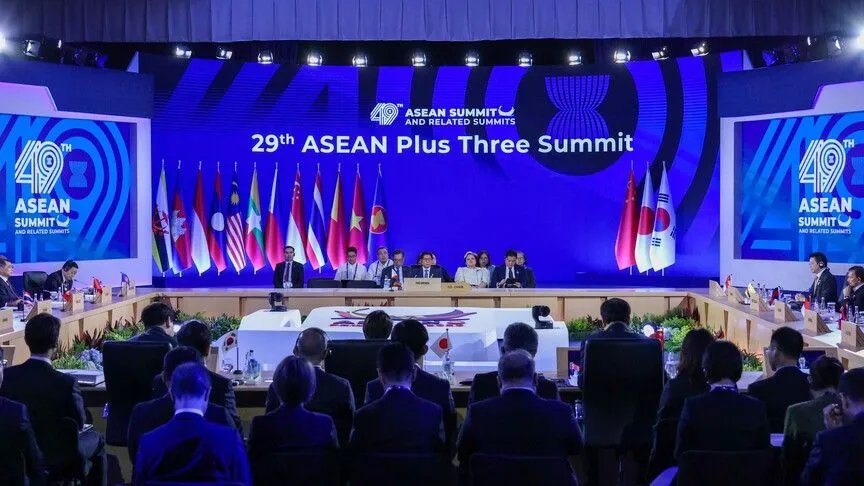
China, Japan and South Korea discussed growing geopolitical disruptions and their impact on regional stability during the 29th ASEAN Plus Three Summit in Manila on Tuesday, calling for stronger cooperation to address shared challenges.
Philippine President Ferdinand Marcos Jr., who chairs the Association of Southeast Asian Nations (ASEAN), warned that disruptions thousands of miles away were affecting East and Southeast Asia through rising food and energy prices, highlighting the immediate impact of global economic shifts on people across the region.
Opening the summit, Marcos called for the benefits of regional cooperation to be “tangible and reach our peoples with the same urgency,” saying the partnership could provide “greater security today and confidence for tomorrow.”
He said the ASEAN Plus Three framework offered a platform for developing practical measures and financial arrangements to safeguard economic stability.
“These are foundations we can build upon as conflict, supply disruptions, financial uncertainty, and natural disasters place new pressures on our economies,” he said.
Japanese Prime Minister Sanae Takaichi said cooperation under the framework strengthened national autonomy and resilience, highlighting opportunities to expand collaboration on disaster response and combating organized crime alongside existing efforts in financial cooperation and food security.
She reaffirmed Japan’s commitment to supporting ASEAN centrality and unity.
South Korean President Lee Jae Myung said the international political and economic landscape had become “more complex and uncertain” since the ASEAN Plus Three framework was established nearly three decades ago.
“At a time when conflicts and shocks occurring in one region are rapidly threatening everyone’s daily lives, now is precisely the moment when the role of ASEAN Plus Three, which has consistently demonstrated its strength in times of crisis, will shine even brighter,” he said.
Lee called for strengthening the region’s ability to respond to and recover from complex crises while laying the groundwork for sustainable growth.
Chinese Agriculture Minister Zhang Zhu also warned of rising geopolitical tensions, slowing global economic growth and overlapping risks, while describing East Asia’s economic achievements as “remarkable.”
He said the region nevertheless continued to face challenges involving energy supplies, food security and supply chain stability.
“We Chinese believe that the flame runs high when everyone adds wood to the fire. The more difficulties we face, the more unity and coordination we need,” he said.
Zhang emphasized that mutual trust remained the foundation of regional cooperation, urging countries to “contribute” to mutual trust, peace and stability while assuming greater responsibility rather than prioritizing geopolitical calculations.