








The stock market used to be the domain of banks and investment professionals, with retail investors only accessing it through a dense web of brokers, advisors, and fund managers.
As the industry digitized and stock investing became more common, the need for better management of digital voting rights and other financial technologies for corporate governance grew.
Instead of each reinventing the wheel independently, at the risk of creating incompatible technologies, brokers and banks rely on service providers that offer the scale to reduce costs and the quality to deliver highly reliable services.
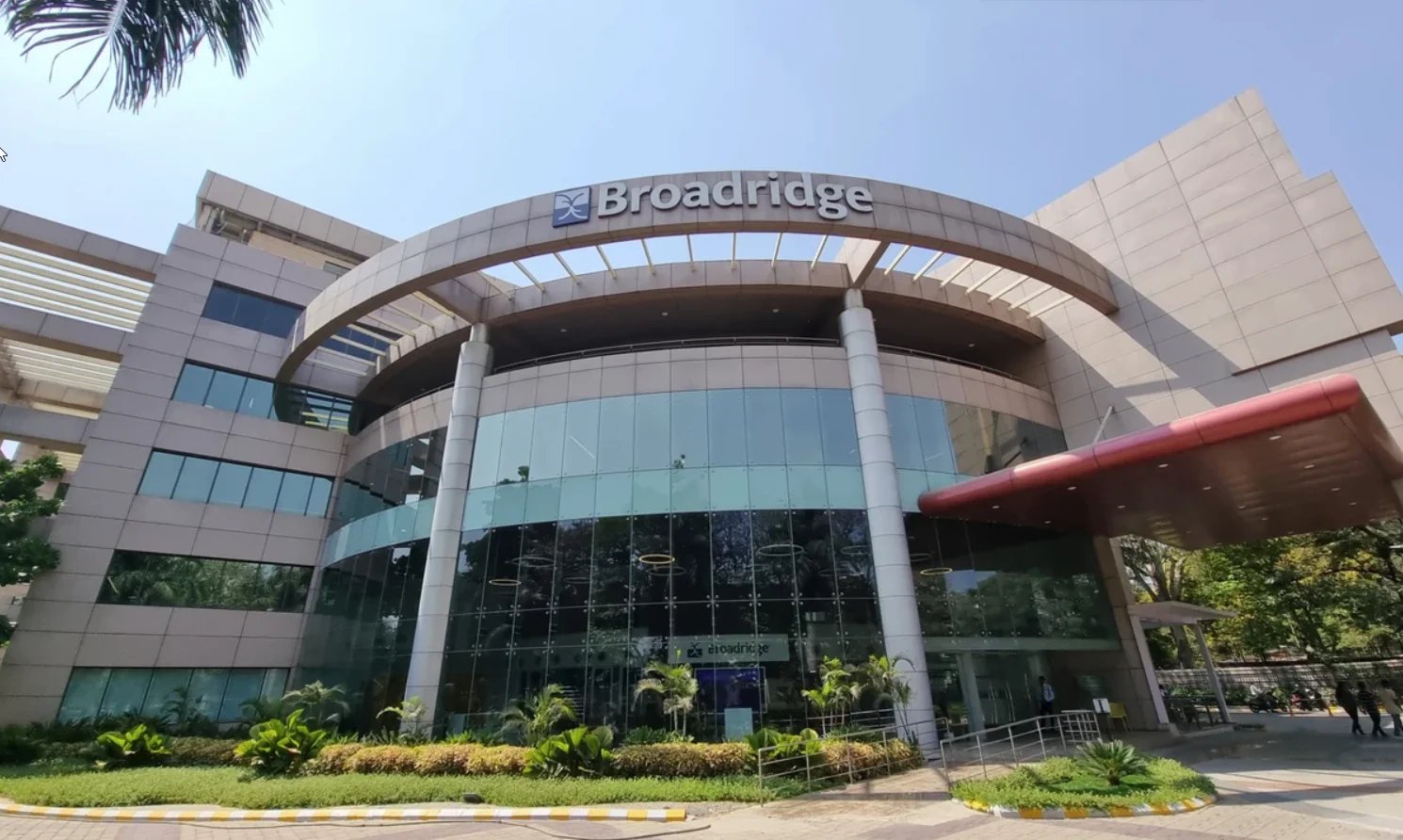
One such company is Broadridge Financial Solutions (BR ), providing services like clearing, settlement, order routing, trading and execution of buy/sell, management of voting rights, etc.
From humble beginnings, the company has grown into a multi-billion-dollar giant, serving tens of thousands of funds and corporations, hundreds of thousands of financial advisors, and hundreds of millions of retail accounts.
Broadridge Financial Solutions Overview
Broadridge History
The company started in 1962 as the Brokerage Services Group of Automatic Data Processing (ADP ) (ADP). It initially served a single client by processing an average of 300 trades per night.
But the real opportunity for the future Broadridge was a change in securities law in the 1970s:
- Immobilization: Securities (paper certificates) are “immobilised” in the sense that they are held by the depository at all times. As such, the sale and ownership of securities are only recorded through chains of transaction records.
- Dematerialization: fully trading only “virtual” ownership of the shares, creating an intermediary through which shareholders can vote by proxy.
During the 1980s, ADP also created an offering for investor communication, immediately onboarding 30 major clients for the service. It quickly became the top full-service brokerage processor, with approximately 80% of the market.
In the 1990s, the company introduced internet proxy voting and digital delivery of shareholder communications.
It also rolled out a multi-instrument, multi-currency trading and settlement system.
In 2004, it acquired Bank of America’s (BAC ) Clearing & Broker-Dealer Services, adding roughly $85 million in annual revenue and expanding back-office outsourcing capabilities.
The company was ultimately spun off from ADP in 2007, while continuing to expand; its services include print solutions, electronic voting platforms, tax services, business process outsourcing, mutual funds, and retirement solutions. It notably held the very first virtual annual shareholder meetings, hosting its first event for Intel Corporation (INTC ) in 2009.
It also expanded its global footprint and reach through new connectivity to major European and Asian markets for global securities processing solutions.
By the 2010s, Broadridge was adding the remaining corporate services it still wasn’t offering: data management, mutual fund processing, proxy and shareholder communications, and fee and expense management. It was partially achieved through a series of acquisitions:
- NewRiver in 2010 (mutual fund prospectus and compliance tools).
- Paladyne Systems in 2011 (buy-side order management, portfolio accounting, and data warehousing).
- DST Systems’ North America Customer Communications (NACC) in 2016 (print and digital billing/statement capabilities and addressing data for roughly 75% of public company shareholders in the U.S. and Canada).
- M&O Systems & Spence Johnson in 2016 (advisor desktop tools for broker-dealers and institutional fund-flow data).
The company was ultimately included in the S&P500 in 2018, reflecting its growing importance as a financial technology provider and one of the major corporations in the USA.
By 2023, the company started to provide VMware Blockchain distributed ledger software to facilitate repurchase agreements to large banks like UBS and Societe Generale.

Another recent use of blockchain technology by Broadridge is its blockchain-enabled proxy-voting infrastructure.
“Fixed income markets offer an excellent example of distributed ledger technology in action. The technology makes it easier to leverage smart contract technology, which can help digitize and mutualize workflows between counterparties, or execute corporate actions such as bond coupon payments and principal repayment.”
It also incorporated OpenAI’s GPT-4 into its BondGPT, a chatbot focused on bonds (read more about Broadridge & blockchain and AI below).
Broadridge By The Numbers
From its early start with only one client, Broadridge has become the share transaction and voting rights provider, servicing more than 10,000 public companies worldwide, 200,000+ financial advisors, and settling more than $15 trillion in trades daily.
With 30,000+ mutual funds and ETFs, the company services around 20% of all funds in the world, and a much larger percentage of the US funds.

Source: Broadridge
Its systems have facilitated voting for 544 billion shares during the 2025 proxy season, with 97% of voted shares submitted electronically.
Broadridge has over 15,000 employees operating in more than 100 countries.
It processes equity trades for seven of the ten largest global investment banks and 21 of 25 U.S. fixed-income primary dealers. V
Virtually anyone working in finance has unknowingly interacted with Broadridge services, as it provided two billion regulatory fund communications for asset managers and seven billion regulatory and customer communications for corporate issuers.
Its broader operations include approximately $1.5 trillion managed on Broadridge Investment Management platforms and 2,500 virtual shareholder meetings held each year.

Source: Broadridge
Broadridge also acts as the primary provider for proxy voting services, processing over 50% of proxy statements for public companies and mutual funds globally.
Despite these remarkable metrics, Broadridge is still far from running out of addressable market, with the sector still relatively fragmented. In total, the company sees a total addressable market of $225B, of which Broadridge’s current share is only 27%, with the two largest markets being governance and capital markets services.

Source: Broadridge
Revenues have been and are expected to keep growing at an 8% growth rate. A large part of the company’s revenue is recurring (65%), as corporations and banks will not lightly move away from a trusted and reliable service provider for critical governance activities. The fastest growth is coming from the regulatory and issuers segments.

Source: Broadridge
In fiscal 2025, Broadridge generated approximately $6.9 billion in total revenue, including $4.5 billion in recurring revenue. Over the ten years ending in fiscal 2025, recurring revenue grew at a compound annual rate of 10%, while adjusted earnings per share grew at 13%.

Source: Broadridge
The company has also steadily redistributed profits to shareholders through a mix of share repurchases and dividends. The total per share has been growing steadily since 2021, at the pace of 10-13% yearly since 2022.

Source: Broadridge
Broadridge Businesses
As settlements and transactions move closer to matching the speed of other information technologies, fintech (financial technology) companies are becoming key partners to banks, funds, and insurers.
Broadridge provides technology solutions that automate the entirety of the trading lifecycle for capital markets, wealth, and asset management.

Source: Broadridge
The company is organized around 2 main segments:
Between the two segments, ICS is by far the largest, responsible for around 3/4th of total revenues.
As mentioned, Broadridge sees an opportunity in growing its market share, but the overall market for services related to corporate shares and bonds is also growing. So, besides the eventual gain of market share, Broadridge’s growth is supported by several deep trends, including:
- Population growth, globally and more specifically linked to immigration in the USA.
- Market participation growth, carried by financialization and the democratization of investing solutions, including digital wallets, zero-fee online brokerage, etc.
- More accounts per investor, and more products and positions per investor, in large part driven by easier access to a level of information previously reserved for professionals, but also lower transaction fees leading to more trading and more diversification.
The expansion into new markets, especially Europe, should also support long-term growth.
Broadridge Future, Blockchain, & AI
BlockChain
As mentioned, Broadridge has already started to deploy blockchain technology for financial institutions as early as 2023. This is in large part because the company is already well equipped to handle large amounts of data, identification and certification processes, and is trusted by its customers to handle such technology and data with enough care that it is worth risking using it.
A growing topic for Broadridge will be pass-through voting for asset managers: investors in pooled funds such as pension funds, institutional clients, or retail investors can use digital methods to direct or influence how asset managers cast proxy votes on underlying company equities.
This would be a radical change from how such voting rights are often handled today, with companies like BlackRock often de facto controlling and using the voting rights of the actual shareholders, who have invested through derivatives like ETFs.
Today, Broadridge’s blockchain-based repo platform processed $7.6 trillion in October 2026, averaging $345 billion in daily volume.
In addition, in November 2026, Broadridge announced partnerships with the New York Stock Exchange (NYSE) to provide on-chain governance and digital transfer agency services, alongside Dinari to enable proxy voting for tokenized U.S. equities.
Scaling AI For Corporate Governance
As a knowledge- and data-driven industry, the financial industry is quickly transforming under the pressure of new AI capabilities.
“AI is rapidly moving from isolated applications to the center of the enterprise operating model. At Broadridge, we are applying AI to create new products and improved workflows for clients while also using it within Broadridge to increase productivity, accelerate development, and fund continued investment. ”
For example, Global Demand Model, which predicts asset flows across more than $120 trillion of global assets under management, is steadily growing and acquiring new clients.
Meanwhile, OpsGPT simplifies and optimizes trading ops and real-time post-trade visibility for bonds and other capital market products.
Broadridge also claims that new Capital Markets and Wealth Management services clients can achieve up to 30% in Day 1 operational cost reductions, with additional savings over time, through its new AI partnership model.
The company is also using AI internally ot save costs on software development and increase margins.
“We expect to achieve $25 million of AI efficiency gains for fiscal 2027 and will use these gains to help fund investment and support margin expansion. As our AI capabilities continue to scale, we see them as a valuable tool that will enable Broadridge to deliver more value to clients, scale faster, and further unlock the value of the data flowing across our platforms.”
Broadridge Investment Case
Investment Pros
The strong dominant position of Broadridge in U.S. proxy processing (>70%) and the 97% client retention rate make it a world-class company to invest in when it comes to quality.
In addition, the company is still growing quickly at an almost double-digit rate and still has space to grow its market share, on top of the overall market growing as well.
Very high switching costs, dominant position, and secular growth ensure that the current business is stable and predictable.
In addition, the company has been among the first to embrace blockchain and AI for financial institutions. This could give it a long-lasting advantage to become one of the trusted providers in these activities when it comes to using these technologies for corporate governance and management of transactions of financial assets.
Investment Cons
Despite its current position, Broadridge is in a position where rapid technological change could create new competitors and new alternatives to its legacy systems.
Even if such a threat does not materialize, the R&D costs of tokenization, blockchain-tech, and AI in general will represent a serious expense for a company previously used to be a middleman collecting toll charges and expanding through acquisitions.
Another potential pressure is a decline in revenues due to fee compression, as brokerages push for lower operational costs and full digitalization.
Lastly, the financial industry is undergoing a process of consolidation, with many smaller banks and funds being acquired or merging, ultimately reducing the total number of customers Broadridge can reach.
Broadridge Place In A Portfolio
Broadridge appears as a good option for investors interested in the “plumbing” of the financial system. Thanks to stable recurring revenues and a dominant market position, this is also an inherently defensive position, even if it’s also a growth compounder, with growing dividends.
This is not to say that an investment in Broadridge is riskless.
The company is relatively richly valued in 2026 (P/E > 21), reflecting that markets are already at least partially pricing in its quality as a business. So investors will want to assess how much the future growth from tokenization and expansion in overseas markets can carry the stock price, with a focus on long-term, compounding steady gains more than quick short-term trading profit.
In a portfolio, Broadridge stock will likely play the role of a defensive stock with a moderate dividend yield (2-3%) and potential for long-term gains, but potentially significant volatility in the short term.