








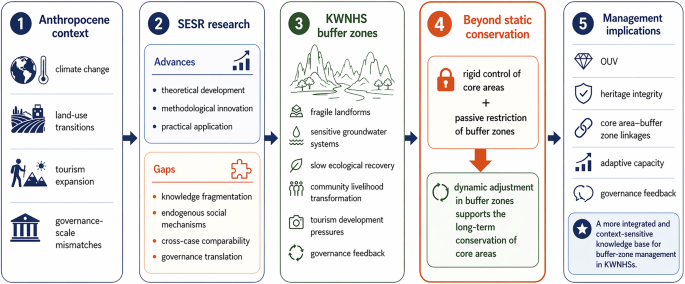
This section reports the review results in a progressive way. It first outlines the publication patterns, spatial distribution, case-study contexts, and thematic structure of the literature, and then synthesizes the major advances and landmark contributions across the five themes. Together, these results clarify the knowledge trajectory of SESR research and identify the strands most relevant to the management challenges of KWNHSs’ buffer zones.
Annual distribution of the literature
Research on SESR has evolved from low-frequency exploration to rapid growth and, more recently, accelerated expansion. According to the annual distribution of publications (Fig. 3), the development of this field can be broadly divided into three stages. The period from 1973 to 2009 represents the theoretical emergence stage, during which relatively few studies were published and research mainly focused on conceptual development and theoretical exploration. The period from 2010 to 2020 marks a stage of rapid growth, characterized by a clear increase in publication output and the gradual strengthening of methodological integration and empirical research. From 2021 to February 2026, the sampled literature suggests a phase of accelerated expansion, with topics such as machine learning, network analysis, model simulation, and adaptive governance increasingly associated with methodological innovation and governance-oriented applications.

The figure presents the annual publication trend of SESR research and highlights its three broad developmental stages: infancy (1973–2009), rapid growth (2010–2020), and surge (2021–February 2026).
Regional and institutional distribution of the literature
The sampled literature covered 23 countries. The leading continents and institutions in terms of publication output after regional aggregation are shown (Fig. 4). Asia ranked first, represented by institutions such as Northwest University, Anhui Normal University, Guizhou Normal University, the Chinese Academy of Sciences, and Xi’an University of Architecture and Technology. It was followed by North America, represented by the University of Manitoba, Cornell University, and the University of Florida. Europe was represented by the University of Lisbon, the University of Strathclyde, and the University of York. Oceania, represented by CSIRO, James Cook University, University of Tasmania. South America, represented by the Universidad de los Andes and University of Campinas. Africa, represented by the Scientific Services-SANParks and Indiana University. Overall, SESR research has formed several relatively stable academic communities, mainly distributed across geography, ecology, tourism studies, environmental governance, and protected-area management.

The figure presents the continental distribution of SESR publications, country composition, and representative institutions across the six continents.
Based on first-author affiliations, the national distribution of publications on SESR is highly concentrated, with China and the United States contributing the largest number of studies (Fig. 5). In most high-output countries, publications were mainly concentrated in the second and third stages. China not only had the highest total publication output, but also exhibited the most pronounced growth in the third stage, indicating that it has become an important contributor to the recent expansion of this research field. Although the international distribution of SESR research remains uneven, scholarly attention to this field has continued to increase over the past decade.

A Ranked publication output of the ten most productive countries based on first-author affiliations; B Distribution of publications from these countries across Stage I (1973–2009), Stage II (2010–2020), and Stage III (2021–present).
Overall, the case-study sites covered in the reviewed literature are spatially concentrated in several representative regions (Fig. 6): karst and heritage landscape areas in China, coastal and wetland systems in the United States, island and coral reef systems in Australia, coastal-mountain areas and Indigenous/community governance contexts in Canada, and internationally dispersed cases led by European scholars. Across countries, these case-study sites are mainly located in ecologically fragile areas, tourism-dependent regions, protected areas, coastal zones, wetlands, mountainous areas, and rural communities. This spatial pattern indicates that existing studies tend to examine SESR in regions where conservation pressures, livelihood transformation, tourism development, and environmental change are closely intertwined. In the karst-related literature, case-study sites are mainly concentrated in the Southwest-South China Karst (SCK) region, particularly the SCK WHSs, and extend to typical karst areas in Guizhou, Guangxi, and Guangdong. Representative cases include Fanhua Village in Guizhou, Baise in Guangxi, karst areas in Guangdong, and the karst mountainous city of Guiyang. These studies mainly focus on rocky desertification control, ecological restoration, rural landscape resilience, and the sustainability of mountainous cities.

The figure shows the spatial distribution of mapped case-study areas, with numbered markers indicating different study locations and case types.
Thematic classification of the literature
The thematic distribution of SESR research shows a clear dominance of theoretical and methodological studies (Fig. 7). Theoretical research accounts for the largest share, with 70 studies, representing 35.53% of the total, followed by technical methods, with 68 studies, accounting for 34.52%. Together, these two categories account for approximately 70% of all included studies, indicating that current SESR research remains primarily focused on conceptual framework development, theoretical explanation, and methodological operationalization. By contrast, empirical demonstration, model construction, and benefit monitoring and evaluation account for relatively small proportions, at 15.74%, 7.61%, and 6.60%, respectively. This suggests that, although the field has developed a substantial body of theoretical and methodological knowledge, model construction, practical validation, and long-term benefit evaluation for specific governance contexts are less represented in the sampled literature, suggesting possible directions for future research.

A Proportional distribution of the 197 studies across five research themes; B Number of articles assigned to each research theme in the combined Chinese- and English-language SESR literature.
Major advances and landmark contributions
Theoretical research
It represents the first major dimension of SESR studies and has contributed to the formation and deepening of an integrated paradigm of SESR. These studies mainly address foundational questions concerning what SESR is, why it matters, and how it should be understood. They focus on its conceptual meaning, core attributes, analytical perspectives, and relationships with related concepts such as adaptation, transformation, and governance. Together, these studies have advanced resilience from an ecology-based concept of system persistence to an integrated analytical framework for explaining the complex coupling between human societies and the natural environment. In doing so, they provide the conceptual basis and explanatory logic for subsequent measurement, model construction, and practical application.
A central advance in SESR theory lies in the redefinition of resilience from a capacity to “return to the original state” toward a dynamic process of continuous adjustment and transformative reorganization. In early ecological usage, resilience emphasized system persistence after disturbance. In social-ecological systems research, however, the concept no longer refers simply to a system’s capacity to “return to its original state” after a shock. Rather, it is understood as a dynamic capacity through which a system maintains continuity under thresholds, uncertainty, and pathway shifts, while continuously adjusting its future trajectory through adaptation, learning, reorganization, and even transformation. Walker et al. distinguished among resilience, adaptability, and transformability, arguing that a system’s future trajectory depends not only on its capacity to absorb disturbance, but also on actors’ capacity to regulate the system and open new development pathways when existing structures fail2. Walker et al. further used the concepts of adaptive cycle, panarchy, resilience, adaptability, and transformability to construct a heuristic framework for understanding change in social-ecological systems18. Subsequently, Folke et al. further clarified that resilience is not the rigid maintenance of an existing state, but a dynamic capacity to sustain system continuity amid thresholds, pathways, and uncertainty19,20. In this sense, adaptation and transformation are not external supplements to resilience, but intrinsic components of it. The concept of “pathway diversity” proposed by Lade et al. further extends resilience thinking toward future action pathways and their sustainability21. Thus, resilience theory has shifted from asking “how systems recover” to asking “how systems persist, adjust, and reorganize under change”2,18,19,20,21,22,23.
A second major advance is the shift from ecological-process explanations toward institutional, knowledge-based, and power-sensitive explanations of resilience. In this shift, the “social” is no longer treated merely as a background condition for ecological change, but has become central to explaining the mechanisms through which resilience is generated. Adger argued early on that social resilience is essentially the capacity of communities to cope with external stress, and that its key determinants lie not in individual traits, but in institutional arrangements, resource dependence, and structures of collective action24. Rotarangi and Russell25 and Bohensky and Maru26 subsequently introduced knowledge-related issues into resilience research, emphasizing that the integration of local and scientific knowledge is not a purely technical process, but is deeply shaped by social contexts and cultural relations. Stone-Jovicich et al. further clarified that bringing social science into resilience research should not simply mean adding several “social variables”27,28. Rather, it requires repositioning agency, value conflicts, and social change at the theoretical center. Later, Cinner and Barnes29 and Calderón-Contreras and White30 showed that resilience is now clearly understood as an outcome jointly shaped by assets, flexibility, social organization, learning, accessibility, and the distribution of power. Yang et al. further argued that the formation and enhancement of system resilience cannot be fully understood without considering institutional processes and social-environmental connections31. Accordingly, the deepening of SESR theory is, in essence, a shift in explanatory logic from ecological-process dominance toward a more balanced account of institutions, knowledge, and power.
A third important advance is the movement from system-attribute assessment toward cross-scale relational-structural explanation. The object of explanation in resilience theory has shifted from general system attributes to cross-scale relational structures and their evolutionary processes. Janssen et al. were among the first to introduce a network perspective, arguing that social-ecological systems research had long lacked a clear account of structural change, while nodes, ties, and network topology constitute key conditions for system resilience32. Duit et al. emphasized that the real explanatory power of resilience research lies in revealing how rapid, highly connected, and cross-scale changes penetrate institutional boundaries33. Cumming proposed the concept of spatial resilience, bringing location, connectivity, and spatial context into the theoretical center34. Chaffin et al. and Tai further regarded actors, networks, organizations, institutions, and cross-level interactions as key conditions for the formation of resilience35,36. Cumming et al. more explicitly noted that many governance dilemmas do not arise from the absence of goals, but from persistent mismatches between the scale of ecological change and the scale of governance37. Along this line of thought, this theoretical shift has also been summarized in Chinese review studies. Liu et al. identified spatial scale as an important theoretical issue in SESR research6, while Huang et al. summarized research hotspots such as dynamic evolution, regime shifts, and adaptive management from a knowledge-mapping perspective9. In comparison, Yang et al. further incorporated scale, thresholds, feedbacks, and transformation into the theoretical discussion of SESR31. It is therefore clear that the focus of resilience theory is no longer on judging whether a system “has resilience,” but on explaining what kinds of cross-scale relational structures and governance processes shape the formation, loss, and reorganization of resilience.
Technical methods
It constitute the second major dimension of SESR studies and have advanced the operationalization and methodological expansion of resilience research. As theoretical understanding became clearer, research attention further shifted toward the operationalization of SESR. This body of work mainly focuses on indicator systems, analytical frameworks, modelling tools, and integrated methods. Its core contribution lies in transforming resilience from an abstract concept into an object that can be identified, compared, and analyzed, thereby addressing how resilience can be measured, characterized, and examined. With the development of this research trajectory, resilience studies have gradually acquired a more stable empirical basis, creating conditions for the subsequent construction of governance models and practical testing.
A first major advance in technical methods research is the shift from generic indicator measurement toward contextualized and operationalized assessment frameworks. Early studies mainly used comprehensive evaluation methods to characterize resilience levels, whereas later studies have increasingly emphasized the correspondence among assessment objects, disturbance sources, reference states, and measurement logic. Alongside this shift, methodological frameworks such as grey-fuzzy models, set-pair analysis, resilience-well-being coupling frameworks, and the operational resilience framework (ORF) have emerged, moving resilience assessment away from simple indicator aggregation toward more logically structured framework design. In particular, González-Quintero and Avila-Foucat systematically reviewed pathways for operationalizing and measuring resilience38, while Lloret et al.’s ORF, which focuses on system variables, disturbances and pressures, reference states, and measurement indicators, marks a transition in SESR assessment from “conceptual application” to “methodological reflexivity”39. In addition, Zhou systematically summarized resilience measurement methods, noting that threshold and breakpoint methods remain a quantitative basis, that resilience measurement is shifting from temporal recovery to spatial recovery and from ecosystems to social-ecological systems, and that complexity science and interdisciplinary integration will become major directions for methodological development40. As resilience assessment has become increasingly contextualized, relevant studies have begun to explicitly treat tourism activities as sources of system disturbance and to incorporate object-based measurement, subsystem comparison, and community cognition into the same analytical chain, thereby promoting the operationalization of SESR in tourism destinations41,42. This progress indicates that the focus of resilience assessment is no longer simply to produce a resilience score, but to establish an operational system capable of supporting cross-context application and comparison40.
A second methodological advance is the movement from static outcome measurement toward dynamic process simulation and relational identification. As assessment frameworks have continued to improve, resilience analytical methods have gradually moved beyond the limitations of static outcome measurement toward dynamic process simulation and the identification of relational structures. Compared with approaches that only characterize resilience levels at a given point in time, later studies place greater emphasis on system responses after disturbance inputs, feedback transmission, key nodes, and threshold changes. Herrera proposed using system dynamics to translate resilience into simulatable characteristics of system response, marking the entry of resilience analysis into process-oriented research43. Subsequently, methods such as agent-based models, Boolean networks, transfer entropy, network analysis, GIS-based hotspot identification, and neural network prediction have been continuously introduced to identify information flows, relational structures, and nonlinear changes in system evolution44. Studies by García-Jácome et al., Li et al., and Grêt-Regamey et al. demonstrate the applicability of dynamic modelling and relational identification methods in resilience analysis from the perspectives of resource-use strategies, information flows, and actor diversity, respectively45,46,47. Thus, methodological research on SESR has advanced from “measuring states” to “identifying processes,” and the analytical focus has shifted from “obtaining results” to “explaining evolutionary processes and structural relationships”45,46,47,48,49.
Another important development lies in the move beyond researcher-led external assessment toward participatory approaches that integrate multiple actors and scales. Along with the methodological shift from outcome measurement to process identification, the knowledge sources and analytical scales of SESR research have also changed markedly. Resilience is no longer viewed only as a system attribute that can be externally identified by researchers. Rather, it is increasingly understood as a processual feature that needs to be revealed through local knowledge, actor perceptions, household practices, and multi-scale interactions. The participatory resilience analysis framework proposed by Walker et al. emphasized the co-construction of system understanding by stakeholders, the identification of key drivers, and the development of future scenarios, thereby laying the foundation for subsequent methodological shifts50. Thereafter, methods such as PAR, the SEPLS toolkit, focus groups, group mental models, household-scale analysis, and structural equation modelling have increasingly entered this field, allowing local knowledge, behavioral factors, and social relations to be incorporated into resilience analysis. Accordingly, relevant studies have gradually moved analysis down to the levels of communities, households, and farmers, while linking regional, community, and individual practices through multi-scale research designs. This has promoted a shift in resilience research from researcher-led external assessment toward a process-oriented methodological system characterized by participatory, multi-actor, and multi-scale integration50,51,52,53,54. In recent years, resilience research has further moved toward combining standardized tools with localized interpretation, enabling methodological systems to enhance comparability while still responding to actor experiences and governance needs in specific contexts55.
Model construction
It represents the third major dimension of SESR studies and marks a shift from conceptual interpretation and technical analysis toward governance logics and action structures. As resilience research moved beyond conceptual interpretation and technical analysis, scholars began to ask how SESR can be built through specific governance logics and action structures. Accordingly, relevant studies have increasingly focused on adaptive governance, social learning, and collaborative governance, examining the organizational forms, action mechanisms, and governance arrangements through which resilience can be enhanced. Their central concern is no longer only what resilience means or how it can be measured, but through what governance modes it can be realized. This body of research builds on the theoretical and methodological foundations discussed above and further shifts attention to the organizational level of governance practice.
Adaptive governance is often discussed as an important framework for constructing SESR-oriented governance modes. It was the first major mode to emerge in research on governance model construction. In commons research, Folke clearly argued that, in the face of uncertainty, cross-scale interactions, and sudden changes in complex systems, governance should no longer be understood as linear control over a system, but rather as an open process of continuous adjustment and revision56. Garmestani and Benson subsequently proposed a resilience-based governance framework, advancing adaptive governance from a general proposition to a resilience governance framework with a clearer internal logic57. Following this line of thought, later studies gradually incorporated adaptive cycles, flexible management, and context-specific regulation into model construction. For example, Wang et al.’s analysis of the adaptive cycle process and mechanism of the social-ecological system of the Qiandao Lake tourism destination shows that the primary premise of resilience modes is to recognize that systems are always embedded in dynamic change and cross-scale interactions, and that governance must therefore maintain openness, revisability, and responsiveness58.
Social learning can provide an important mechanism through which SESR modes operate within the adaptive governance framework. Resilience is not generated automatically by institutional arrangements themselves. Rather, it is continuously shaped through learning, reflection, knowledge integration, and cognitive adjustment. Through a study of village forest restoration in South Korea, Lee and Krasny showed that learning elements such as interaction, integration, systems orientation, and reflection can be embedded in local governance processes and directly influence the formation of resilience59. de Kraker further argued that social learning is not an ancillary process outside governance arrangements, but a key mechanism linking institutional design with resilience enhancement60. Along this line, relevant studies have increasingly emphasized that multi-actor interaction, knowledge integration, and institutional adjustment jointly constitute important conditions for the sustained operation of resilience modes61. In other words, social learning is not another mode independent of the governance framework, but the core mechanism through which adaptive governance becomes effective.
Collaborative governance can provide an organizational form through which SESR modes are implemented. If adaptive governance defines the overall direction and social learning provides the internal driving force, collaborative governance explains the organizational form through which resilience modes are implemented. This mode emphasizes that multiple actors are not merely assigned separate tasks. Rather, governance capacity is formed through joint participation, knowledge co-production, and continuous negotiation. Berkes’s discussion of collaborative learning directly links collaborative learning with environmental governance62. Ross et al. further argued that, in disaster risk governance, stable interfaces must be formed among knowledge transfer, social learning, and policy processes if resilience building is to be translated into sustainable governance practice63. Accordingly, collaborative governance is not simply an increase in participation, but a way of incorporating communities, governments, experts, organizations, and other actors into a shared governance network, thereby providing an organizational foundation and implementation pathway for resilience building. Relevant studies have increasingly incorporated multi-actor interaction, system coordination, and scenario differentiation into mode analysis, indicating that collaborative governance not only constitutes the organizational basis of resilience modes, but also shapes their implementation pathways and evolutionary differences across contexts64. At this level, collaborative governance forms the main organizational mode of SESR, enabling adaptive governance frameworks and social learning mechanisms to become genuinely embedded in real-world governance processes.
Empirical demonstration
It represents the fourth major dimension of SESR studies and reflects the expansion of application contexts and the deepening of practical validation. It refers to case-based validation, contextual application, and practical testing of resilience-related frameworks, rather than experimental research in the strict sense. As mode-oriented research has deepened, related studies have further moved into real-world settings across different types of social-ecological systems. At this stage, the focus is no longer on demonstrating, in abstract terms, whether the resilience framework is valid, but on examining whether it can explain complex changes, identify key mechanisms, and support governance practice in real systems. Along this line, empirical demonstration studies have gradually formed a relatively clear application spectrum across mountain and karst regions, rural resource-livelihood systems, protected-area conservation systems, and coastal and tourism-dependent systems.
Mountain and karst regional systems constitute an important application context in which empirical demonstration has moved from regional explanation toward spatial governance. These systems became important objects of empirical demonstration in resilience research at an early stage because they are characterized by complex terrain, ecological fragility, sensitivity to disturbance, and pronounced human–environment tensions. They therefore provide strong contexts for testing the explanatory power of resilience frameworks in complex territorial systems. Brunner and Grêt-Regamey compared resilience differences among policy pathways under global-change scenarios in the Swiss Alps, indicating that resilience research had begun to move from regional state assessment toward the comparison of policy strategies65. Subsequently, Wu et al. and Liu et al. applied landscape resilience and social-ecological systems perspectives, respectively, to landscape sustainability analysis in karst mountainous cities and ecological restoration zoning in the karst regions of Guangdong66,67. These studies show that resilience-related frameworks have begun to support spatial identification and zoning regulation in karst regions. In line with this direction, multi-scale research on rural SESR in ecologically fragile areas also suggests that resilience analysis is moving from general regional explanation toward scenario-based application with stronger spatial hierarchy and governance orientation68.
Rural resource–livelihood systems provide another important field in which empirical demonstration has shifted from community adaptation analysis toward livelihood–governance coupling analysis. Studies in this field mainly examine whether resilience frameworks can reveal the complex interactions among livelihood practices, local knowledge, social relations, and governance processes within resource-dependent communities. Bingeman et al. discussed the resilience capacity of resource-dependent systems from the perspective of farmer-land-use relationships69. Subsequently, Delgado-Serrano et al., Jarzebski et al., and Leite et al. showed, respectively, through studies of community-based natural resource management in Latin America, community forestry in the Philippines, and fishing communities in Brazil, that community capital structures, institutional responses, and multi-level governance play key roles in system sustainability70,71,72. On this basis, the analytical unit of empirical demonstration has begun to extend from the community as a whole to the farmer and household levels. Taking six tourism villages in Xiangxi Prefecture as an example, relevant research has constructed a resilience analysis framework from the perspective of farmers, consisting of human, policy, social, economic, ecological, cultural, and psychological subsystems. It further links resilience type classification, influencing-factor identification, and improvement pathway design, indicating that resilience research in this context has advanced from general community adaptation analysis.
Protected-area conservation systems constitute a classic application context in which empirical demonstration has shifted from ecological conservation analysis toward the understanding of complex social-ecological systems. González et al. reconceptualized the Galápagos Islands as a complex social-ecological system, thereby moving beyond an analytical pathway that treated protected areas merely as ecological units73. Newton, through a long-term case study of the New Forest in the United Kingdom, further showed that the effectiveness of protected areas depends not only on ecological outcomes themselves, but also on long-term coordination among social structures, institutional capacities, and ecological processes74. López-Angarita et al. further demonstrated that the conservation effectiveness of marine protected areas and national parks must be understood within more complete linked social-ecological systems75. Along this line, research on Tianchi Bogda Nature Reserve further treats the protected area and surrounding communities as a coupled system. Taking human-livestock-grassland relationships as the main analytical thread, and combining external disturbance analysis, adaptive-cycle simulation, resilience measurement, and flexible management strategy design, this research indicates that empirical demonstration in protected areas has shifted from judging “whether ecological conservation is effective” to developing an integrated understanding of “how protected areas operate as social-ecological complex systems”73,74,75.
Coastal and tourism-dependent systems further extend empirical demonstration from risk-response analysis toward the testing of complex governance contexts. These systems are highly open, externally dependent, and uncertain, making them typical contexts for testing the applicability of resilience perspectives in complex governance settings. Larsen et al. incorporated stakeholder agency into discussions of resilience building in tourism-dependent coastal communities in Thailand76. Kleisner et al. compared policy approaches for marine fisheries under different capacity and context conditions, showing that empirical demonstration in resilience research is shifting from general risk-response analysis toward systematic testing in complex governance contexts77. Consistent with this trend, studies of Qiandao Lake and coastal tourism destinations in Liaoning also indicate that empirical demonstrations in tourism-dependent systems no longer focus only on measuring overall resilience levels. Instead, they have begun to integrate adaptive cycles, comparisons of subject and object resilience, community cognition, and spatiotemporal difference analysis into a single research chain. This suggests that resilience frameworks may be useful for examining external shocks, multi-actor interactions, and governance uncertainty in such open systems78.
Benefit monitoring and evaluation
It represents the fifth major dimension of SESR studies and reflects a shift from state measurement toward management feedback. As SESR research has increasingly moved into practice, scholarly attention has shifted beyond whether a given mode can be applied in real-world settings to what actual effects governance, management, and planning modes produce. This body of work mainly focuses on identifying post-implementation outcomes, assessing integrated effects, and supporting decision-making. It evaluates whether a given mode enhances system resilience, improves governance processes, and coordinates well-being and sustainability. In this way, resilience research has further moved from practical validation to effect assessment, providing more direct evidence for mode optimization and governance decision-making.
A first advance in benefit monitoring and evaluation lies in the shift from measuring system states toward identifying the effects of governance modes. The primary concern of this line of research is no longer simply to measure the level of system resilience, but to examine whether different governance and management modes actually generate resilience-enhancing effects. Walker et al. argued early on that it is necessary to reconsider whether enhancing resilience can become an explicit goal of natural resource management research79. Mitchell et al. further embedded resilience thinking into a “planning-by-doing” process of natural resource management, emphasizing that evaluation should focus on whether the management process itself strengthens the system’s capacity to cope with change80. Tai and Jozaei, Mitchell, drawing respectively on forest areas in Taiwan and coastal governance in Tasmania, examined the correspondence between governance attributes and resilience capacities36,81. Studies on community perceptions of resilience in tourism destinations and the effects of ecological policies further show that resilience evaluation is no longer limited to measuring system states, but has begun to examine how community actors perceive changes in resilience and how policy interventions affect resource-use patterns and governance outcomes42,82.
A second advance is the movement from single-outcome judgement toward integrated effect assessment. More specifically, the research is no longer limited to judging whether a given mode improves resilience. Instead, it has begun to assess the linked effects of such modes on livelihoods, well-being, sustainability, and governance transformation. Prado et al. used livelihood pathway analysis to identify the long-term impacts of different coping strategies on livelihood resilience83. By comparing changes in resilience attributes across different governance stages, Salomon et al. revealed opportunities and constraints in environmental governance transformation84. Drawing respectively on coastal systems and regional sustainability, Wu et al. and Qu et al. show that the evaluation of mode effects has begun to examine the relationships among SESR, production-ecological trade-offs, and human well-being85,86. Studies on scenario planning, ecological policy effects, and intervention evaluation further indicate that the identification of resilience effects has shifted from judging a single resilience outcome to an integrated assessment of the linked relationships among social benefits, ecological responses, and development performance82.
Evaluation has also moved beyond the presentation of assessment results and is increasingly used to support governance-mode comparison and decision optimization. Homayounfar et al. showed that a real trade-off exists between resilience and performance, and that the value of mode evaluation lies in revealing the consequences of trade-offs among different governance goals87. Garmestani et al. emphasized that the effects of modes must be assessed under conditions of multiscale adaptive management88. Jafari et al. further suggested that an important purpose of resilience evaluation is to provide diagnostic evidence and action cues for adjusting watershed governance modes89. Consistent with this, studies on scenario comparison, policy simulation, and intervention evaluation have begun to translate evaluation results into a basis for pathway optimization. As a result, benefit monitoring and evaluation has shifted from judging “whether a given mode is effective” toward decision support that asks “under what conditions different modes are effective, and how they should be optimized”82.