


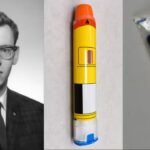





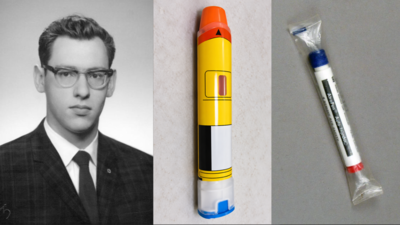
The EpiPen’s origins lie in space medicine and military need. Sheldon Kaplan, an engineer at Survival Technology, designed the first emergency medical kit for Nasa’s Apollo missions and was asked to work on the redesign of the AtroPen. The National Inventors Hall of Fame says that in 1973, with his design concept almost complete, the Pentagon approached the company seeking a delivery method for a nerve agent antidote. According to the Lemelson Centre, his invention became the ComboPen for the Department of Defence and the EpiPen for consumers, enabling medication to be delivered swiftly to the outer thigh during anaphylaxis, a severe allergic reaction.
Who was Sheldon Kaplan, the engineer behind the EpiPen invention
Kaplan was a biomechanical engineer who enjoyed tinkering with computers, model trains and cake icing. He worked for a company called Survival Technology, where he designed the first emergency medical kit for Nasa’s Apollo missions to the moon. The National Inventors Hall of Fame adds that he earned a bachelor of science degree in mechanical engineering from Northeastern University.According to the Hall of Fame, Kaplan developed a pneumatic medical dressing for reconnaissance pilots, along with numerous other medical and hospital products. It lists his birth date as 6 June 1939 and his death as 21 September 2009. He was inducted in 2016 for the EpiPen Auto-Injector, which is covered by US Patent No. 4,031,893.
How did a Nasa medical device project lead to a military antidote injector
The Lemelson Centre explains that, in the early 1970s, Nasa contracted Survival Technology to redesign the AtroPen, a device for self-administering atropine to treat irregular heartbeat. Company founder Stanley J. Sarnoff, who already held several patents related to hypodermic injectors, asked Kaplan to work on the project. The Lemelson Centre says the original device could hold only a limited amount of medicine, sometimes less than the prescribed dose. Its stainless steel casing could also make some drugs, including atropine, unstable.According to the National Inventors Hall of Fame, Kaplan developed a system that allowed a glass container to deliver a large volume of a drug. The Lemelson Centre states that he used tempered glass for the casing and improved the calibration of the spring so that larger doses could be injected. The Hall of Fame says that in 1973, when his design concept was almost complete, the Pentagon approached STI looking for a delivery method for a nerve agent antidote.
US military use the ComboPen to protect soldiers from nerve gas
The Lemelson Centre reports that Nasa renamed the improved device the AstroPen, while the US military made extensive use of it because atropine is also an antidote for nerve gas. It adds that since the mid-1970s, American soldiers in combat situations involving chemical weapons have been issued what the military calls ComboPens for emergency self-administration. The National Inventors Hall of Fame says Kaplan’s invention became the ComboPen for the Department of Defence and the EpiPen for consumers.According to the Lemelson Centre, Kaplan and others at STI then adapted the design to carry epinephrine, the synthetic form of adrenaline. The inventors were issued US Patent 4,031,893 in 1977, titled “Hypodermic injection device having means for varying the medicament capacity thereof.” The two sources give different dates for the consumer product. The Lemelson Centre says the FDA approved the EpiPen for commercial use in 1987, while the Hall of Fame says it was introduced in 1980.
Why is the EpiPen used to treat anaphylaxis and severe allergic reactions
The National Inventors Hall of Fame describes anaphylaxis as a severe allergic reaction during which airways tighten and blood pressure drops significantly. It says epinephrine opens airways and blood vessels to counteract these symptoms but must be injected promptly. Before auto-injectors, the Lemelson Centre notes, medicine had to be drawn from a vial into a syringe and then injected, which worked for trained personnel in medical settings but was risky in an emergency.The Hall of Fame explains that the EpiPen lets a person deliver medication by “thrusting the autoinjector against a patient’s outer thigh”. This activates a spring-loaded mechanism that launches a needle into the muscle. According to the Lemelson Centre, quick administration of epinephrine increases heart rate, blood pressure and breathing rate, easing symptoms until emergency responders can provide more substantive treatment.