






Deep in the Amazon forest, along the hundreds of tributaries to the world’s largest river, small teams of miners make a living using a process called artisanal or small-scale gold mining.
The problem: Their mining method relies on mercury to coax flakes of gold out of the soils in and around the rivers. That toxic heavy metal wreaks havoc on the Amazon forest as well as the people, animals and plants living in it.
Artisanal mining is not inherently illegal, but illegal operations are a major concern across the Amazon.
But with global gold prices soaring past $5,000 an ounce earlier this year, organized crime networks have started to hijack this illegal marketplace, said Luis Fernandez, research professor of biology at Wake Forest University and a senior fellow with the Sabin Center for Environment and Sustainability.
The remote nature of the mining sites hinders law enforcement, he said, making it a lucrative, low-risk venture for bad actors from around the globe.
“Organized crime networks have gotten into the business to generate profits that cause environmental damage, mercury pollution for Indigenous communities, and…potentially fund illegal activities around the world,” Fernandez explained.
As the executive director of the Center for Amazonian Scientific Innovation (CINCIA) in Peru, Fernandez has studied the environmental impact of gold mining and mercury pollution in the Amazon for decades.
Here, he explains why addressing the problem is vital to the Amazon’s survival and why it matters to people living thousands of miles away.
What is artisanal gold mining and what does it do to the environment?
Artisanal and small-scale gold mining sounds innocuous—artisanal bread, artisanal coffee—but it involves millions of miners who are incentivized to take apart rainforests and to use mercury that poisons air, water and soil to produce gold that is difficult to trace.
CINCIA is an independent nonprofit research center established in 2016 through a partnership between Wake Forest University and the U.S. Agency for International Development, or USAID. We are tackling the difficult job of generating evidence of the mercury pollution, deforestation and ecosystem destruction created by artisanal and small-scale gold mining.
This type of gold mining uses technology that is more similar to the California gold rush in the 1850s than it is to industrial mining. Artisanal and small-scale miners produce about 20% of the world’s newly mined gold. Many work in small teams using basic equipment and mercury, a powerful neurotoxin, often with little regulation or oversight.
How are gold mining and mercury pollution affecting the forests?
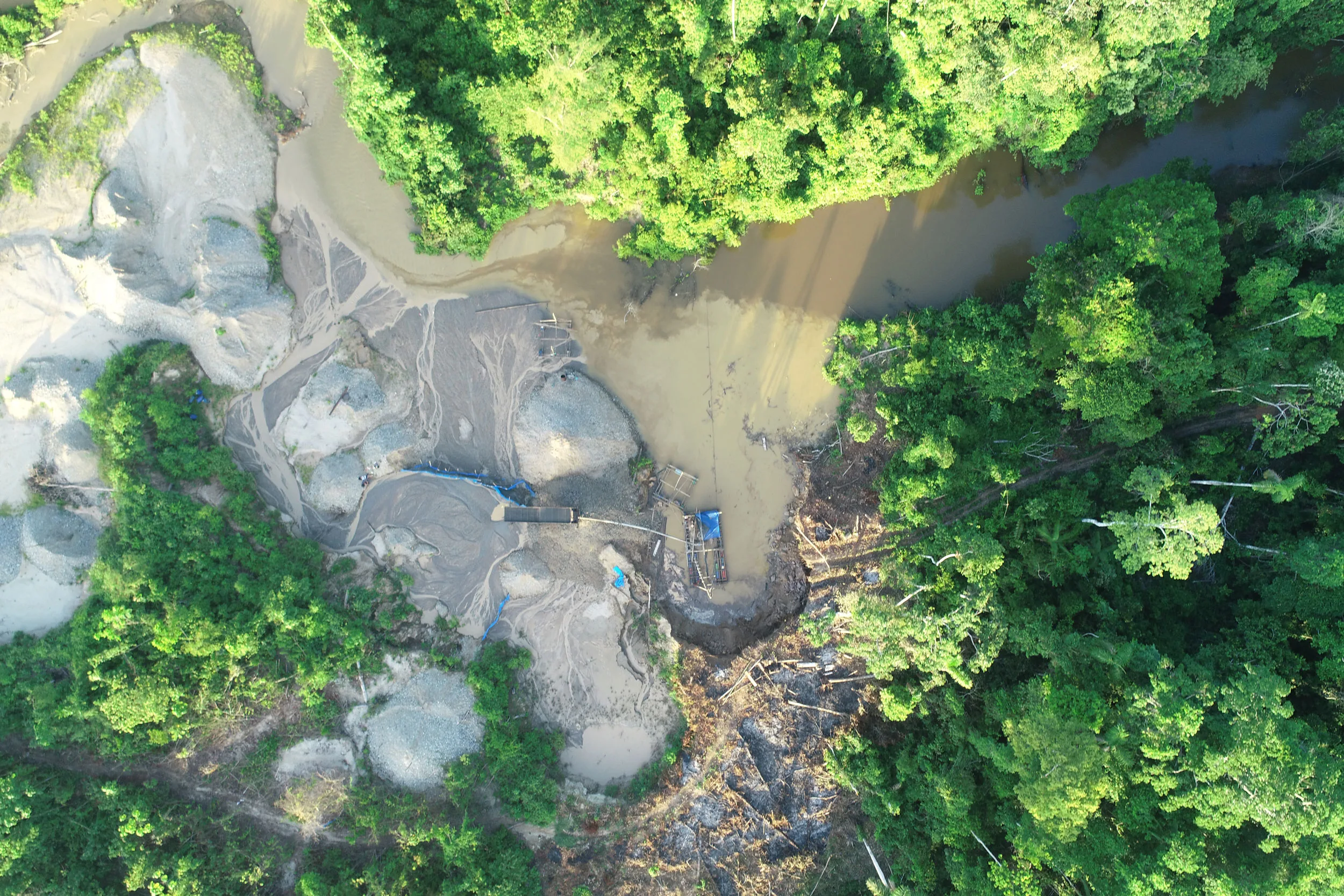
It’s pretty stunning when you see what this type of gold mining looks like. Imagine flying in a plane and seeing a carpet of green, the rainforest. And then instead of seeing a river, you see what looks like a scar, maybe two miles wide and 30 miles long where the river was. Mining has stripped away the trees, destroyed wildlife habitat, and left a landscape of bare sand and abandoned mining ponds, where mercury contamination can persist.
Where there were trees that were 200 feet high, now it’s just sand dunes and these weird, multicolored ponds. Where there was the noise of birds, you just hear the wind. It is really the death of the forest.
In Madre de Dios, which is considered one of the largest areas most severely impacted by gold mining in South America, we found widespread mercury pollution in rivers, lakes, fish, birds, insects and air. Wherever we started to look, we found elevated levels of mercury.
Normally, rainforests have an amazing ability to come back. If you cut it down because of agriculture or cattle ranching, it’ll eventually come back. In some of the most damaged areas, natural recovery could take centuries. But that doesn’t mean these places are lost forever. For the past 10 years, Wake Forest and CINCIA have been studying how to bring these forests back using native trees. We’re working to restore forest cover and wildlife habitat in decades rather than centuries, although bringing back the full diversity of an old-growth forest takes longer.
We’re talking about some of the most important places on the planet. They not only generate the weather across the globe, but they also are critical for regulating carbon management for a world that’s getting warmer.
In the Amazon, we’re facing a triple threat: climate change, biodiversity loss and pollution. Gold mining adds to those pressures by clearing forests, destroying habitat and releasing mercury. Together with drought and wildfires, these stresses can weaken the forest’s ability to recover and help push it toward dangerous tipping points.
It’s not just relevant to the populations that are exposed to mercury and those that are close to it. It is something that is important for our world as we know it. If the Amazon changes, the world changes. This is one of the reasons why this work is, I think, critical.
How is mercury pollution affecting the Amazon’s people?
In our research in Peru’s Loreto region, we tested hair samples from 439 people in nine river communities. Nearly all of them, 97%, had mercury levels above the health-based reference value used in the study. The highest measurement was more than 20 times that value.
For communities that rely on fish, a major route of exposure is food. Mercury that’s released from mining gets transformed into the most toxic form, methyl mercury. This bioaccumulates and bio-magnifies, which means it gets more concentrated as it goes up the food chain.
Small fish eat contaminated organisms, larger fish eat the smaller ones, and mercury becomes more concentrated as it moves up the food chain. People who regularly eat contaminated fish can then accumulate high levels of mercury in their bodies.
For children, repeated exposure to mercury through contaminated fish can damage the developing nervous system, with effects that can be permanent.
Why is illegal and artisanal gold mining growing in the Amazon and other places? Why is it so hard to stop?
Small-scale gold mining, many times, occurs in response to the price of gold. Gold is at historic highs, more than twice of what it was only three years ago. That has kicked off a global gold rush.
In more than 80 countries, this is causing a great amount of environmental damage, including deforestation, the destruction of rivers and lakes, and mercury pollution. In some cases, it’s funded by transnational organized crime.
But we all play a part. Gold mining has become a serious and rapidly growing threat to forests and rivers across the Amazon, with impacts in every Amazonian country. Gold is a commodity that everyone wants. It’s a thing that we turn to when we want to express love for the people we care about. It represents excellence, and it’s even covering a lot of the monuments that we have in our capital cities. Every time the price of gold increases, gold mining increases, more forests are destroyed and more mercury is released into places like the Amazon.
Unless we have a system of regulations that can provide accountability for the gold that we buy, that we need, not just for our necklaces and our earrings and our fancy watches, but for the components of our cell phones, our laptops, this problem will not be solved.
That means helping miners use mercury-free technologies to reduce mercury pollution. It also means making gold supply chains more transparent, so we know where our gold comes from and how it was produced—and aren’t supporting destructive or illegal mining.
How has this become an issue with Pope Leo?
We visited Pope Leo XIV at the Vatican in September to bring scientific evidence, more than 10 years of research, of mercury pollution in the Amazon. His pulpit can move opinion, put things on the lists of global leaders, educate and raise awareness of things.
Before becoming pope, he spent many years in Peru as a missionary and later served as bishop of Chiclayo from 2015 to 2023. He’s American, but he’s also a Peruvian citizen. When we heard that he was going to travel to Peru in November 2026, we decided to bring the science directly to him so he could see with his own eyes the evidence of a widespread poisoning of the ecosystems and the people of the Peruvian Amazon.
We hope that he takes the opportunity to highlight what’s happening there.
We need as many voices as possible. I think it’s important for scientists to leave the laboratory and to speak directly to those who make the decisions. With the world’s problems multiplying as fast as they are today, I think the time to communicate directly is now.
Learn more
See the On Topic page to hear more Wake Forest University experts discuss relevant topics and new research.
Categories: Environment & Sustainability, Experts