







Last week’s U.S. election results were, to use a technical term, overdetermined. There were so many reasons for people to vote the way they did, or to stay home, that it would be madness to attempt to reduce the thousands of individual outcomes to a single thesis about what “the people” desire.
Nevertheless, it is worth noting that a plurality of voters in exit polls (39%) claimed that “the economy” was the single most important issue facing the country, meaningfully ahead of “the state of democracy” (33%) and far ahead of all the other options, which were “immigration” (14%), “healthcare” (8%), “foreign policy” (4%), and “crime” (3%).1
Among all respondents, 75% claimed that “the condition of the nation’s economy” was either “poor” (36%) or “not so good” (39%). Of those with negative opinions about the economy, 70% reported voting for Democrats. Among the 25% of exit poll respondents who claimed that the economy was either “good” (23%) or “excellent” (2%), just 10% said that they voted for Democrats.2
This downbeat assessment is hard to explain. Employment is close to all-time highs, with broad measures of underemployment close to all-time lows. Real consumer spending has been rising steadily and is currently above the pre-pandemic trend. American households across the income distribution have more assets than ever before, not just in dollar terms, but relative to their liabilities and relative to their spending. And according to the most recent Survey of Consumer Finances (SCF), real incomes rose faster for Americans in the bottom 80% of the distribution than for those in the top 20%.
The exit polls imply that most people do not care.
Instead, 79% of respondents claimed that inflation over the past year caused them and their families either “a severe hardship” (21%) or “a moderate hardship” (58%), while 89% of respondents claimed that “the cost of living” was either “crucial” (49%) or “a major factor” (40%) in determining their vote. Democrats won about 60% of these self-identified inflation victims.
This seems straightforward, especially given the specific emphasis in exit polls on the prices of gasoline, diesel, groceries, utilities, and health care.3 Almost two-thirds of exit poll respondents said that “higher than usual prices” were “more because of Trump’s policies” vs. “factors outside Trump’s control”. Two-thirds of respondents said that tariffs “hurt the national economy” and two-thirds also said that the U.S. made a “wrong decision in taking military action against Iran”, which curtailed the flow of commodities and refined products through the Strait of Hormuz.
The problem with this explanation is that the 2026 exit poll results on the economy are extremely similar to what people said in exit polls in 2024.
Back then, 68% of respondents said that the economy was either “not so good” or “poor”, and 70% of those people reported voting for the out-of-power Republicans. Of the 31% with a positive view of the economy in 2024, 92% voted for the then-incumbent Democrats. Meanwhile, 75% of exit poll respondents two years ago claimed that inflation was responsible for either “a severe hardship or a moderate hardship”, with about 60% of them saying that they voted for the Republicans. (There were no equivalent cost of living questions in 2024.) For those who do not remember, there were no tariffs or shipping disruptions in 2024, although there were complaints about the effects of the fiscal policies of 2021-2022.
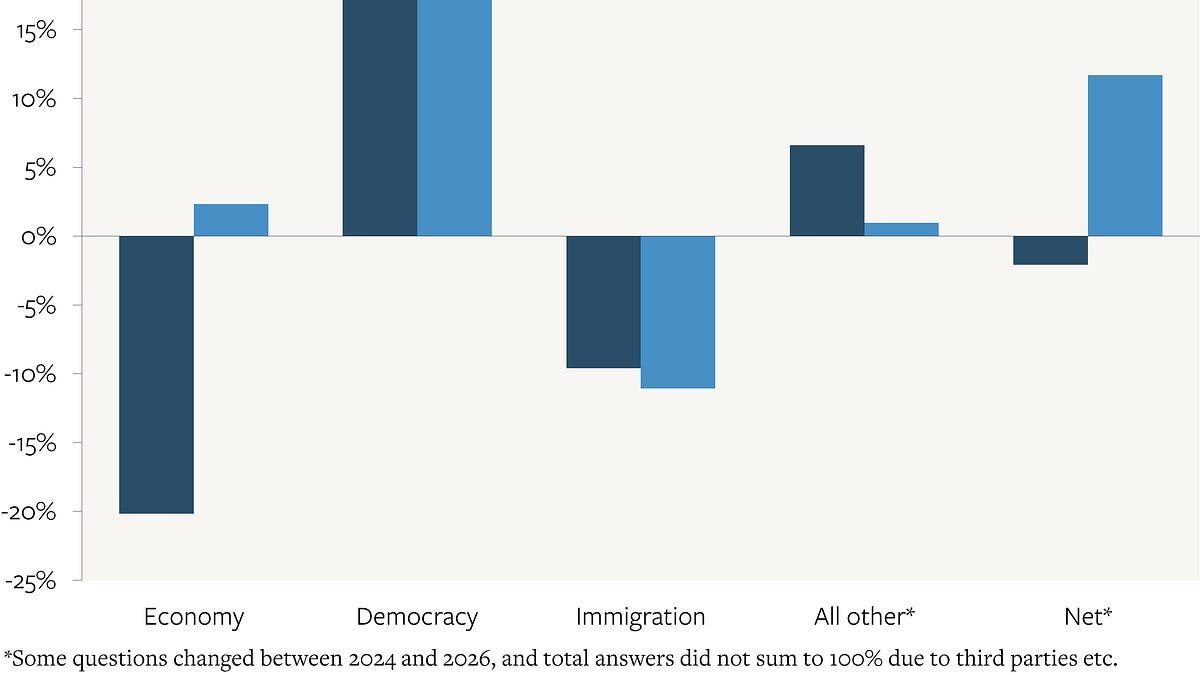
Perhaps even more remarkable is that far more than all of the total swing towards Democrats between 2024 and 2026 among exit poll respondents can be explained solely by those who ranked “the economy” as their most important issue.
In 2024, Republicans won 81% (!) of that group, which accounted for about 26% of all exit poll respondents and a little more than half of Republicans’ total support that year. Put another way, their margin just among those voters was worth about 20 percentage points of margin overall.
In 2026, by contrast, Democrats won 52% of those who ranked “the economy” as their most important issue, worth 20% of all exit poll respondents. (The share prioritizing the economy also went up.) That swing alone was worth 23 points of overall margin improvement. Democrats’ margins among those who prioritized “democracy” and “immigration” fell slightly,4 while their margins on foreign policy improved a little and their implied margins in all other categories also dropped. (Some of the questions changed, which prevents a pure comparison.)
Democrats did not decisively win a national argument on the economy in 2026, but they were able to claw back enough of those who had voted against them for “economic” reasons in 2024 (and in 2022) to rout the Republicans overall.
If elected officials and other policymakers cannot figure out what motivated these voters in 2024 and in 2026, they may find themselves doomed to relentless swings and rising public dissatisfaction. Today’s triumphs by one party may prove just as fleeting as yesterday’s triumphs by the other.
I am not a social psychologist, a politics expert, or a master of public opinion. But the simplest explanation is that the voters who either stayed home or switched their votes in the most recent election were reacting to the same perceived problems in both 2024 and 2026. Moreover, whatever it was that bothered them in those elections was not enough of a problem to motivate them to swing so wildly between parties in earlier elections. In 2016, for example, Democrats won the same 52% of exit poll respondents who put “the economy” as their most important issue as they did in 2026, but with dramatically different results overall.
Given that, and given what we know about economic conditions in 2024 and now, the most straightforward interpretation is that U.S. voters hate nominal price increases far more than they value other economic outcomes.
That has implications for everyone,5 but especially for the Federal Reserve.