









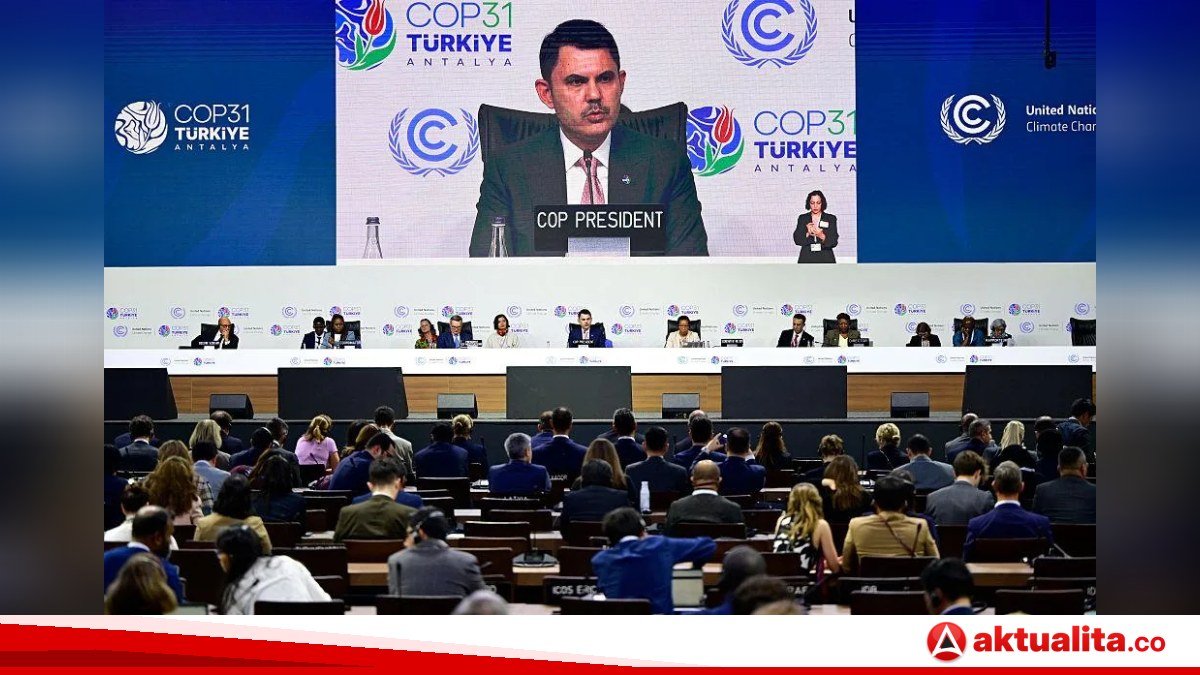
ANTALYA, Aktualita.co – The United Nations Climate Change Conference (COP31) in Antalya, Turkey, became increasingly tense after participating countries failed to reach a final agreement by the scheduled deadline on Friday (11/20/2026). Negotiations continued into Saturday (11/21/2026) amid differing views on phasing out fossil fuels and providing funding for countries most vulnerable to the impacts of climate change.
Small island nations and several developing countries are urging wealthy nations to increase financial assistance to cope with disasters, ranging from floods and droughts to storms and rising sea levels.
These demands emerged after the latest draft of the COP31 agreement removed a target for climate adaptation funding of 120 billion US dollars per year by 2035.
The change drew criticism, as vulnerable nations argue that measurable financial support is essential to protect their populations from the increasingly unavoidable impacts of global warming.
As of developments reported on Saturday, negotiators from nearly 200 countries were still working to find common ground so that the conference could produce a decision acceptable to all parties.
COP31 Negotiations Continue Past Deadline
COP31 took place from November 9–20, 2026, at the Antalya Expo Center, Turkey. However, the talks did not conclude on the final day as scheduled.
COP31 President and Turkish Minister of Environment, Murat Kurum, postponed the closing plenary session on Friday night because several key issues had not yet been resolved.
He stated that while discussions had shown progress, delegates still needed time to bridge their differences.
“We are making progress and are getting closer to the point needed to finalize the draft agreement,” said COP31 President Murat Kurum in a statement delivered on Friday (11/20/2026), as translated from the negotiation reports.
The negotiating teams were then asked to continue discussions and prepare a new draft decision.
Extending negotiations is not new for UN climate conferences. Several previous meetings also ran past their schedules due to conflicting economic interests and energy policies between nations.
However, this current uncertainty arises at a time when the need for funding to address climate change impacts continues to rise.
Vulnerable Nations Demand Disaster and Adaptation Funding
One of the main issues at COP31 is funding for developing countries facing the greatest risks from climate change.
The group of small island nations, including Pacific countries, warned that the impacts of global warming are threatening settlements, clean water sources, food security, and people’s livelihoods.
For these countries, climate finance is not merely development aid, but a necessity to ensure the safety of their populations.
Vulnerable nations are requesting international support through two critical channels: adaptation financing and mechanisms for addressing loss and damage caused by climate change (loss and damage).
Adaptation funding is used to strengthen resilience before disasters occur. Examples include building coastal defenses, strengthening early warning systems, water management, and infrastructure that is more resistant to extreme weather.
Meanwhile, loss and damage funding is directed toward helping countries that have already experienced climate impacts, including damage to homes, infrastructure, agricultural land, and the loss of livelihoods.
Tuvalu’s Minister of Environment, Maina Talia, expressed the growing dissatisfaction among countries most affected by climate change regarding the slow pace of the negotiations.
“Every year, there seems to be greater dissatisfaction, distrust, and frustration from civil society, indigenous peoples, and countries that are more vulnerable to climate change,” said Tuvalu’s Minister of Environment Maina Talia in a press conference on Saturday (11/21/2026), as translated from his statement.
Nevertheless, Talia stated that he is still trying to remain optimistic while awaiting the next draft of the agreement.
120 Billion US Dollar Funding Target Becomes a Point of Contention
The debate over adaptation funding intensified after the COP31 draft decision was revised.
The initial draft included a proposal to increase adaptation funding to at least 120 billion US dollars per year by 2035.
This figure was linked to efforts to double adaptation financing so that developing countries would have adequate resources to face the threats of climate change.
However, the 120 billion US dollar figure was no longer included in the second draft released on Thursday (11/19/2026).
The text still includes a push to triple adaptation funding by 2035, but it does not set a specific nominal amount or a clear basis for calculation.
The removal of the figure has raised concerns, as commitments without measurable financial targets are considered difficult to evaluate in terms of implementation.
Several African nations also requested clarity on how developed countries will fulfill their funding responsibilities.
Ghana’s Minister of Environment, Science, and Technology, Zanetor Agyeman-Rawlings, emphasized that developing countries have come to demand fair cooperation, not just to ask for voluntary aid.
“We did not come here to beg,” asserted Ghanaian Minister Zanetor Agyeman-Rawlings at the COP31 press conference, as translated from her statement.
This debate reflects a long-standing issue in international climate diplomacy: the gap between the funding needs of developing countries and the resources actually available.
Fossil Fuels Again Divide Participating Nations
Beyond financial issues, COP31 negotiations are facing sharp divisions regarding the future use of coal, oil, and natural gas.
The initial draft of the agreement contained several proposals to accelerate the reduction of reliance on fossil fuels.
However, subsequent versions removed explicit references to the transition away from these energy sources.
This change was met with opposition from several countries, including France and Panama, which want the agreement to include concrete steps to reduce fossil fuel use.
Panama’s Minister of Environment, Juan Carlos Navarro, stated that his country could not accept a final document that makes no mention of fossil fuels.
Conversely, several oil and gas-producing nations are pushing for an approach that considers energy security, economic interests, and the use of carbon capture technology.
These differences have made the effort to formulate a joint agreement increasingly difficult.
Yet, the burning of fossil fuels is the primary contributor to greenhouse gas emissions that cause global warming.
Civil Society Groups Warn of Failure Risks
Pressure on the COP31 organizers is also coming from civil society groups.
A total of 100 civil society organizations sent a letter to the conference leadership on Saturday (11/21/2026).
They warned that COP31 risks becoming one of the most disappointing climate conferences if the final decision does not show meaningful progress.
These organizations are urging that adaptation funding be clarified, commitments to reduce fossil fuels be strengthened, and protections for indigenous peoples remain part of the agreement.
They also questioned the emphasis on carbon capture technology, which they argue is not yet capable of replacing the need for direct emission reductions.
The negotiations are taking place amid growing concerns that the world will exceed the 1.5-degree Celsius warming limit compared to pre-industrial levels, which is the primary target of the Paris Agreement.
What is the Impact of the COP31 Outcome for Indonesia?
For Indonesia, the outcome of the COP31 negotiations is important because it relates to access to international funding for climate change adaptation and energy transition.
As an archipelagic nation, Indonesia faces various climate threats, including sea-level rise, coastal abrasion, flooding, drought, and changing rainfall patterns.
International financing support has the potential to help the government and the public strengthen infrastructure, improve disaster preparedness, and protect the most vulnerable groups.
However, these benefits will depend heavily on the final COP31 decision, the mechanisms for fund distribution, access requirements for financing, and policy implementation at the national level.
The protracted negotiations show that global agreements on climate change still face major challenges.
As of Saturday (11/21/2026), the world’s attention is focused on Antalya to see if participating countries can reach a compromise that provides greater certainty regarding emission reductions and funding for vulnerable nations.
The final COP31 decision will be an important measure of the capacity for international cooperation in facing the climate crisis, the impacts of which are increasingly felt by people in various parts of the world.