







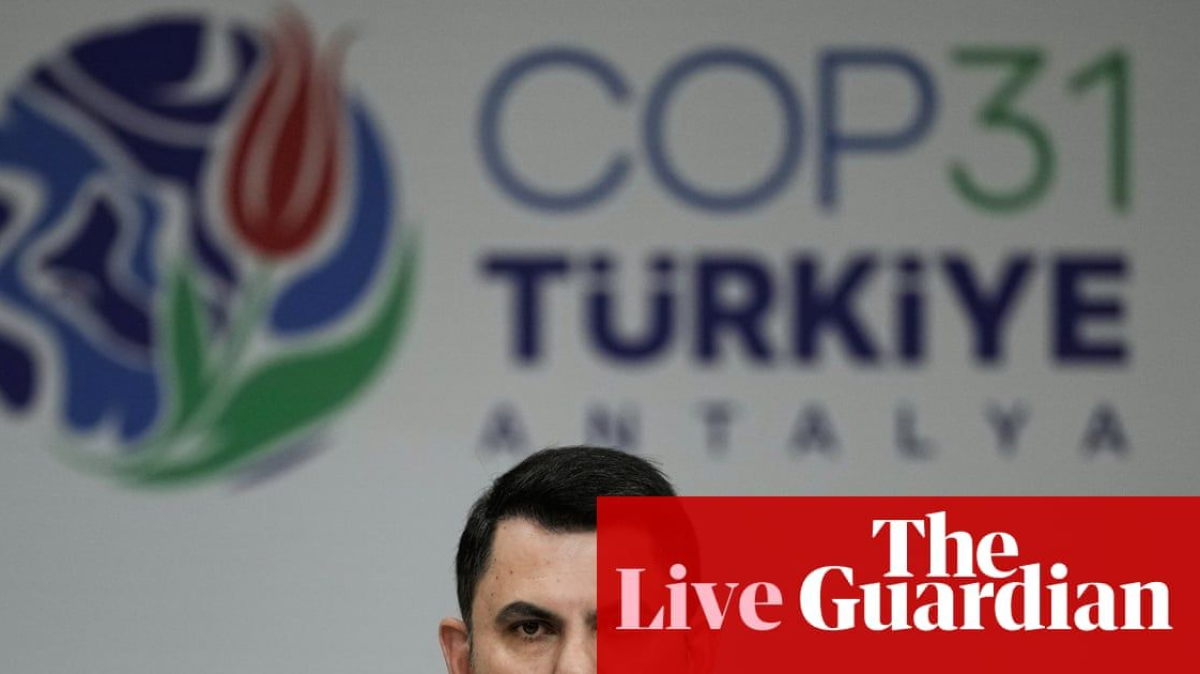
The latest negotiating document at the COP31 climate summit in Antalya, Türkiye, has removed references to fossil fuels, prompting criticism from environmental organizations concerned about weakening international climate commitments. The development, reported on November 19, 2026, comes as delegates face growing pressure to address global warming, climate finance, and increasingly destructive wildfires.
The removal has raised questions about progress toward reducing dependence on fossil fuels, particularly after nearly three decades of international climate negotiations. Environmental advocates have nevertheless identified opportunities for progress through forest protection initiatives and cooperation outside formal negotiations.
John Verdieck, Director of International Climate Policy at The Nature Conservancy, warned that removing the reference would undermine previous diplomatic achievements.
“It took almost 30 years to secure explicit reference to fossil fuels in the finalized COP text – now COP31 risks eliminating that progress overnight,” said John Verdieck, Director of International Climate Policy at The Nature Conservancy.
He also emphasized that climate action extends beyond formal summit agreements, particularly through forest conservation and national environmental policies.
“However, while fossil fuels tend to overhang everything at climate COPs – with good reason – what happens between these meetings and on the ground also matters,” said John Verdieck, Director of International Climate Policy at The Nature Conservancy.
Verdieck pointed to Brazil’s deforestation roadmap and the Tropical Forest Forever Facility, a conservation financing initiative designed to encourage countries to protect tropical forests.
“Give cause for hope at an otherwise underwhelming COP31,” said John Verdieck, referring to those initiatives.
Chris Dragisic, Managing Director for Global Policy at the National Audubon Society, highlighted diplomatic efforts taking place alongside the formal negotiations. She said forest-related initiatives demonstrated that international cooperation could continue even when agreements failed to capture every priority.
“We want to see things be as strong as possible in the Covered Decision text, but when things aren’t recognized here, it doesn’t mean that there’s no real-world action possible,” said Chris Dragisic, Managing Director for Global Policy at the National Audubon Society.
Dragisic cited a forest leaders summit and several side events examining the forest roadmap as examples of continuing cooperation during COP31.
“You’re seeing this sort of drumbeat of progress outside the rooms,” said Chris Dragisic, Managing Director for Global Policy at the National Audubon Society.
Fernanda de Carvalho, head of Policy and Climate Energy at WWF International, expressed concern about the overall direction of negotiations, particularly discussions involving climate finance and adaptation. She also questioned the weakening language concerning the possibility of temporarily exceeding the 1.5C warming threshold.
“We always have hope and we always have to see the positive side of this, but it’s not going well and there is concern,” said Fernanda de Carvalho, head of Policy and Climate Energy at WWF International.
She called on participating countries to reaffirm the long-term temperature target established under international climate agreements.
“It would be great if parties could highlight that 1.5 remains the ultimate goal of the convention,” said Fernanda de Carvalho, head of Policy and Climate Energy at WWF International.
De Carvalho also criticized a provision supporting the expansion of global carbon capture, describing the proposal as problematic because its projected figures could be overstated.
“Dangerous,” said Fernanda de Carvalho, describing the carbon capture provision.
“We think the numbers are overestimated,” said Fernanda de Carvalho, head of Policy and Climate Energy at WWF International.
Despite her criticism, she urged the summit’s leadership to continue negotiations rather than abandon efforts to reach agreement.
“There’s a Lenny Kravitz principle – it ain’t over till it’s over,” said Fernanda de Carvalho, head of Policy and Climate Energy at WWF International.
“I’m calling on the double presidency or the presidencies to keep moving and keep striving for consensus,” said Fernanda de Carvalho, head of Policy and Climate Energy at WWF International.
Beyond the negotiations, severe wildfires across Indonesia and Papua New Guinea have highlighted the growing consequences of extreme climate conditions. Data from the Copernicus Atmosphere Monitoring Service (CAMS) showed that Indonesian fire emissions approached 200 megatonnes of carbon this year, ranking third highest in more than 20 years.
The other two highest-emission years, 2006 and 2015, also coincided with El Niño conditions. Papua New Guinea recorded its second-highest wildfire emissions, approaching its 2015 record.
El Niño, which involves unusually warm conditions in the Pacific Ocean, can intensify heat and drought across Southeast Asia. These conditions dry peatlands and other carbon-rich ecosystems, increasing their vulnerability to fires.
According to the Centre for Research on Energy and Clean Air (CREA), smoke exposure from the Indonesian fires has been linked to more than 5,200 deaths and approximately 400,000 respiratory illnesses. The fires burned across more than 88,000 square kilometers of Indonesian territory.
Laurence Rouil, Director of the Copernicus Atmosphere Monitoring Service, attributed the exceptional fire conditions to the combination of climate change and strong El Niño conditions.
“High temperatures and a lack of precipitation, driven by strong El Niño conditions and human-induced climate change, favored this exceptional fire season,” said Laurence Rouil, Director of the Copernicus Atmosphere Monitoring Service.
Several countries, including Brazil, Canada, Indonesia, Türkiye, and the United Kingdom, have supported a new international action plan addressing wildfire risks. The initiative focuses on sharing resources, strengthening early-warning systems, expanding training, and improving access to technology.
Rouil said scientific observations and climate projections should inform international negotiations, emphasizing the importance of incorporating research into policy decisions.
“We hope that the clues and insights that we provide based on our work – on observations, on models, on projection – are taken into the negotiations,” said Laurence Rouil, Director of the Copernicus Atmosphere Monitoring Service.
She warned that increasingly severe fires could release substantial quantities of carbon dioxide, potentially reinforcing the conditions that contribute to further warming.
“You cannot neglect this thing,” said Laurence Rouil, Director of the Copernicus Atmosphere Monitoring Service.
“Now we are in a situation with very intense wildfires, which will release a lot of carbon in the atmosphere, and that will create quite a vicious cycle,” said Laurence Rouil, Director of the Copernicus Atmosphere Monitoring Service.
Meanwhile, negotiations over the publication schedule of the Intergovernmental Panel on Climate Change (IPCC) assessment reports have raised additional concerns about international scientific cooperation. Johan Rockström, director of the Potsdam Institute for Climate Impact Research, warned that delays could undermine global efforts to address climate change.
Rockström described climate science as “foundational” to the Paris Agreement and international efforts to limit global warming. He argued that the IPCC must be allowed to complete its next comprehensive assessment as quickly as possible, although some countries are holding up work on the three-part report.