









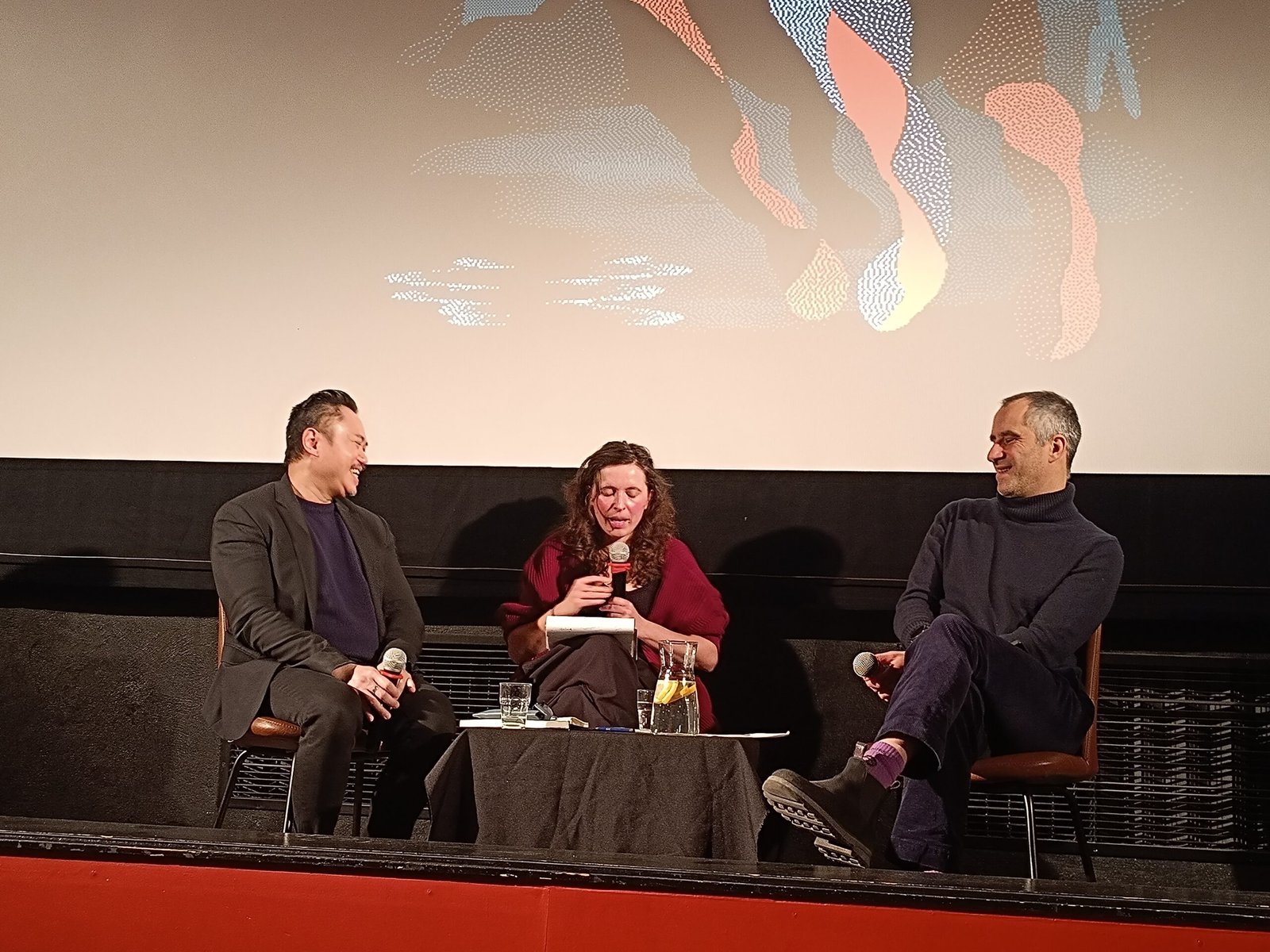
Tsui Hark’s cinema becomes more complicated when viewed through the experiences of the people who first encountered it. Images that international audiences might interpret as expressions of Chinese nationalism can carry different meanings for Hong Kong spectators, while apparently chaotic action can give form to anxieties about displacement and political uncertainty. Speaking at Five Flavours, Victor Fan explored these overlapping perspectives, placing Tsui’s work within the histories of migration, television, popular culture and commercial filmmaking that shaped it.
Fan began with an aspect of the director’s biography he believes receives insufficient attention: his childhood in Saigon. Before establishing himself in Hong Kong cinema, Tsui experienced displacement from Vietnam and later studied and worked in the United States. For Fan, that trajectory complicates attempts to describe his politics through a single national allegiance. The anger running through his early films draws on experiences extending beyond Hong Kong’s relationship with Britain.
“Dangerous Encounters of the First Kind” provides a particularly forceful example. Fan argued that its hostility towards imperial power should also be understood through the history of American intervention in Vietnam. He pointed to the film’s intimidating American figure, whose military associations and abusive behaviour suggest a source of violence that cannot be explained solely through Hong Kong’s colonial circumstances. “A Better Tomorrow III,” meanwhile, represents a more direct engagement with the traumatic memories associated with Vietnam.
This attention to overlooked histories also informed Fan’s account of the Hong Kong New Wave. Rather than treating it exclusively as a movement that emerged in cinemas, he discussed the argument that some of its most important experiments had already taken place on television. Broadcasters’ demand for material created opportunities for filmmakers to work rapidly, often on 16mm, and to introduce unfamiliar visual and narrative approaches into ordinary viewing hours.
Patrick Tam’s “Seven Women” illustrated how adventurous that environment could be. Fan recalled watching television dramas as a child that drew on modernist filmmaking and addressed adult relationships with surprising openness. His memories of encountering such material during early evening broadcasts suggested a moment when experimentation was reaching households directly, rather than remaining confined to specialist film clubs or art-house cinemas.
Tsui developed within that atmosphere, bringing an interest in psychological complexity and visual invention to martial arts television. Fan remembered a sequence in which the wooden boards of a bridge suddenly flipped as an ambush approached. What stayed with him was the ambition of the image: an elaborate physical transformation appearing within a television production, demonstrating the filmmaker’s determination to make spectacle itself a source of surprise.
The transition to features brought those ambitions into a more contentious public arena. Discussing “Dangerous Encounters of the First Kind,” Fan recalled the debate surrounding its violence and the restrictions placed on its release. He stressed the importance of distinguishing between versions of the film, arguing that censorship altered the relationship between particular acts of brutality and the narrative surrounding them. Images that appeared gratuitous in one version could acquire a different function when restored to a broader context.
For audiences watching around 1980, the film’s violence also encountered memories of Hong Kong’s 1967 unrest. Fan described how references to bombs, anti-imperialist action and political confrontation could reopen feelings that remained vivid for an older generation. The result was a film capable of provoking discomfort across political positions, with its anger resisting an easy division between sympathetic protesters and oppressive institutions.
The controversy extended to the authority of the censors themselves. For Fan, the film became part of a larger debate about who could determine the final form of a work and how much control filmmakers retained over their images. Its significance therefore lay both in what it depicted and in the institutional conflict surrounding its presentation to the public.
Commercial filmmaking offered a different set of constraints. Fan discussed Tsui’s work with Cinema City, whose energetic production model generated successful comedies and action comedies but also depended on the expectations of distributors and exhibitors. Decisions were shaped by what cinemas believed audiences would buy tickets to see. The popularity of a formula could consequently become a reason to repeat it, narrowing the opportunities available within an otherwise productive industry.
Fan recalled the extent of that association through the advertising for “Papa, Can You Hear Me Sing?” The promise that the film was not a comedy could itself become a selling point. Against an abundance of familiar entertainment, Tsui’s work offered him the expectation of something more distinctive: a popular film in which visual decisions and thematic concerns would bear the mark of an individual filmmaker.
“Shanghai Blues” and “Peking Opera Blues” were particularly important to that perception. Fan read their historical settings through the anxieties experienced by Hong Kong audiences during the 1980s. In “Shanghai Blues,” a city facing upheaval could suggest fears about the future of another prosperous metropolis. Its combination of pleasure, romance and insecurity allowed spectators to recognise concerns about their own lives within a story set elsewhere.
“Peking Opera Blues” intensified questions of departure and uncertain reunion. Fan drew attention to the desire to escape that runs through the film and to its closing separation, when the central characters promise to meet again after the revolution. For viewers contemplating whether they too might need to leave, such moments could carry an emotional force extending beyond the immediate historical narrative.
The films’ political resonance was inseparable from their visual construction. Fan recalled the backstage sequences of “Peking Opera Blues,” where movement, fragmented editing and sudden changes of colour produce an impression of instability. He resisted describing this as uncontrolled chaos. The flashes of red, blue and yellow, and the disruption of straightforward continuity, were carefully organised to create an effect that audiences could feel without needing to analyse its mechanics.
His discussion of the French New Wave similarly challenged a simple account of influence. Films by Jean-Luc Godard circulated through Hong Kong film clubs, while criticism and cultural publications provided spaces for debate. Yet Hong Kong filmmakers were engaging with these works from a position shaped by colonialism and proximity to mainland China. Admiration could coexist with disagreement about the political assumptions behind the images.
Patrick Tam’s references to Godard were especially useful to Fan’s argument. A filmmaker working in Hong Kong had to negotiate capitalism, colonial rule and competing representations of communism at once. European critiques could offer resources without adequately describing those circumstances. Fan presented the relationship as an exchange involving adaptation and criticism, with Tsui’s own interest in technology and camera movement representing another route towards formal experimentation.
“Once Upon a Time in China” brought these questions together within an industry confronting uncertainty. Fan situated the film alongside concerns about declining returns, piracy, criminal pressure and the search for production opportunities in mainland China. Its emergence was therefore connected to practical questions about how Hong Kong cinema could sustain itself, as well as to the meanings attached to its martial arts hero.
That hero, Wong Fei-hung, already possessed a long history in Cantonese popular cinema. Fan argued that this familiarity matters when interpreting the film’s patriotism. Wong could embody an attachment to China while also representing a specifically Cantonese cultural tradition. For Hong Kong viewers, his return could consequently express local pride and a desire for renewed strength rather than straightforward identification with a central national authority.
The opening sequence, with martial artists training to a familiar musical theme, crystallised that distinction. Fan suggested that an image received as nationalism by one audience could be experienced as local self-assertion by another. Jet Li’s presence added a further complexity: his mainland training brought together different martial arts traditions, while his public identification with Hong Kong helped position him within its cinema.
Across the discussion, Fan returned to the importance of preserving these competing meanings. Tsui’s films contain anger, patriotism, commercial calculation and extraordinary visual pleasure, but those elements change according to the histories spectators bring to them. Reading the spectacle closely means attending to the displaced child from Vietnam, the experimental television director, the filmmaker negotiating industry demands and the Hong Kong audience wondering what its future might hold.