


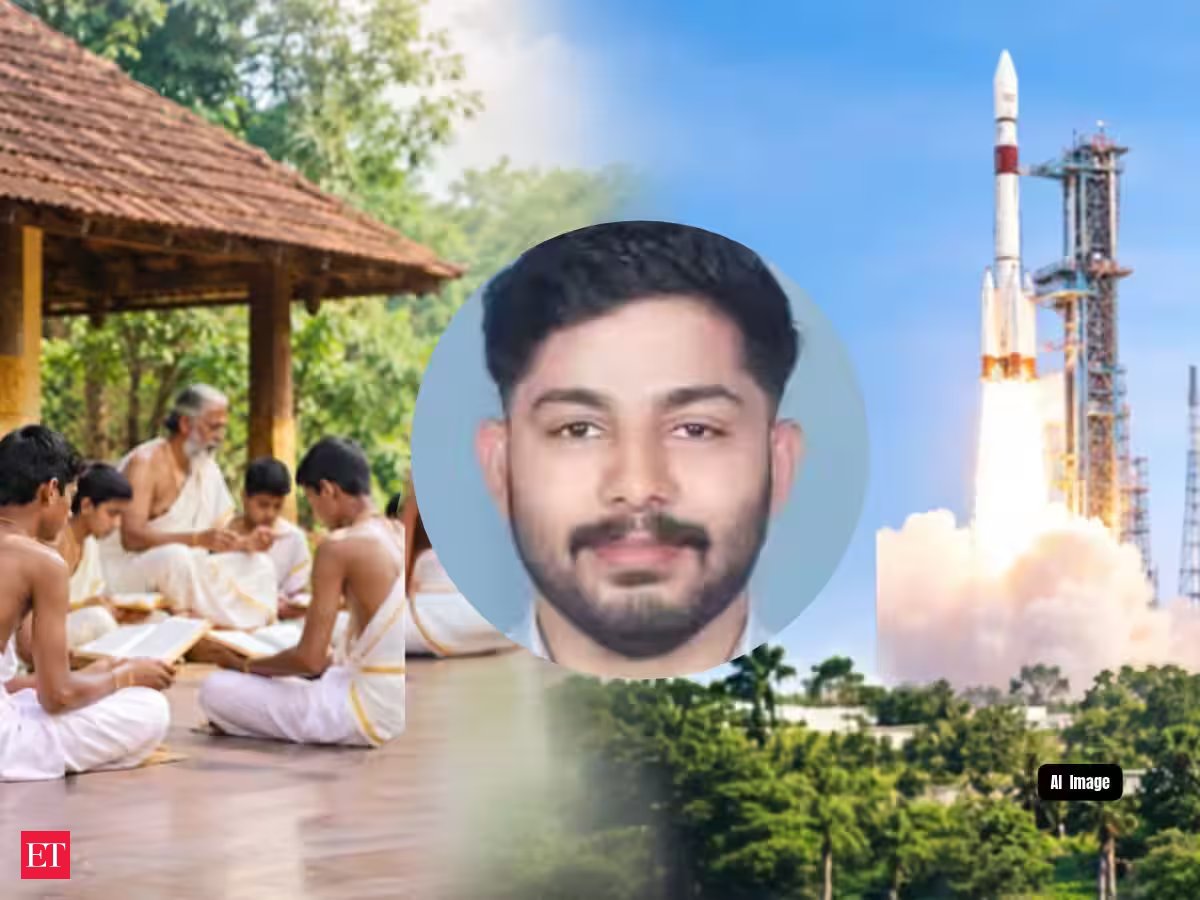
His journey brought together two seemingly different worlds: the traditional study of ancient scriptures and modern science. While his childhood was spent learning Vedic verses through oral recitation and memorisation, his later years involved engineering studies, competitive examinations and an ambition to work in India’s space programme.
Govind’s story also challenges the assumption that choosing a traditional form of education can restrict a student’s future career options. For him, the discipline and concentration developed during his years at the gurukula remained useful even after he moved into formal science education. In an interview with Onmanorama, Govind spoke about how he managed to maintain a connection with his Vedic education while pursuing a career in science.
Why Govind left regular school after Class 4
Govind’s educational journey took an unusual turn in 2011, after he completed Class 4 at Kendriya Vidyalaya in Payyannur. Instead of continuing with the conventional school system, he moved to Bhramaswam Madham, a traditional gurukula in Thrissur, to study the Yajurveda. The decision was influenced by his father, Hareesh Kumar, a former Indian Navy officer who had taken voluntary retirement in 2009. He wanted his son to experience traditional Vedic learning.
Before settling in Kaithapram in Kannur, the family had lived in several places because of his father’s naval career. Their earlier postings included Kochi, Lonavala and Mumbai. Govind had undergone his upanayanam, or sacred thread ceremony, while he was still in Class 4. His admission to the gurukula followed soon afterwards.

What awaited him was very different from the classroom environment he had known until then. His education revolved around listening to his teachers, memorising verses and following a disciplined daily routine. Written textbooks and conventional teaching aids played little role in the process.
The course was originally designed to last five years. However, Govind completed it in four. The initial adjustment was difficult. He was young and had to live away from his family for the first time. He was also entering an environment where learning depended heavily on concentration, repetition and memory. There were only five students in his batch, and all of them chose to study the Yajurveda.
How he managed gurukula education and regular school
Although most of his time was devoted to Vedic studies, Govind did not completely disconnect himself from mainstream education. He was enrolled in a nearby government school but primarily attended it to appear for examinations. By the fifth year of his gurukula training, he returned to regular schooling and joined Vivekodayam Boys Higher Secondary School in Nadakkavu.
He studied there from Class 8 to Class 10 while continuing his gurukula routine. Balancing the two educational systems required considerable effort. His mornings started early, and his schedule remained packed throughout the day.
Gurukula classes continued until 8.30 am. After attending school, he returned for another round of lessons that lasted until 9 pm. He would then study his regular school subjects until approximately 11 pm before preparing for another early start the following morning.
It was a demanding routine, but his academic performance showed that he was keeping up. Govind secured full A+ grades in his Class 10 examinations. He subsequently joined Alva’s College in Moodbidri, Mangaluru, for higher secondary education. By this stage, his academic interests had moved towards engineering and science. He began preparing for the highly competitive engineering entrance examinations and cleared both JEE Main and JEE Advanced.
From studying Yajurveda to engineering at IIST
Clearing JEE Advanced opened the door to another important chapter in Govind’s life. He secured admission to the Indian Institute of Space Science and Technology (IIST) at Valiamala in Thiruvananthapuram. In 2021, he enrolled in its BTech programme in Electronics and Communication. The transition was significant. The student who had spent years learning ancient Vedic verses through oral instruction was now studying modern technology and engineering at an institution focused on space science.
However, Govind did not consider his earlier education irrelevant to his new academic environment. He believed the habits developed during his gurukula years had helped him in several ways, particularly when it came to maintaining concentration, discipline and consistency. His interest in Vedic practices also continued after he left the gurukula.
How he got selected for ISRO
Govind’s journey reached another milestone in 2025 when he was selected for a scientist’s position through the ISRO Centralised Recruitment Board (ICRB) selection process. According to the Onmanorama report, the recruitment process involved interviews and other selection criteria.
He was scheduled to join the Vikram Sarabhai Space Centre (VSSC) in July 2025. Located at Thumba in Thiruvananthapuram, VSSC is one of ISRO’s major centres and plays a key role in India’s launch vehicle development programme. For Govind, the selection marked a significant transition from his years of traditional learning to a career in India’s space programme.
Yet, he did not intend to abandon his spiritual routine after beginning his professional life. He expressed hope that he would continue devoting at least an hour or two every day to the practices he had learnt at the gurukula. He also spoke about a future ambition to teach children what he had learnt, although he was unsure when or how he would pursue that goal.
Looking back at his educational journey, Govind said he had no regrets about choosing Vedic education at such a young age. He believed the experience had given him discipline, focus and mental strength. His journey is an unusual example of how different forms of learning can coexist. Leaving conventional schooling after Class 4 did not prevent him from pursuing engineering, clearing one of India’s toughest entrance examinations or securing a selection at ISRO.
Instead, the lessons he learnt in a gurukula in Thrissur remained an important part of his life even as he prepared to take on responsibilities at one of India’s leading space research institutions.