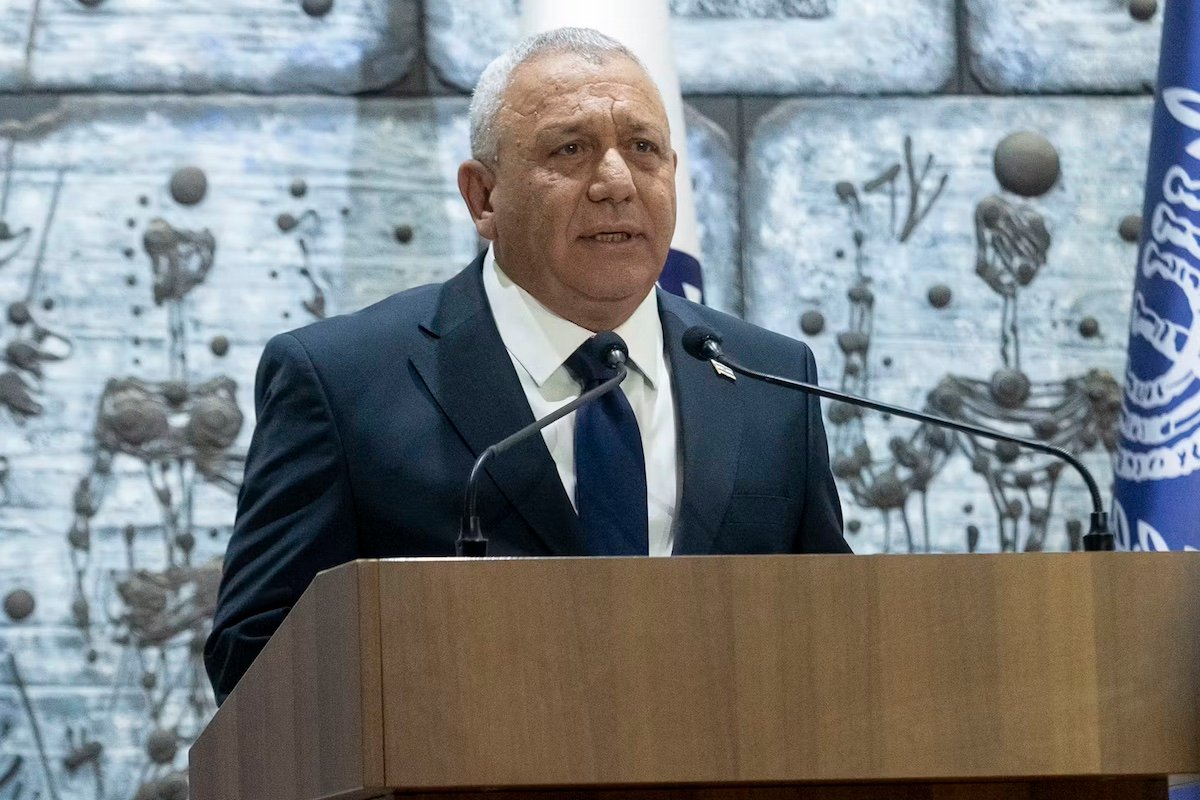
Eisenkot’s ‘disaster bloc’ edges closer to Israel’s next government


On Sunday, Israeli President Isaac Herzog announced he would grant Gadi Eisenkot – main challenger to Prime Minister Benjamin Netanyahu – the opportunity to form a new government in Israel.

It followed almost a fortnight of political gridlock, after what has been called the “most consequential election in Israel’s history” failed to produce a clear winner.

Eisenkot now has 28 days (with a possible 14-day extension) to attempt to convene a stable coalition government. He’ll have to bring together a deeply divided opposition.

Even if he succeeds, his government will face major challenges – including keeping his coalition together, a changing relationship with the United States, and escalating violence in the West Bank.

An extraordinary election

In Israeli elections, it is standard practice for the president to formally nominate who should bring a coalition government together. This does not have to be the leader of the party that has secured the most votes – in this case, Netanyahu.

Israel’s voting system is intrinsically geared toward producing coalition governments. The country has never had a one-party government.

Netanyahu’s Likud party won the highest number of seats in Israel’s election on October 27. But his coalition lacked the 61 seats required for a majority in Israel’s 120-seat parliament.

The parties in opposition to Netanyahu – led by Eisenkot – also lacked the numbers to form a governing coalition.

Meanwhile, the two Arab-majority parties representing the interests of two million citizens of Israel (the Joint List and Ra’am) received 19 seats between them – more than ever before.

While the procedure that has given Eisenkot a chance to become Israel’s new prime minister is standard practice, the conditions in which this election has taken place are historically fraught.

This is the first time Israelis have gone to the polls since Hamas’ shocking attack of October 7, 2023, and the devastating war in Gaza that followed.

Many challenging questions are raised by the fact that, at this momentous time in the history of the Jewish nation-state, the electoral process has ended inconclusively.

A new Israeli government, dependent on Arab parties?

The election outcome was made much more complicated by the tension between numbers and politics.

To form a potential governing coalition, Eisenkot’s Yashar party could be joined by Naftali Bennett’s B’Yachad, Yair Golan’s Democrats and Avigdor Liberman’s Yisrael Beytenu. But to achieve a majority in parliament, they would need at least one the two Arab parties to join a historically broad unity government.

Doing so, however, would require Eisenkot – and Bennett and Liberman – to go against campaign promises that they would not enter into coalition with the Arab parties.

This leaves Eisenkot in a difficult position. The support of these two Arab parties could help break the political deadlock. But it could also make what is already an improbable coalition of Israeli parties fall apart before it even starts governing.

The need for political cooperation and unity in Israel today is perhaps greater than ever before. Eisenkot has emphasized that “all of us will need to compromise.”

But compromising in principle needs to be possible in practice. A multi-party government that relies formally or informally on two different Arab parties may not be a feasible basis for political renewal in Israel.

Men wearing suits are seen on outdoor political advertising billboards.
Two Arab-led parties, Ra’am and Joint List, won a record 19 seats in Israel’s 2026 election. Photo: David Goldman / AP via The Conversation

Observing the political dilemma facing their opponents, members of Netanyahu’s Likud party have referred to them as “the disaster bloc.”

Coalition conundrums

There is no question that the enlarged parliamentary presence of the two Arab parties is significant. It poses fundamental questions about the nature of Israel’s democracy.

Israel’s 2018 Nation-State Law states that “the right of national self-determination in the state of Israel is unique to the Jewish people.” This makes it difficult for Arab parties to represent the national self-determination interests of Palestinians while also supporting an Israeli government.

Such cooperation has been tried in the past and failed. In 2021, history was made when the Ra’am party joined a coalition government under Bennett, giving him a narrow majority. The experiment lasted 12 months, ending in the collapse of the unlikely coalition government.

Ra’am has now announced it will support an Eisenkot coalition government. But that is no guarantee the experiment would last any longer this time. Even without the Arab parties, Eisenkot may struggle to hold a coalition together.

Formerly chief of staff of the Israeli Defense Forces, he was seen as a down-to-earth antithesis of Netanyahu. Yet, he has limited political experience. He only entered politics in 2022, and his party, Yashar, was established only last year.

Less than six months ago, Eisenkot dismissed the idea of opposition parties joining forces, specifically criticizing the opposition leader Yair Lapid.

But perhaps the most vexed question of coalition-building is how Jewish ultra-orthodox parties – mainly Shas and United Torah Judaism – will choose to align.

These groups strongly oppose compulsory military service for ultra-orthodox Jews, an issue that has caused deep divisions in Israel and given them a powerful role in Netanyahu’s current coalition government.

How they choose to align, and what demands they make, will now powerfully shape Eisenkot’s prospects.

Ultra-orthodox Jewish men are seated at desks working on computers, with political posters on the wall behind them.
The alignment of ultra-orthodox parties such as United Torah Judaism could be a decisive factor for Eisenkot’s prospects. Photo: Ohad Zwigenberg / AP via The Conversation

Big challenges at home and abroad

The challenges facing Israel’s new government are formidable. The situation in Gaza is unresolved, Hamas remains armed, and war has now spread from the Gulf to Saudi Arabia.

Close to home, the ongoing violence by Israeli settlers against Palestinians in the West Bank will pose another serious challenge to whatever government emerges.

And with the US midterm elections giving the Democrats control of both chambers of Congress for the remainder of US President Donald Trump’s term, US foreign policy could become more unpredictable.

Whatever shape the new government of Israel takes, its internal coherence will need to be sustained in a period of great uncertainty, from Washington to the West Bank.

In recent days, Eisenkot has emphasized that, having received this opportunity to lead, he will do his utmost to be “worthy.” In order to sustain leadership and government – and avoid being at the head of a “disaster bloc” – he will also need to be effective.

Benedict Moleta is a PhD student at the Australian National University and an affiliate researcher at London Dialogue.

This article is republished from The Conversation under a Creative Commons license. Read the original article.



Source link

Abnormal AI -The behavioural security platform company – Partner Content


Abnormal AI was born from an unexpected insight. Founded in 2018, the company applied lessons from large-scale Adtech, where machine learning models analyse vast datasets and make split-second behavioural decisions to a new mission: stopping cybercrime.

Before starting Abnormal, its founders spent years building AI systems in advertising technology. The experience revealed a blind spot in cybersecurity. The founders discovered what many insiders had missed: the AI that models behaviour can also stop the attacks that exploit it.

Attacks such as phishing, business email compromise, and account takeover often exploit normal human patterns rather than obvious technical vulnerabilities.

Abnormal AI is today well positioned to help organisations manage the next generation of AI-driven and automated cyberattack in priority markets such as Asia Pacific and Japan (APJ).

To find out more about Abnormal AI, iTNews Asia speaks with Tony Burnside, Abnormal AI’s Vice-President of Asia Pacific and Japan.

iTNews Asia: You’ve joined Abnormal AI as VP of APJ Sales at a time when organisations across the region are digitising quickly. With increasing digitisation, we’re also seeing cyberattacks now becoming smarter, faster, and more dangerous.

What drew you to the role, and how would you introduce Abnormal AI to readers who don’t know the company?

Burnside: There is no doubt that APJ is at an inflection point. Digitisation here is moving faster than almost anywhere, and every new cloud application, supplier and remote team widens the attack surface.

At the same time, attackers are using AI to work faster and sound more credible than ever before. I’ve spent my career selling cybersecurity and the last 12 years in this region, and what drew me to Abnormal is that it approaches the problem differently.

Abnormal is an AI-native behavioural security company that stops cyberattacks legacy security can’t see. It started with email, learning what normal looks like for every employee so it can spot the subtle anomalies behind business email compromise (BEC), phishing, and account takeover.

Abnormal now applies that same understanding of people and behaviour beyond the inbox to identity, collaboration tools, and AI.

For readers new to the company, think of it as security that understands how your people actually work, rather than only matching known threats.

The email security challenge

iTNews Asia: Email is now the primary entry point for attackers. Why is email their most accessible and most used attack surface, and what are security leaders in APJ telling you about it?

Email is the one channel every organisation has to leave open to the outside world. Anyone can reach any employee and a single convincing message can lead to stolen credentials, a fraudulent payment, or a foothold inside the network.

Attackers target people because they are usually easier to exploit than a hardened system, especially now that most attacks capitalise on abusing trust, not just technology.

Email is also where business gets done, from invoices and approvals to supplier negotiations. That gives attackers plenty of cover. A fraudulent request can look just like the dozens of legitimate ones that arrive each day.

What I hear from security leaders across APJ is that their teams are stretched and that attacks no longer look like the old phishing examples in awareness training. Many tell me their existing controls catch the obvious threats, but targeted, socially engineered ones get through. Many of these attacks contain no link or attachment at all, so leaders are looking for ways to detect intent and context.

iTNews Asia: Attackers, often using AI, can now write fluent, culturally convincing messages in many languages. In a region as linguistically diverse as APJ, how does that change or accelerate the risk?

AI removes one of the oldest giveaways. For years, poor grammar, awkward phrasing and a clumsy translation gave many phishing emails away, especially in languages where attackers lacked fluency. Generative AI erases those tells. An attacker can now produce a polished message in Japanese, Bahasa, Mandarin, Hindi, or Korean in seconds, with the right tone and business etiquette.

In APJ, that matters more than elsewhere. Organisations operate across many languages and cultures, and employees often work across several of them. Attackers can tailor each message to a local market at scale and at very low cost, and refine campaigns far faster than before, which makes them both broader and more personal.

The practical implication is that language quality can no longer be a signal of risk.

Defences have to look past how a message reads and ask whether the request, sender relationship, and behaviour make sense, in any language.

Good AI versus bad AI

iTNews Asia: AI is now transforming cybersecurity into an AI contest on both sides, where attackers and defenders of this fight are both trying to gain the upper hand.

How do you describe the difference between attackers using AI to deceive and defenders using AI to detect it?

Attackers use AI to imitate. They study how people write, how businesses operate, and what makes a request believable, then generate messages that blend into normal activity. Their goal is to look legitimate, and they need to succeed only once.

Defenders use AI to understand. Rather than asking whether something resembles a known threat, our models ask whether it fits what is normal for a specific person, supplier, and relationship. That is a different question, and it is harder to fool because the attacker can copy the style of a message, but struggles to replicate the full pattern of genuine behaviour behind it.

The contest is not just about who has better AI. It is about what the AI is aimed at. Attackers aim it at persuasion. Defenders should aim it at context: identity, relationships, communication patterns, and intent. The advantage goes to whoever has the richest understanding of normal. That is what Abnormal is built around.

iTNews Asia: Many attacks now look like routine business requests, which is where existing security boundaries, rules and known-bad signatures struggle. What does behavioural AI see that traditional approaches miss?

Traditional security tools rely on rules, reputation, and known-bad signatures. They work well on threats that have been seen before, such as a malicious link or a flagged domain, but many of today’s most damaging attacks contain none of the above. A request to change bank details, or an urgent message that appears to come from an executive has no malicious payload at all.

Behavioural AI builds a baseline of normal activity, such as who communicates with whom, how often, in what tone, and from which locations and devices. Against that baseline, behavioural AI goes beyond rules to see signals to detect things like a supplier writing from a new account, a payment request that departs from past patterns, or an unusual sign-in.

No single signal is conclusive. It’s the combination of tens of thousands of signals assessed in context that reveals the threat. It lets us catch attacks that look routine but are subtly wrong underneath and stop them before someone acts.

Where security goes next

iTNews Asia: As enterprises roll out AI agents, copilots, and other tools, where do you see risk moving once email is under control, and what does AI security mean in practice for a CISO? How critical is the CISO’s role, and how is it being reshaped?

Attackers follow the path of least resistance. As email gets better protected, risk moves to where identities, data, and trust sit. This can be cloud applications, collaboration platforms, compromised credentials, and even the AI tools themselves. Agents and copilots can reach sensitive data and act on someone’s behalf, so they become both a new asset to protect and a new route to exploit.

For a CISO, AI security in practice means answering three questions:

  1.  What AI is being used across the business, including unsanctioned tools?
  2.  What data can AI access?
  3.  And how do we detect when AI behaves abnormally?

The CISO role is moving from guarding the perimeter to enabling the business to adopt AI safely. That makes it more strategic and more visible at board level. The CISOs who do it well will be those who can say yes to innovation because they have visibility and control underneath it.

iTNews Asia: Why is Abnormal so well placed to help with the next generation of AI-driven and automated cyberattacks, and what other measures can organisations look at that carries over from securing email attacks?

Abnormal is a behavioural AI platform that is built to learn what normal looks like for every person and system. We have been solving the hardest version of this problem for many years, spotting attacks that have no obvious signature and succeed by looking normal. To achieve this depends on understanding behaviour, identity, and context at scale, and that same foundation applies as attackers and risk move beyond the inbox. It is why we are extending the platform to identity threats, the wider cloud and collaboration environment, and the governance of AI.

For organisations, several lessons carry over from email:

  • Establish a baseline of normal behaviour rather than relying only on known threats.
  • Treat identity as the new perimeter, with strong authentication and continuous monitoring of accounts.
  • Get full visibility of what tools and AI are in use.
  • Automate detection and response so your team’s time goes to judgement calls, not triage.
  • And keep training people, but as a complement to technology rather than a substitute.

APJ focus and close

iTNews Asia: How important is APJ to Abnormal, and which industries or markets are showing the strongest demand?

APJ is a strategic priority for Abnormal. The region combines rapid digital adoption, a diverse set of markets, and a threat environment that is growing more sophisticated every day, so there is both a strong need and real opportunity. Our investment in local teams, distributors, resellers, engineering, and customer support reflects that. Security leaders here want to work with people who understand their regulatory environment, languages, and business practices.

Demand is strong in sectors where trust and sensitive data are central. Financial services is an obvious one, as well as government and public sector, healthcare, education, and large enterprises in areas like manufacturing, retail, and technology.

Many of these organisations are consolidating tools and want to replace manual, rule-heavy approaches with AI-driven ones. We are seeing that momentum build across ANZ, Japan, Southeast Asia, and India, each with its own regulatory and language needs.

iTNews Asia: If a security leader in the region could do one thing this quarter to get ahead of AI-driven threats, what should it be?

Test your assumptions. Take a good look at which AI-enabled attacks your current controls would actually stop, particularly the ones with no malicious link or attachment, like a convincing payment change request or an impersonation of your CEO.

Many organisations discover that the threats most likely to hurt them are the ones their tools were not designed to see.

You can do that by running a proof of value on your live environment, or by reviewing recent incidents and near-misses to see what got through and why. Either way, you’ll leave with evidence rather than assumptions, a clear view of your gaps, and a stronger case for the board.

If you can only do one thing this quarter, make sure you understand where your real exposure is today and then prioritise from there.


Source link

NEC Returns to Singapore Fintech Festival with AI-Powered Financial Services Solutions


SINGAPORE, Nov. 10, 2026 /PRNewswire/ — NEC Asia Pacific will return to the Singapore FinTech Festival (SFF), taking place from 18 to 20 November 2026 at Singapore EXPO. 

Visit NEC Asia Pacific at Booth #3G31 at Singapore FinTech Festival 2026

At Booth #3G31, NEC will present AI, analytics and partner-led offerings that help financial institutions make better-informed decisions, improve operational performance, and advance business transformation. 

Guided by its vision to create what’s ahead, NEC is bringing together practical applications spanning Agentic AI, financial intelligence, insurance risk analytics, technology integration and wealth management. 

Michio Kotegawa, SVP, Head of Digital Finance Solutions & Innovation, NEC APAC, shares, “As financial institutions navigate growing complexity and rapidly evolving customer expectations, success will depend on their ability to turn technology into tangible business outcomes. By combining trusted AI innovation with deep financial services expertise, NEC is helping organisations create what’s ahead through smarter decisions, stronger customer experiences, and more resilient operations.” 

What to Expect at NEC’s Booth 

1. NEC cotomi Agent: Advancing Agentic AI in Financial Services 

NEC cotomi Agent observes how users complete tasks in a web browser, captures reusable operational know-how and applies that knowledge across web-based business systems. By turning individual expertise into organisational capability, the service can autonomously execute digital workflows while retaining appropriate governance and human oversight. 

2. NEC Financial Insights & Supply Chain Finance 

NEC Financial Insights and Supply Chain Finance combine Agentic AI, financial data and financing capabilities to help CFOs anticipate scenarios, act more quickly and optimise working capital and liquidity. Developed in partnership with TASConnect, the offering also supports risk management and closer collaboration across supply chains. 

3. AI Image Analytics for Insurance and Risk Management 

NEC will demonstrate AI-powered image analytics that examines motor-claim photographs for potential fraud and misrepresented damage. The technology can identify signs of pre-existing or staged damage and assess whether visible damage is consistent with a reported accident, supporting faster, more consistent claims decisions and reducing claim leakage. 

4. Financial Technology Partnerships  

NEC’s Financial Technology Partnerships approach brings together financial-services expertise, technology capabilities and strategic partnerships with leading technology providers to help financial institutions modernise operations, address business challenges and advance their transformation goals. Across business consulting, wealth management, payments, financial-crime management and liquidity management, NEC connects relevant platforms, specialist solutions and delivery capabilities around evolving business needs.

NEC’s collaboration with Avaloq demonstrates this approach in practice. Through NEC’s Avaloq Wealth Management Implementation Services, NEC combines Avaloq platform capabilities with financial-services knowledge, engineering expertise and regional delivery experience to help institutions transform their wealth management capabilities and realise greater value from their technology investments.

5. Avaloq Wealth Management Transformation  

Avaloq’s integrated, front-to-back platform supports banking and wealth management across the value chain, from onboarding and payments to investment management, credit, treasury, risk and compliance. A unified data model, real-time accounting and broad functional coverage can simplify operations, strengthen control and establish a foundation for AI-enabled innovation.

Vibhooti Chaturverdi, Managing Director for Asia Pacific, Avaloq, says: “A strong technology foundation is essential for wealth managers looking to scale into new markets and client segments, deliver more personalized advice and make effective use of AI. Together with NEC, we are helping financial institutions modernize by connecting data, process and ecosystems across the wealth management value chain.“

Fireside Chat Sessions 

  • 18 November 2026, 10:30 AM  
    Speakers:
    Yash Shah, Partner, Global Head of Avaloq Practice, Synpulse
    Prashant Sharma, Business Development Director, NEC APAC
    Topic: Beyond Platforms: Building the Future of Financial Services Through Partnership
  • 18 November 2026, 11:00 AM  
    Speaker: Emily Lee, Head of Sales, South Asia, Avaloq
    Topic: One step ahead: AI-powered client experience
  • 18 November 2026, 11:30 AM  
    Speakers:
    Dr. Liu Jianquan, Senior Director, NEC Laboratories Asia Pacific
    Albert Hardy Tanutama, Senior Principal Designer, NEC Laboratories Asia Pacific
    Dukey Rakesh, Manager, Digital Finance Division, NEC Corporation
    Topic: Human in Command. AI in the Loop. Agentic AI and the future of CFO and treasury decision-making
  • 19 November 2026, 10:00 AM
    Speaker: Sridhar Thangavelu, Global Head, Service Management, Avaloq
    Topic: Making AI work where banking gets complex
  • 19 November 2026, 10:30 AM 
    Speaker: Akrawit Sooksai, CEO, AIRA Factoring 
    Topic: AIRA Factoring and NEC’s Future of Digital Supply Chain Financing in Thailand
  • 20 November 2026, 10:30 AM
    Speakers:
    Eric Barbier, Founder and CEO, Triple-A
    Madhivanan Periannan, Chief Technology Officer, TASConnect
    Suresh Neelakantan, Head of Innovation and Development (Digital Finance), NEC APAC
    Topic: Connecting Capital to Commerce: Tokenisation and the Next Generation of Supply Chain Finance

Attendees are invited to visit Booth #3G31 at Singapore FinTech Festival 2026 to connect with specialists and explore how NEC and Avaloq are creating what’s ahead.

About NEC

NEC Asia Pacific leads in propelling Singapore’s Smart Nation initiatives, integrating trusted technology with social responsibility. As a leading information and communications technology provider, NEC APAC is creating what’s ahead with innovative solutions through AI, analytics, data, digital services, enterprise infrastructure, and Managed Services to promote safety, security, and enhance the quality of life for individuals and the community.

NEC APAC’s technological advancements, dedicated to privacy and ethical usage, solidify trust among businesses and citizens. Together with NEC’s research laboratories, NEC APAC provides cutting-edge public safety, cybersecurity technologies, and enterprise solutions to enable smart and sustainable cities, with a vision to create a brighter future.

For more information and to learn more about NEC APAC’s innovative solutions, visit https://sg.nec.com/.

Most Americans want new US Congress to end Trump’s Iran war, repeal tariffs: Survey


Majorities of Americans want the newly elected Democratic-majority US Congress to act to end the war with Iran and to repeal tariffs put in place by President Donald Trump, signaling demand for quick action to address the high cost of living, a new Reuters/Ipsos poll found.

US President Donald Trump (AP/File Image)

The four-day poll, completed on Monday, showed 71% of Americans — including 93% of Democrats and 51% of Republicans — want US Congress to pass legislation ending the conflict with Iran that Trump launched alongside US ally Israel in February.

Democrats won their largest majorities in the Senate and House of Representatives since at least 2008 in last week’s midterm elections, in a sharp rebuke to Trump’s Republicans over high costs and a deeply unpopular war. Democrats will take power when the new Congress is sworn in on January 3.

ALSO READ: Trump says Nvidia boss Jensen Huang told POTUS he’d no idea his affair was with a Chinese spy

A smaller but still-significant share of respondents — 62% — said they would support an effort to repeal tariffs on imports put in place by the Trump administration.

The war with Iran has pushed fuel prices sharply higher, adding to inflation already stoked by the new taxes Trump slapped on hundreds of imported goods. Trump has defended the war as necessary to prevent Iran from acquiring a nuclear weapon. The tariffs, he has said, will boost American industry by protecting it from cheap imports.

Democratic Party leaders have vowed to address cost of living concerns, and say they will try to force an end to the US war with Iran. Many in the party have also vowed to end Trump’s tariffs.

Desire for bipartisanship

Large majorities of people in both political parties said it was important for Trump to make an effort to work with Democrats and for Democratic leaders in the new Congress to try to work with the president.

ALSO READ: Trump says US war in Iran is ‘militarily effectively over’, suggests ‘status quo’ to continue

Nine in 10 respondents said cost of living issues should be a focus for the Congress during its first 100 days. Smaller shares wanted a focus on issues like artificial intelligence regulation, immigration reform and climate change.

Opposition to impeachment

But many Americans appear concerned Democrats will use their new power to launch legal proceedings against Trump. Some 42% of poll respondents said it would be “bad for the country” if the new Congress tried to impeach Trump, compared with 33% who said it would be good for the country. The rest weren’t sure or didn’t answer the question.

Congressional Democrats are divided on how to bring down healthcare costs, and also disagree on how aggressively to target Trump, including whether to impeach the president or members of his cabinet. Defense Secretary Pete Hegseth is expected to face a House impeachment vote this week, following a move by a Republican lawmaker.

While Trump said after the elections he would “probably” get along with Democrats, he also promoted Stephen Miller, a polarizing aide who has called the Democratic Party a domestic extremist group, to be his new White House chief of staff.

While the poll showed Trump’s approval rating near the lowest level of his political career, at 32%, it also showed Democrats were not particularly popular either.

Some 45% of Americans had a favorable view of Democrats, while 51% had an unfavorable view. Some 35% had a favorable view of Republicans and 60% viewed them unfavorably.

Asked which party had a better approach to regulating artificial intelligence, which could be an important issue for Congress in the coming months, 28% picked Democrats and 20% picked Republicans while the rest said they weren’t sure or that neither was better.

The Reuters/Ipsos poll, which was conducted online and nationwide, gathered responses from 1,705 US adults and had a margin of error of about 2 percentage points.

Warhammer 40,000: Dark Heresy’s release date has been revealed — Here’s when you can play WH40K’s next epic, grimdark turn-based CRPG on Xbox and PC


For a couple of weeks, Owlcat Games has been teasing the release date of its highly anticipated follow-up to Warhammer 40,000: Rogue Trader, Warhammer 40,000: Dark Heresy.

The hints have now ended as the game’s latest trailer confirms that Warhammer 40,000: Dark Heresy will launch on January 28, 2027, for Xbox Series X|S, PlayStation 5, and Windows PC via Steam, GOG, and Epic Games Store.

NC State’s depth chart keeps getting uglier


I’ve changed my mind on this whole releasing-a-depth-chart-like-a-normal-team thing—I no longer care for it. I do not need my irrational hopes dashed this early in the week; it’s best instead for that to come on Wednesday or Thursday, as Dave Doeren made tradition.

Anyway, neither Popo Aguirre nor Ronnie Royal are listed on the defensive side this week after sustaining injuries against Duke, which will leave NC State without two of its top three tacklers against Syracuse. There haven’t been many bright spots on defense this season, but Aguirre has been one.

Advertisement

The defense is just gonna have to luck its way into some turnovers on Saturday and hope for the best.

Teague Andersen and Kamen Smith are on the depth chart for the offense, and it looks like Duke Scott will suit up again, but the Pack is going to be without Keenan Jackson at receiver, which is a slight problem. Eh, I’m sure it’ll be fine.

Science Museum Gets $2.5M For Rural STEM Centers


ST. PAUL (WJON News) — The Science Museum of Minnesota has received $2.5 million in federal funding to establish a statewide network of Regional STEM Educator Resource Centers.

AM 1240 WJON logo

The funding will allow the Museum to partner with regional organizations to open five new Resource Centers in greater Minnesota, bringing the Museum’s total network to six sites statewide.

How the Regional STEM centers work

The new centers are expected to put STEM teaching materials, equipment, and professional development within reach of more than 87 additional rural school districts.  The Science Museum’s existing Educator Resource Center in St. Paul has served metro-area teachers for years with consultations, professional development, and a lending library valued at more than $500,000.  The library includes stream tables, curriculum kits, skulls, and fossils.  Because teachers typically visit the library outside school hours, its reach has been effectively limited to about a one-hour drive from the Museum.

The initial phase is already underway in partnership with Headwaters Science Center in Bemidji.  Specific sites and collaborations are being finalized for the remaining sites.

LOOK: The Most Iconic Magazine Covers of the ’80s and ’90s

From Demi Moore’s groundbreaking pregnancy portrait to Janet Jackson’s provocative Rolling Stone cover — and even “Bat Boy” makes an appearance — these unforgettable ’80s and ’90s magazine moments defined pop culture and captured an era before the internet took over.

Gallery Credit: Stephen Lenz


Overnight strikes in Yemen kill at least 1 person and injure 9, and other Mideast news


Overnight strikes hit a gas station and an oil facility in Yemen, killing at least one person and injuring nine people, residents and the Iran-backed Houthi rebels said on Tuesday.

In Iran, a top security official claimed that the Iran war had already “wrecked” the United States, and called on Washington to accept seven demands that Tehran has made for an end to the conflict.

Here is the latest news from the Middle East on Tuesday. Read our full coverage here.

Overnight strikes in Yemen injure 6, damage homes

Houthi-run health ministry spokesperson Anees al-Asbahi said in a statement on X on Tuesday that a strike hit a gas station in a district of Yemen’s capital, Sanaa, killing one person and injuring three others.

He said another airstrike targeted an oil company, injuring at least six people, causing “extensive damage” to nearby homes and shops and panicking residents.

Al-Asbahi blamed Saudi Arabia for both strikes. The Associated Press couldn’t independently verify his claims.

The strikes come amid renewed fighting between the Houthis and Saudi-backed government forces, which escalated this summer. The rebels continue to target Saudi energy facilities and airports as part of a campaign they say is meant to push Saudi Arabia into lifting its blockade on Yemen.

Sanaa resident Khaled al-Khawlani told the AP on Tuesday that he was horrified by the explosions that targeted the oil facility near residential areas of Sanaa at around 4 a.m.

Another resident said the explosions shattered his windows and reverberated across the city while people slept. The resident spoke on condition of anonymity for security reasons.

The spokesperson for the Saudi-led coalition fighting the Houthis, Maj. Gen. Turki al-Malki, said on X in the early hours of Tuesday that a drone was intercepted and destroyed in the Eastern Region of Saudi Arabia. The Associated Press couldn’t independently verify that claim.

— By Fatma Khaled in Cairo

Iranian security official calls on Washington to accept Iran’s terms for ending the war

A top Iranian security official claimed that the war had already “wrecked” the United States. The comments by Secretary of the Supreme National Security Council Mohsen Rezaei in a social media post came as U.S. President Donald Trump said the conflict was “militarily effectively over.”

Rezaei said on X late Monday that it was time for the U.S. to “surrender” to the seven conditions Iran has repeatedly proposed in an effort to end the conflict.

“The war on Iran has already wrecked the US government. But Washington flails like a desperate gambler. FOLD YOUR HAND. STOP manufacturing FAKE NEWS about imaginary talks. Stop denying the West Asian NEW ORDER,” he wrote.

Trump told reporters in Washington on Monday that he believes the war in Iran “militarily is effectively over,” suggesting that, for now, he is not prepared to resume airstrikes.

“Iran militarily is effectively over,” Trump said after meeting earlier in the day with Qatar’s prime minister, Sheikh Mohammed bin Abdulrahman bin Jassim Al Thani. “We’re just keeping it the status quo.”

Tehran continues to demand U.S. concessions before resuming talks, such as the lifting of sanctions and of the blockade on its ports, the unfreezing of its assets, compensation for war damage and ending regional hostilities, including Israeli operations in Lebanon.

___

This report will be updated throughout the day as new developments emerge.

Copyright 2026 The Associated Press. All rights reserved. This material may not be published, broadcast, rewritten or redistributed without permission.