









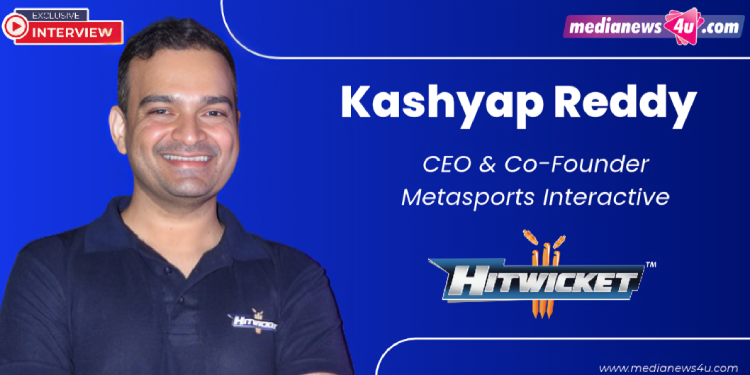
Founded by Kashyap Reddy and Keerti Singh, Metasports Interactive is an Indian gaming company behind Hitwicket, a mobile cricket strategy game that combines the sport’s competitive appeal with tactical decision-making. Launched in 2020, Hitwicket has built a global player base of over 20 million users across 120 countries. The game puts players in the roles of team owners, coaches and captains, challenging them to make strategic decisions around batting, bowling and field placements. With cricket legend Sachin Tendulkar recently joining the company as a strategic investor, Metasports is looking to accelerate Hitwicket’s global expansion, targeting 100 million downloads over the next three years.
At IGDC, MediaNews4U caught up with Kashyap Reddy, CEO and Co-founder of Metasports Interactive, to discuss the growth of Hitwicket, its user engagement and monetisation strategies, the evolving gaming investment landscape and the company’s expansion plans. In this conversation, Reddy reflects on the journey of building a differentiated cricket gaming IP, its global ambitions, the growing role of non-dilutive user acquisition funding and the opportunities for brand integrations within mobile gaming.
Q) To begin with, could you tell us about Metasports Interactive, its gaming IPs and how the company has been performing in terms of user connections, reach and engagement?
Kashyap Reddy: I am Kashyap Reddy, CEO and Co-founder of Metasports Interactive. Our flagship product is Hitwicket, a mid-core sports game based on cricket, where players take on the roles of owner, coach and captain of a virtual cricket team.
Today, we have recorded over 20 million downloads across more than 100 countries. Players spend an average of 51 minutes on the game every day, making it one of the most engaging sports games on mobile. This is even 15 minutes more than the time users typically spend on Candy Crush.
In terms of engagement and reach, we are among the leading cricket gaming experiences on mobile. Our ambition is to reach 200 million users over the next four years. We are backed by venture capital investors, including Harsha Bhogle, and have raised Series B funding.

Q) You recently secured funding focused on user acquisition. Could you explain how this funding model works and how it differs from traditional venture capital funding?
Kashyap: Traditionally, one of the primary reasons gaming companies raise venture capital is to secure funds for marketing. To put this into perspective, around 60–70% of the capital raised by a gaming company could go towards marketing. If a company raises $10 million, for instance, approximately $7 million may be allocated to user acquisition.
However, what we have realised, particularly after achieving product-market fit, is that companies need not necessarily dilute equity to finance their marketing efforts. Instead, they can access non-dilutive user acquisition capital, where they pay a relatively small percentage to the funding provider for the capital extended.
These funding companies typically have a strong understanding of the gaming ecosystem and use sophisticated machine-learning models to evaluate a game’s performance metrics and predict how effectively marketing investments can translate into revenue and profitability.
They also examine a company’s marketing track record, often over the preceding two years, before deciding whether to invest. Since these providers share the risk associated with marketing performance, they are selective about the games they support.
In our case, we have raised $20 million in non-dilutive user acquisition funding. This provides us with the ability to scale marketing without the additional equity dilution associated with conventional fundraising.
Q) Scaling and marketing an original gaming IP remain significant challenges for Indian gaming companies. Could you take us through the journey of building Hitwicket, the challenges you encountered and the opportunities that helped establish it as a successful IP?
Kashyap: It has been a long journey of experimentation and trial and error. One of the interesting aspects of the gaming industry is that there is no predefined formula for success. Every game has to be developed and refined from scratch, based on what resonates with its audience. Ultimately, nobody has a formula for fun.
When we started, we recognised two things. First, cricket had an enormous following. Second, there were already several cricket games in the market that offered relatively similar experiences. We believed there was an opportunity to create a differentiated product that would work particularly well on mobile devices.
Based on this thesis, we conducted several gameplay experiments. The current Hitwicket experience is the outcome of more than 30 experiments involving user testing and iterative development. Eventually, we arrived at a probability-based, tap-driven gameplay mechanic that we believed would remain enjoyable not just on the first day but even after 30 or 60 days.
That distinction is critical because many games can be entertaining initially but struggle to retain players beyond the first few days.
Once we had established the core gameplay mechanic, our focus shifted towards building engagement and monetisation layers. These, too, have evolved through continuous experimentation.
At any given time, we have around six or seven experiments running within the game to understand what drives engagement, which price points work better, what items users are willing to purchase and what should not be monetised. This iterative approach has helped us continuously develop Hitwicket as an IP.

Q) What does Hitwicket’s current user profile look like in terms of age, gender and geographical distribution? How does the engagement pattern differ across these audience segments?
Kashyap: We have a particularly diverse user base, which in many ways parallels the profile of an IPL viewer.
Approximately 30% of our users are above 30 years of age, another 30% fall within the 18–30 age group, and around 30% are below 18 years. Women account for approximately 20% of our user base, which is among the highest proportions for sports games and, based on the data available to us from Google and Apple, the highest among cricket games.
One of the reasons behind this diversity is the gameplay experience we have developed. Unlike several competing games that tend to skew heavily towards younger male audiences, Hitwicket is designed to be more accessible.
A single match takes approximately three minutes to play. This allows working professionals to enjoy the game between meetings or during their commute, making it accessible to a broader audience across age groups and genders.
We are available globally, with users across approximately 110 countries. India remains our largest market, accounting for around 60% of our user base. However, an interesting aspect of our business is that more than 50% of our revenue comes from outside India. The UK, the United States, Australia and the Middle East are among our key international markets.
Q) Of your overall user base, what proportion comprises paying users and how does their engagement compare with that of free users?
Kashyap: Paying users account for close to 10% of our overall user base. While an average user spends approximately 51 minutes on Hitwicket every day, a paying user typically spends around 1.5 hours daily.
Engagement is one of the most important indicators of revenue performance for us. The higher engagement among paying users demonstrates the relationship between the depth of participation and monetisation.
Q) From a monetisation and financial performance perspective, where does Metasports Interactive currently stand? Are you approaching profitability or breakeven?
Kashyap: We are very close to breakeven. However, our immediate priority is growth. We have reached a scale of 20 million downloads, but our ambition is to build a platform that reaches 200 million users.
Gaming businesses can be fundamentally cash-efficient because they typically operate with lean teams. Once the product-market fit is established, the focus shifts towards scaling marketing investments effectively.
Mature gaming companies can operate at EBITDA margins of around 45%, even at significant scale. That is the kind of operating efficiency we would ultimately like to achieve as we continue expanding.

Q) There is a wider industry perception that international gaming audiences have a greater willingness to spend than Indian consumers. Given that more than half of Hitwicket’s revenue comes from outside India, what explains this difference, and how do you see Indian gaming monetisation evolving?
Kashyap: At the individual user level, Tier-1 international markets naturally tend to generate higher revenue per user than India. However, one interesting observation from our experience is that the bigger difference is not necessarily the revenue generated by each paying user, but the conversion percentage of users who actually make a purchase.
Once an Indian user starts paying, the spending levels can be fairly comparable to those of international users.
This also indicates that consumers in India who have disposable income and are willing to spend on gaming are already spending reasonably well. That is a positive indicator for the industry.
We believe it is only a matter of time before a larger proportion of Indian consumers enter this segment. Increasingly, we are seeing this trend develop.
Q) Beyond Hitwicket, what are Metasports Interactive’s plans for developing additional gaming IPs? Are you looking at expanding into other sports?
Kashyap: So far, our focus has been entirely on cricket. However, we have realised that the playbook we have developed with Hitwicket, spanning gameplay engagement, monetisation and user acquisition funding, can potentially be replicated across other sports.
We have a couple of other games in the pipeline, which we expect to launch over the next three to four months. These will mark the next phase of our IP expansion.
Q) In content and entertainment, cultural relevance plays a significant role in determining how an IP connects with audiences across markets. How does this translate into gaming? Do cultural nuances influence your IP development and market expansion strategies?
Kashyap: If you look at successful games such as Candy Crush or PUBG, they have demonstrated that gaming experiences can remain relevant across markets despite cultural differences.
The most important foundation of any successful game is its gameplay. It has to be genuinely fun. Once users are hooked on the core experience, developers can introduce culturally relevant events and experiences on top of it.
For instance, we can introduce special events around Diwali, Halloween or Christmas to make the experience more relevant to specific markets.
However, the underlying game should have global appeal. Most successful games are built around fundamental aspects of human behaviour, which transcend geographical boundaries. While there are exceptions of games that become particularly successful in specific markets such as Japan or China, successful gaming IPs generally have the potential to travel across markets.
Our philosophy is to establish a strong, universally appealing gameplay experience first and then build culturally relevant layers around it.

Q) There is growing interest in integrating brands into gaming environments, with major advertising networks such as GroupM and WPP exploring opportunities across entertainment and interactive formats. Would Metasports Interactive be open to collaborating with such agencies to integrate brands into IPs like Hitwicket?
Kashyap: Absolutely. Today, users spend more than 15 minutes on our game every day, and that presents an interesting opportunity for brand integrations.
The key, however, is to ensure that advertising is not intrusive. We need to identify opportunities where users can engage with brands while playing, without disrupting the overall gaming experience.
The IPL has demonstrated how brand integrations can be incorporated into an entertainment environment without necessarily breaking the viewing experience.
We are thinking along similar lines. Rather than simply replicating conventional banner advertisements, we would prefer to explore deeper integrations that are more organically embedded within the gameplay and overall user experience.