






Our goal with The Daily Brief is to simplify the biggest stories in the Indian markets and help you understand what they mean. We won’t just tell you what happened; we’ll tell you why and how too. We do this show in both formats: video and audio. This piece curates the stories that we talk about.
You can listen to the podcast on Spotify, Apple Podcasts, or wherever you get your podcasts and watch the videos on YouTube. You can also watch The Daily Brief in Hindi.
In today’s edition of The Daily Brief:
1. Coal India’s largest subsidiary goes public
Mahanadi Coalfields (MCL), which mines a fifth of India’s thermal coal, is heading for a massive IPO. Because this is an offer for sale, all proceeds will go directly to parent company Coal India, not MCL. Buyers get a minority stake in a highly efficient, volume-driven mining machine that reliably pays out 80% of its profits as dividends. However, its upside is capped by Coal India’s strict pricing controls, and it faces a massive, unpredictable ₹31,000 crore retrospective tax threat from Odisha that could wipe out years of profit if a recent parliamentary amendment fails to hold.
2. India’s wire wars embrace its new challengers
India’s largest wires and cables (W&C) makers posted explosive 40% to 53% revenue growth this quarter, largely driven by surging retail demand for house wires rather than industrial cables. Seeing this retail momentum, massive challengers like UltraTech Cement and Crompton are aggressively entering the wires space, leveraging their massive existing distribution networks to cross-sell to builders and homeowners. With rising copper prices already pushing price-sensitive buyers toward cheaper unorganized brands, incumbents are being squeezed from both ends. To protect their moats, legacy players like Polycab and KEI are increasingly retreating to highly-regulated, high-voltage industrial cables and export markets where new entrants cannot easily follow.
Coal India’s largest subsidiary goes public
Last financial year, a single company dug out more than a fifth of all the thermal coal India produced. Its mines sit in two coalfields in Odisha, Talcher and Ib Valley. It earned ₹10,698 crore in profit on ₹30,550 crore of revenue.
That company is Mahanadi Coalfields, or MCL, a wholly owned subsidiary of Coal India, which now wants to sell ~10% of MCL to the public. This is an offer for sale where an existing shareholder sells its shares to new investors, and the money goes to the seller. MCL itself won’t get a rupee; all of it goes to Coal India. And by some estimates, the deal could value MCL at up to ₹94,600 crore.

So, what will buyers be getting?
Mainly, a minority stake in a company that will stay 90% owned by Coal India, which the government controls. Coal India sets the price at which most of MCL’s coal is sold. MCL’s executives are seconded from Coal India meaning they are Coal India employees posted to MCL, though MCL pays their salaries.”. And as the controlling shareholder, Coal India has the final say on dividends.
MCL is the third Coal India subsidiary to head to the market this year. There was Bharat Coking Coal (BCCL) which listed in January, and Central Mine Planning & Design Institute (CMPDI) in March. Moreover, South Eastern Coalfields (SECL), India’s second-largest producer of thermal coal after MCL, filed its own draft papers on November 1.
All of these listings are part of a larger divestment program undertaken by the government to introduce market forces to the functioning of PSUs. But will listing its subsidiaries one by one unlock value for Coal India, or leave it trading like a holding company that’s worth less than the sum of its parts? That will take a few years to answer.
But the buyers of MCL also get one of the best coal assets in the country, a business that hands most of its profit back to its owners, and a business whose fortunes hinge on how much coal India’s power plants still want.
The coal MCL sells
Let’s start with the kind of coal MCL dabbles in.
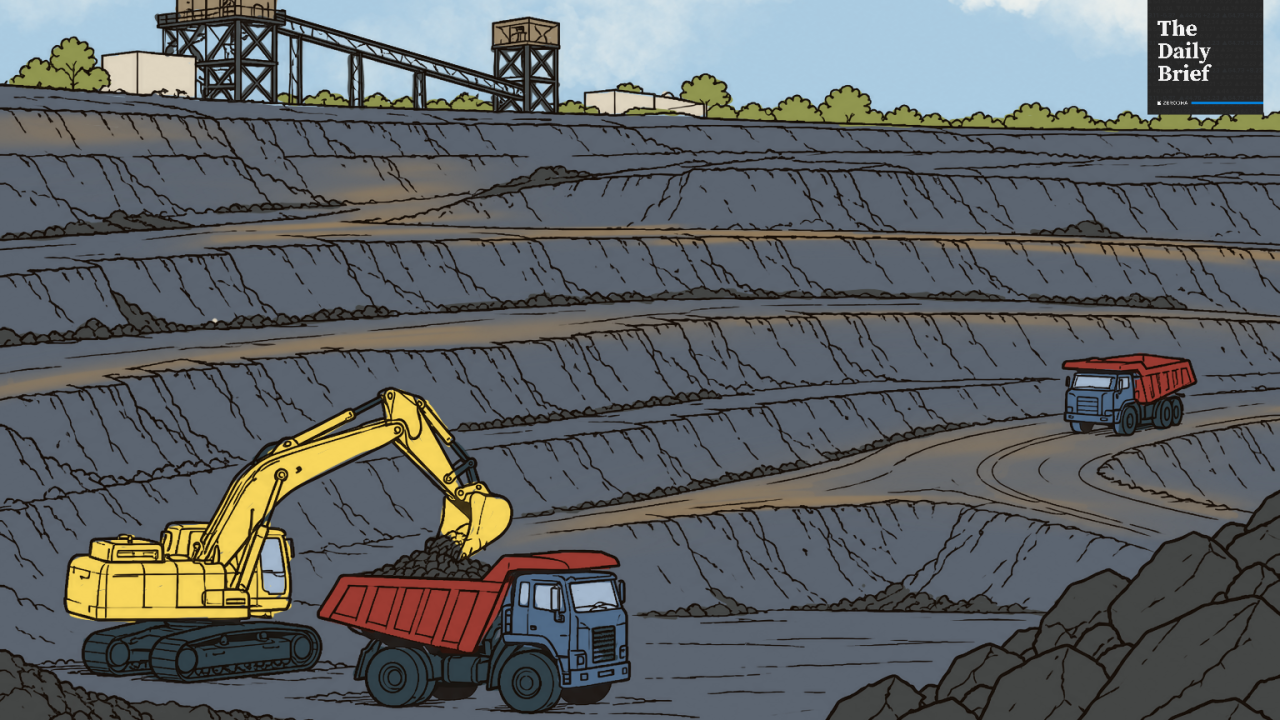
MCL’s coal lies in thick, continuous seams close to the surface. About 79% of its resources are within just 300 metres of the ground. That means MCL can mine almost entirely from open pits without using underground tunnels by merely scraping away the soil and rock on top. In FY26, 99.4% of its coal was cut by shaving coal off the seam in thin layers without blasting.
That makes MCL unusually efficient. It produces about 2.4 times as much coal per worker-shift as the Coal India average. As per CRISIL, MCL also has the lowest production cost per tonne of any Coal India subsidiary. Interestingly, MCL’s own employees dig only about 18% of that coal. Contractors and outside mine operators do the rest. If you wish to know more about the history of India’s shift to opencast mining and subcontracting, we highly recommend our Subtext episode with economic historian Rohit Chandra.

The trade-off is quality, which is a well-known problem with open-pit coal. Thermal coal is graded from G1 to G17 by its gross calorific value (GCV), which measures how much heat a kilogram gives off when burned. G1 is the best. MCL’s coal averages G13, against G11 for Coal India as a whole. Most of its reserves sit between G10 and G14, and even its washed coal carries about 33–34% ash, the unburnable rock left behind.
Grade decides price. In FY25, Coal India’s notified price for G13 coal was about ₹990 a tonne, against ₹3,410 for G3. MCL’s business is mostly a volume play rather than a value one.

Grade also decides who can buy it. Low-grade coal works in power plants designed for Indian coal. It doesn’t suit the roughly 18,000 MW of coastal plants built for imported coal, or industries like cement and sponge iron that need hotter, cleaner coal. MCL’s most natural customer, then, is the power sector, which bought about 69% of its coal by value in FY26. Government-owned power generators alone brought in about 45% of its revenue.

Most of that coal is sold at a price MCL doesn’t set. About 82% of its sales come through fuel supply agreements, or FSAs, which are long-term contracts (mostly with power plants) at prices fixed by Coal India. These “notified prices” exist to keep coal reliable and affordable for regulated sectors such as power. MCL gets no subsidy. The system is built to protect its customers, not its margins.
The rest of its coal goes through e-auctions, where buyers bid a premium over the notified price, or through “flexi linkage”, which lets power plants buy extra coal at a 40% premium.
The fundamentals
How has MCL’s business done recently?
In FY26, MCL’s revenue fell 2.6% to ₹30,550 crore. However, the volume of coal dispatched held steady at the unimaginable scale of 211 million tonnes. What fell was price: MCL earned about ₹1,450 a tonne, down from ₹1,490 the year before.

Costs didn’t fall with revenue, crunching margins. MCL’s EBITDA fell about 7% to ₹12,735 crore. Depreciation jumped 49% as new equipment came into use.

Yet, despite that, reported net profit barely moved at ₹10,698 crore, against ₹10,825 crore the year before. This was primarily because in a one-off, MCL’s other income doubled to ₹3,350 crore, ₹1,164 crore of which was interest on income-tax refunds from earlier years. In each of the two years before, that line item was under ₹20 crore. Without it, profit would have fallen around 9%.
Still, the machine works, and shareholders know it too well. It has paid out between 73% and 81% of its profit as dividends in each of the last three years, ₹8,400 crore for FY26 alone. Even after that, it had about ₹16,000 crore in cash, bank deposits and investments at the end of March. For a minority shareholder, large, consistent dividends are the best attraction.

But how long that cash keeps coming depends on one particular type of customer: power plants.
What power demand means for MCL
MCL’s future rides on how much coal power plants burn, and this year sent a warning of sorts.
For the first time in a non-pandemic year, India generated 4% less electricity from coal and lignite than the year before, while wind and solar generation grew 27% and 20%. Power plants were also already getting all the coal their contracts promised them, so they had little reason to bid for extra. That might help explain why the premium MCL earned at auctions fell from ₹802 a tonne in FY24 to ₹275 in FY26.

CRISIL still expects power-sector coal demand to grow to 843 million tonnes by FY31, though at a slower 2.2% a year over the next decade. India plans to add 80 GW of new thermal power capacity by FY32, and coal still keeps the grid steady to meet peak demand, which renewables can’t yet do at scale without a battery ecosystem.
MCL is betting on that future. It is building coal-handling and loading capacity of 336.5 million tonnes a year by FY30, against 218 million tonnes of production today. If power demand keeps growing — and this is likely to be the case — MCL’s low costs make it the biggest winner.
But it will have more competition. Captive and commercial mines, run by private companies and other users, went from 10.9% of India’s coal output in FY22 to 20.2% in FY26.
The risks
The biggest risk MCL faces isn’t power demand, though. It comes from a question India’s courts and Parliament have fought over for decades, which is, can a state tax the minerals under its soil?
You see, back in 2004, the Odisha government had imposed a levy of 15% of the annual value of coal mined in the state as per its ORISED Act. The state High Court struck it down in 2005, and Odisha’s appeal is still pending in the Supreme Court. However, a ruling in 2024 which clarified that a royalty on mining rights is not the same as a tax let states collect such taxes retrospectively from April 2005.
So, until August 2026, MCL stared at years’ worth of dues appearing out of nowhere. As per Coal India’s estimate, MCL might owe over ₹31,000 crore if Odisha’s claim succeeds. Spread over 12 years, that would be roughly ₹2,600 crore a year, or about a quarter of last year’s net profit.
This is still only a contingent liability, though, for which no bill has arrived. Odisha hasn’t raised a fresh demand, and its appeal is still pending, so MCL’s accounts describe the impact as “not ascertainable”. The CAG, however, has faulted that note, arguing that since Coal India has already put a number on the risk, MCL should disclose it.

However, in August, the Centre stepped in with an amendment which may turn into MCL’s lifeline. The parliament amended the MMDR Act to strip states of the power to levy taxes on mineral rights or mineral-bearing land without central approval, and invalidated all uncollected past dues. We covered this development and its myriad implications for states.
As a result, MCL’s ₹31,000 crore problem would effectively not exist anymore. Yet MCL itself hasn’t said what the amendment means for it. The DRHP mentions the law only in the industry report written by CRISIL. MCL’s own risk factors are silent on it, and its list of key regulations stops at the 2025 amendment. That may simply be down to when the DRHP was filed, but it leaves investors without the company’s own view on all of this.
The amendment’s footing itself is a little shaky. The 2024 judgment said Parliament’s power to limit state taxes on minerals doesn’t extend to taxes on land, and while the Parliament can change a law retrospectively, it can’t simply overturn a court’s verdict. It’s why Karnataka, Kerala, Telangana and Jharkhand have either challenged, or are planning to challenge the amendment.
Odisha’s current government backs the amendment, but if the Supreme Court decides in favor of the challenging states, that might set a precedent.
Even if the tax goes away, this could reach MCL through higher royalties. In 1989, when states’ power to tax minerals was first taken away, the Centre compensated the loss by raising royalty rates. It has again promised to make good any shortfall in state revenue, the cost of which could land on MCL.
Beyond MMDR, the DRHP flags a few smaller risks: a ₹35,195 crore commitment for its Siarmal mine that the CAG says MCL didn’t disclose, a court direction to deposit ₹1,504 crore more to compensate displaced villagers, ~₹3,500 crore in disputed royalty and penalty demands for coal mined beyond approved limits, and payment times that have stretched to ~41 days from 28.
Conclusion
MCL sits on some of the easiest coal to mine in India and digs it more cheaply than any other company in the Coal India group. It sells most of it under long-term contracts to power plants that need it, and it hands most of what it earns back to its owners. That makes for a great business.
But Coal India decides the price of its coal and how much of its profit flows out as dividends. India’s power plants decide how much coal they burn. And the courts will decide whether Odisha, the state that holds all of MCL’s mines, gets to tax them.
None of that makes MCL a bad bet. It just makes it a particular kind of bet: one on India’s appetite for coal, and the ability of the government to steer it, more than on MCL itself.

India’s wire wars embrace its new challengers
This quarter, Polycab, India’s largest wires and cables (W&C) maker, highlighted something on their earnings call that caught our attention. Asked about new competition entering the business, Aditya Nathany, Head of Investor Relations mentioned:
The heat is on the ones who are wires heavy.

His point: wires are a small part of Polycab’s business, so if anyone feels the heat from new rivals, it will be the companies that depend more on wires than cables.
As we’ve written before, wires and cables aren’t the same thing: Wires are the single-core lines that run inside your homes to fans and lights, sold through dealers and electricians; while cables bundle many conductors for heavier jobs, like carrying power to a factory.
For most of the past year, cables were the story we kept coming back to. Electric grids and solar farms were buying heavy-duty cables, and the companies were spending thousands of crores to make more of them.
This quarter, though, the fastest-growing vertical of the business was the humble wire, even at a cable-heavy company like Polycab. And that’s exactly the part of the market, two new entrants (UltraTech Cement and Crompton) have just stepped into. Both are among India’s biggest names in consumer goods and building materials.
Wired up
W&C revenue at the four big listed players grew between 40% and 53% from a year ago. At the company level, Polycab, KEI and RR Kabel all grew their profits by more than a quarter.

But the revenue growth tells only part of the story. Some of it came from higher metal prices rather than companies actually selling more wires and cables. That’s because W&C makers largely work on a cost-plus model: when copper or aluminium prices rise, they pass the increase on to buyers. Polycab, for instance, revises wire prices every fortnight and cable prices every month.
And copper is the biggest cost in making a wire. At Finolex Cables, it makes up 70-75% of raw material costs, and Polycab says copper prices were 40-45% higher on average in the first half of this financial year than a year earlier. Havells, for its part, says it has raised its cable and wire prices by more than 30% over the past twelve months.
But rising metal prices aren’t always good news for manufacturers, and falling prices can hurt too. When metal prices like aluminium drop, a company has to cut its own prices quickly, while it is still selling products made from metal it bought at the higher price. Havells said a fall in aluminium prices during the quarter hurt its cable business, and its W&C margin slid from 13.7% to 10.1%. KEI said its fatter margin in the June quarter came partly from the rising value of its inventory.
So what’s left once you strip the metal out? Last quarter, we wrote about dealers holding back orders in June, when copper and aluminium prices suddenly fell. We asked whether Polycab and KEI could deliver real volume growth rather than just price growth.
The answer is yes, but modestly. In volume terms, Polycab grew in the mid-to-high single digits, RR Kabel in the high single digits, and Havells close to double digits. None of them give exact figures, and KEI gives none at all. That growth comes on a strong base, though: Polycab had grown volumes by 18% in the same quarter last year.
More interestingly, wires grew much faster than cables. At Polycab, wire volumes grew in the early double digits, against mid-single digits for cables, and it was the second quarter running that wires led. RR Kabel saw the same split, with wires growing in double digits and cables in single digits.
For Polycab, this surge in wires is partly due to real estate. It says the industry is now seeing demand from the roughly 3.8 lakh homes sold and launched in 2024, as electrical wiring is used for buildings near completion. Polycab also said its sales through dealers grew faster than its sales to institutions.
KEI shows a similar story, even though it is primarily a cable company. It doesn’t split its wire and cable verticals, but it does report how much it sells through dealers and distributors (the channel electricians, contractors and smaller builders buy from). Those sales grew about 50% from a year ago, while the rest of KEI’s business grew about 24%. Five years ago, dealers made up about 40% of KEI’s sales. Today, they make up 59%; but this isn’t purely a wires number.

Strong demand at the retail end is exactly what makes wires attractive to new entrants.
In September 2026, UltraTech Cement, India’s largest cement maker, launched its own W&C brand, Ultravolt, backed by an investment of ₹1,800 crore. Its Gujarat plant can make about 1.1 million km of wire a year, which the group says makes it India’s second-largest wire maker by capacity. Centrum Broking states it is only about 5% of the industry’s total plant and machinery.
UltraTech does have a head start with distribution: Real estate developers buy cement months before they buy wires, and UltraTech says that gives it a four-to-six-month lead in finding those buyers. With a strong distribution presence in cement and 5,000-plus outlets, it can definitely cross-sell. And Ultravolt is starting mainly with house wires. If the playbook sounds familiar, it’s because, as we wrote before, the Birla group did something similar in paints, with Birla Opus. The other newcomer is Crompton, best known for its fans. It launched house wires in June 2026, starting with southern states like Tamil Nadu, Karnataka and Telangana before going national. Its pitch is a brand Indian households already know, and a distribution network that already sells into their homes.
This brings us back to Nathany’s point about who feels the heat. Wires are only about a quarter of Polycab’s W&C sales, and about a fifth of KEI’s. For RR Kabel, they are about 73%, and for Havells, 60–70%. Those are the companies with the most to lose if a newcomer starts winning over dealers and electricians.

The size of the existing players also puts the new entrants’ ambitions into perspective. Reports estimate that Polycab holds about 22% of India’s ₹1.1 lakh crore W&C market, counting unbranded makers, against about 9% for KEI, 8% for Havells and 6% for RR Kabel. By Polycab’s estimate, wires make up about 30% of that market, or roughly ₹33,000 crore. At industry norms, Ultravolt’s plant could generate ₹9,000-10,000 crore of revenue at full use, though no new plant runs at full use for a while, and not all of that would be wires. Polycab, unsurprisingly, thinks UltraTech’s ambitions look elusive for now.
On their calls, the incumbents mostly played competition down. Nathany said he isn’t seeing any sort of pricing correction, and pushed back on an analyst’s question suggesting the newcomers were pricing wires 10–15% below incumbents. KEI’s CFO, asked whether it had changed prices or dealer incentives, said its twice-a-month price revisions were nothing new, nothing abnormal. RR Kabel said competition was always there and that it has its own growth plans. RR Kabel did trim its full-year volume growth target to 14–15%, from 16–18%, but blamed general market volatility rather than competition, and one quarter is too early to read more into it.
Havells was the most candid, and it drew a sharp line between the two newcomers. Chairman Anil Rai Gupta dismissed Crompton, a direct rival in fans and appliances, as one of many brands that had launched products with “no technology, no factory”, leaning only on their brand and distribution. He said UltraTech, which has actually built a plant, is one he would treat with more respect. He also conceded that “irrational” behaviour from new competitors could cost incumbents some market share, or some margin, for a while.
The pressure in wires isn’t only coming from newcomers. By Polycab’s estimate, 30-35% of the wires market is still unorganised. Gupta said that share had been shrinking for years, but has started growing again over the last couple of years because of high inflation (rise in the prices of branded wires). The likely reason: as copper has pushed branded wire prices up, cheaper unbranded wire has become more tempting. So wires are being squeezed from two directions: deep-pocketed brands at the top, and unbranded makers at the bottom. Gupta’s hope is that new organised players usually win shares from the unorganised end first. Which way it breaks will matter most to the wire-heavy players.
Where do the W&C incumbents focus?
If wires are getting crowded, cables are far harder to break into. Heavier cables need years of approvals and large, specialised plants, so a newcomer can’t follow quickly. That is where the incumbents’ focus sits: in high-voltage cables, in exports and, in a small way, in fibre.
These plans were taking shape well before UltraTech announced Ultravolt. For instance, Polycab’s high-voltage cable expansion plans, KEI’s new plant in Sanand, and RR Kabel’s exports were independent of domestic competition.
One area, we’ve written before, is extra-high-voltage (EHV) cables, which carry electricity across grids and require strict certifications that take years to secure.
KEI is furthest along here. Its EHV sales grew 26% to ₹217 crore this quarter, but that is still only about 6% of its W&C sales, so it is building more capacity. KEI has spent ₹1,876 crore on its new plant at Sanand, Gujarat, with actual production by March 2027.
Polycab is also building an EHV plant of its own, spending ₹609 crore on capex, though it now expects it in FY28.
W&C exports are the second route. RR Kabel, the most wire-heavy of the lot, has gone furthest. Exports rose to 32% of its revenue this quarter, from 27% a year ago, and it says they are tilting from wires towards cables as new cable capacity comes online. It adds three to four international approvals every year. Meanwhile Polycab’s exports grew 17%, but they are only about 5% of revenue, down from 6.5% a year ago, simply because its domestic business grew faster.

The third route is the smallest so far: expanding into optical fibre cables. In our story, data centres are using optical fibre specifically, while copper still carries electricity. And it’s worth chasing. Polycab puts India’s data centre capacity at 1.6 GW with future estimates at ~10 GW. Polycab supplies conventional cables for data centres, and is working on others. RR Kabel bought UM Cables’ optical fibre business for ₹77 crores.
Rewiring the future
House wires carried this quarter, but the incumbents are betting that cables will carry the next few years, in the places where newcomers can’t simply buy their way in. Polycab, for one, still aims to grow its wire and cable volumes at 1.5 times the industry’s pace.
Meanwhile, the wire market is about to be tested. Ultravolt and Cromption both have the brand and distribution to enter Indian homes. The next few quarters should tell us whether India’s wire market is as easy to enter as it looks, and whether the companies that depend on it most can hold their ground.
– This edition of the newsletter was written by Kulsum & Zarieus
Tidbits:
[1] PLI schemes meet just 28% of employment target by FY26, says NITI Aayog
NITI Aayog’s first assessment of India’s 14 production-linked incentive (PLI) schemes shows they created 849,069 jobs by FY26 against a target of 3 million, even as they reached 76% of their investment target. The think tank advised against judging the schemes too early, noting that 42% of the aggregate implementation period is still remaining, and recommended adding demand-side support to future schemes.
Source: Business Standard
[2] MSCI adds LIC, Coforge, Adani Green and Meesho to its India Standard Index
MSCI has added the four stocks to its India Standard Index in its November review and removed PI Industries, with the changes taking effect at the close of November 30. The rejig will raise India’s weight in the index from 12.9% to 13.1%, and Nuvama expects Coforge to see the largest passive inflows at $630 million, followed by LIC at $468 million.
Source: Business Standard
[3] Netherlands remains among top buyers of Indian fuel as origin tracking proves difficult
The Netherlands remains the third-largest buyer of India’s refined petroleum products, even as India continues to buy Russian crude oil. Dutch authorities acknowledged that complex global refining supply chains make it difficult to trace the exact crude origin of imported fuels, allowing Indian petroleum exports to keep flowing into European hubs.
[4] Hero Group’s ₹210 crore semiconductor bet is now worth over ₹2,800 crore
Hero Electronix, the Hero Group’s technology arm, first bought a stake in Tessolve in 2016, when the Bengaluru-based firm was largely a chip-testing business. Tessolve has since grown into a full semiconductor engineering company that counts 18 of the world’s 20 largest semiconductor companies among its customers, and it has raised funding from TPG and Vector Line Capital.
[5] CAG to launch in-house AI model to help auditors analyse financial data
The Comptroller and Auditor General of India (CAG) will launch its own large language model (LLM), developed by IIT Madras and trained on 65,000 internal inspection reports. The model will have three streams, one each for compliance, financial and works audits, and auditors will only be able to query existing reports, not upload new data.
Source: Business Standard
Want more tidbits? Catch up on last week’s recap!
Beyond Today’s Brief
There’s always more happening at Markets by Zerodha.
- The Chatter: What is Sunil Mittal’s strategic vision for Bharti Airtel amidst the evolving telecom landscape? And how is Hitachi positioning itself to capture demand across India’s infrastructure and technology sectors?
- Aftermarket Report: What dragged the markets down as Nifty’s three-day rally finally ran out of fuel? And which sectors faced the brunt of the selling pressure as momentum stalled?
Join us on WhatsApp, where we share interesting soundbites from concalls, articles, and everything else we come across throughout the day. You’ll also get notified the moment a new video or article drops so that you can read or watch it right away.
This post was first published on Substack.
Thank you for reading. Do share this with your friends and make them as smart as you are 😉