









The Ukrainian Embassy in Israel sent an official letter of protest to Culture and Sports Minister Miki Zohar over an exhibition hockey game scheduled to take place in Ashdod on Sunday evening, warning that Moscow could exploit the event to promote its international standing despite the ongoing war in Ukraine.
The Ukrainians fear that Moscow will use the event, intended to mark 35 years since the renewal of diplomatic relations between Israel and Russia, to portray itself as returning to normal relations on the international stage despite the war in Ukraine. In the letter sent to Zohar, the embassy called on Israeli authorities to examine the participants’ identities, the event’s funding sources, and their possible ties to Russian government officials.
The game, titled “Russian Hockey Legends vs. Israeli Stars,” is scheduled for 8 p.m. at the Blue Ice Arena in Ashdod. Among those expected to participate is Vyacheslav Fetisov, a former hockey star and member of the Russian parliament who is subject to international sanctions. His possible attendance is one of the central concerns raised by the Ukrainian Embassy with the minister.
The letter, signed by Hennadiy Breskalenko, deputy head of Ukraine’s diplomatic mission in Israel, states that the participation of prominent Russian representatives in a public event raises “serious political, moral and reputational concerns” at a time when Russia continues to attack civilian populations and critical infrastructure in Ukraine.
The embassy expressed “deep concern and strong opposition” to the event going ahead in its planned format and called on Israel to examine its implications before the game begins..
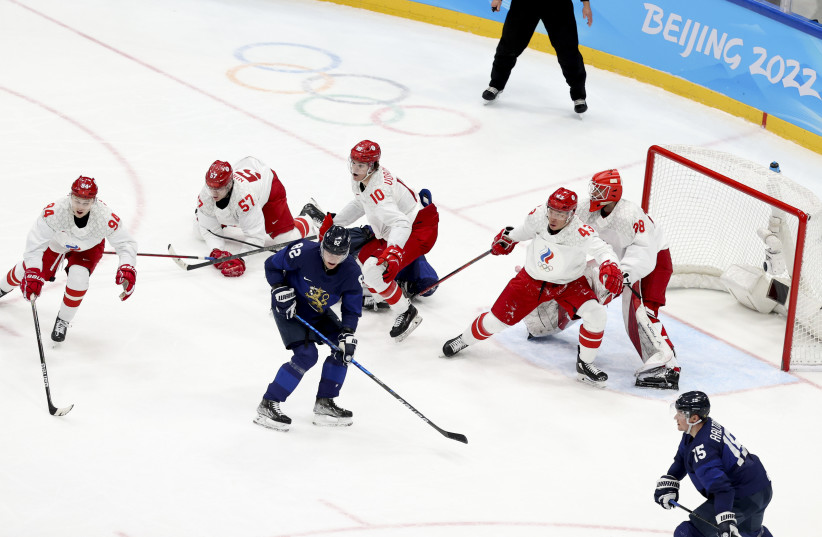
Ukraine warns of sanctions evasions
The issue of sanctions features prominently in the appeal. The embassy emphasized that sanctions imposed by the European Union and the US do not automatically apply in Israel, but argued that the possible participation of sanctioned individuals requires examination by the relevant authorities.
Among other things, the Ukrainians asked Israeli authorities to ensure that the event would not facilitate sanctions evasion, prohibited transactions, or other activities contrary to applicable Israeli law.
The embassy did not claim in its letter that the mere participation of a sanctioned individual violates Israeli law. Rather, it demanded an examination of the possible legal implications of such participation.
The letter outlines five areas requiring examination: the identities of the organizers and sponsors, sources of funding, possible connections to Russian state institutions, the sanctions status of participants, and the diplomatic implications of the event.
The authorities were also asked to take steps to prevent the dissemination of Russian propaganda, justification of the war, or public promotion of individuals associated with Kremlin policies.
Kyiv fears hockey game could serve Russian propaganda efforts
Kyiv’s primary concern is that Moscow will use the game for propaganda purposes.
The letter argues that Russia systematically uses sporting and cultural events to promote political messages, improve its image and divert attention from the war. The Ukrainians warn that even an event presented as an ordinary sporting encounter could become a platform that lends legitimacy to representatives of the Russian establishment.
According to the embassy, it is precisely the ostensibly apolitical nature of such gatherings that allows Moscow to present its representatives’ participation as part of a return to normal international relations.
The embassy is particularly concerned about how the game will be portrayed afterward.
According to Ukrainian officials, Russian state-controlled media outlets could present the event in Israel as evidence that Moscow’s diplomatic isolation is weakening and that relations with Russia are returning to normal.
The letter states that such a message would be particularly offensive to Ukrainian citizens, who continue to bear the consequences of the war.
The concern is that even without any official Israeli political statement, the mere staging of the event in the presence of prominent Russian representatives could be used by the Kremlin to project an image of international acceptance.
The appeal follows a July 28 meeting between Ukrainian Ambassador to Israel Yevgen Korniychuk and Zohar.
The embassy was careful to clarify that it does not oppose international sporting encounters in principle. Its objection concerns the participants’ identities and the possibility that the game could be exploited for political purposes.
The letter itself does not explicitly demand that the game be canceled. Instead, it asks Israeli authorities to examine the circumstances surrounding the event and take preventive measures in accordance with their powers and Israeli law.
The timing is particularly complicated and sensitive for Kyiv. An event intended to celebrate relations between Israel and Russia is taking place as Ukraine works to maintain international pressure on Moscow.
The embassy’s concerns also extend to the diplomatic significance of representatives of the Russian establishment participating in a public event in Israel, while Western countries continue to impose restrictions on individuals connected to the government in Moscow.
The Ukrainians are now asking Israel to examine the event and its participants to ensure that the hockey game in Ashdod is not exploited as part of Russia’s efforts to rehabilitate its international standing.