








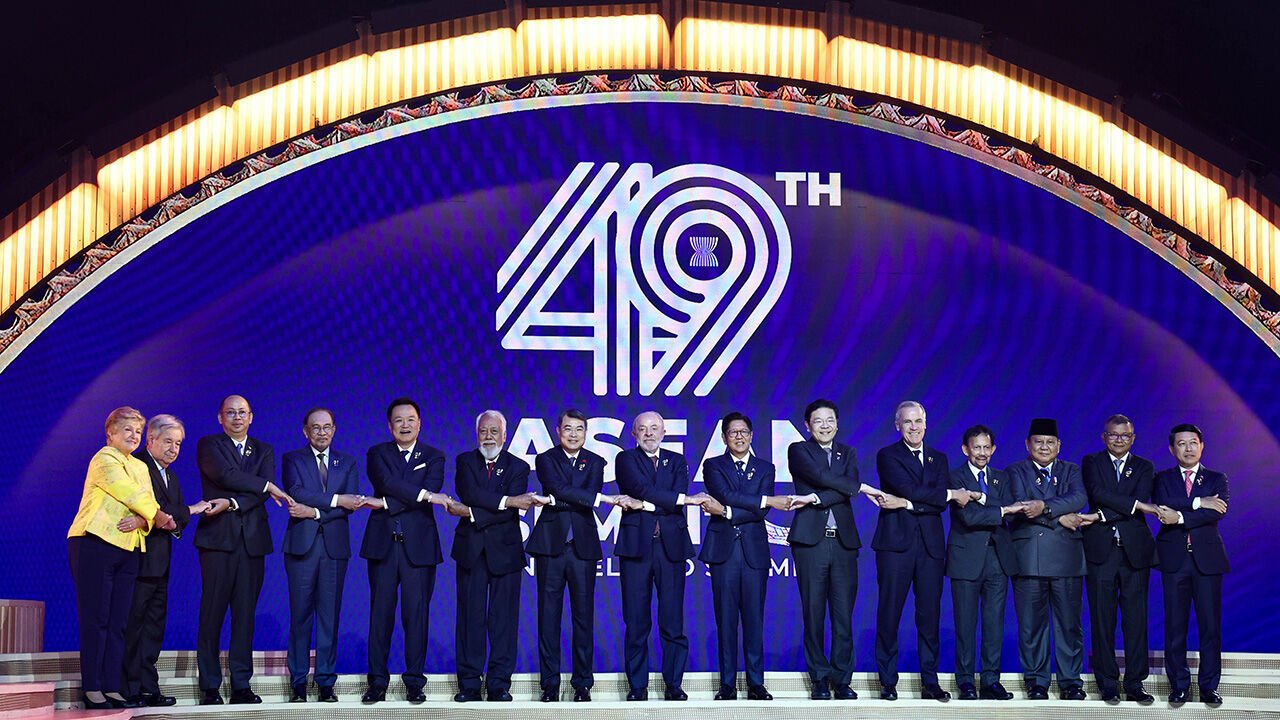
▲ Leaders of ASEAN member states and other countries shake hands during the opening ceremony of the Association of Southeast Asian Nations (ASEAN) Summit held in Manila, Philippines, on November 15 (local time).
The ASEAN Summit, a stage for summit diplomacy bringing together leaders from the Association of Southeast Asian Nations (ASEAN) member states and major countries including South Korea, the United States, and Japan, kicked off its three-day schedule in Manila, Philippines, on November 15 local time.
The event is attended by world leaders including ASEAN member states’ leaders, South Korean President Lee Jae-myung, U.S. President Donald Trump, Chinese Premier Li Qiang, Japanese Prime Minister Sanae Takaichi, Indian Prime Minister Narendra Modi, Australian Prime Minister Anthony Albanese, Canadian Prime Minister Mark Carney, and United Nations Secretary-General Antonio Guterres.
U.S. President Trump, visiting Asia for the first time since the crushing defeat in the midterm elections, will arrive at the venue on November 17, the final day of the event.
The South China Morning Post (SCMP) reported that President Trump is expected to hold a summit with ASEAN and urge Southeast Asian nations to join “Pax Silica,” a U.S.-led artificial intelligence (AI) supply chain consultative body.
It is also reported that he will hold the Quad summit—a four-way security consultative body involving the U.S., Japan, Australia, and India—for the first time in two years to discuss responses to China’s expanding military influence in the Indo-Pacific region.
After solidifying support from allies and partner countries through these efforts, he plans to attend the Asia-Pacific Economic Cooperation (APEC) summit held in Shenzhen, China, on November 18 to 19, where he aims to hold a summit with Chinese President Xi Jinping and the first-ever trilateral summit involving the U.S., China, and Russia, which would include Russian President Vladimir Putin.
The White House confirmed plans to hold the trilateral summit on November 13.
On this day, ASEAN member states’ leaders held consecutive opening ceremonies, member state summit sessions, and closed-door meetings to discuss issues such as the situation in Myanmar.
Philippine President Ferdinand Marcos Jr., the leader of the host country, stated that member states agreed to pursue “constructive and principled engagement” regarding Myanmar.
This signifies a stance to adhere to the existing policy of demanding the implementation of the five-point peace consensus—including an immediate end to violence—which ASEAN extracted from the Myanmar military junta immediately following the 2021 military coup.
President Marcos said that amid the suffering of the Myanmar people, leaders must ask themselves, “What more can we do for Myanmar?” and expressed hope that ASEAN can advance the implementation of the five-point peace consensus.
The Myanmar regime, which shifted its facade from a military junta to a civilian government this year, is actively pursuing the restoration of relations with ASEAN, and some member states such as Thailand and Malaysia are supporting this.
However, Philippine Foreign Secretary Theresa Lazaro told Kyodo News the previous day that the restoration of relations with Myanmar will be left entirely to Singapore, which will serve as the rotating ASEAN chair next year.
ASEAN leaders also sought directions for joint responses to soaring energy costs driven by the Middle East war and discussed peaceful resolution methods for the territorial disputes in the South China Sea.
Member states experiencing economic difficulties from the war due to their high dependency on Middle Eastern oil and gas are expected to discuss ways to strengthen energy security, such as establishing a joint ASEAN petroleum reserve.
Japan is also reportedly planning to support ASEAN’s joint petroleum reserve initiative.
In the South China Sea issue, which is the most significant point of contention between ASEAN and China, the focus is on negotiations to establish a South China Sea Code of Conduct to prevent clashes between countries.
This year, both ASEAN and China made progress by reaching tentative agreements on about 80 percent of the total clauses in the Code of Conduct, but core issues such as legal binding force remain, making it difficult to achieve the original goal of a year-end conclusion, according to reports.
Citing a draft of the summit’s joint communiqué, the Associated Press reported that the likelihood of a breakthrough regarding these issues during the meeting appears small.
Meanwhile, President Lee Jae-myung will maintain a busy diplomatic schedule by consecutively attending the ASEAN-Korea Summit, the Mekong-Korea Summit on November 16, and the ASEAN Plus Three (South Korea-China-Japan) Summit and East Asia Summit (EAS) on November 17, while holding bilateral talks with leaders of various countries including host nation the Philippines in between.
Japanese Prime Minister Sanae Takaichi also plans to seek dialogue with President Trump through the Quad summit and other events during the meeting period.
Once the meeting concludes on 17, many participating leaders will immediately move to Shenzhen to continue summit diplomacy at the APEC summit.
(Photo: Yonhap News)
※ Please note: This article was translated by AI and may contain errors.