







Organisers from four countries told the South Asia Union Summit how women shaped recent uprisings and were often sidelined afterwards.
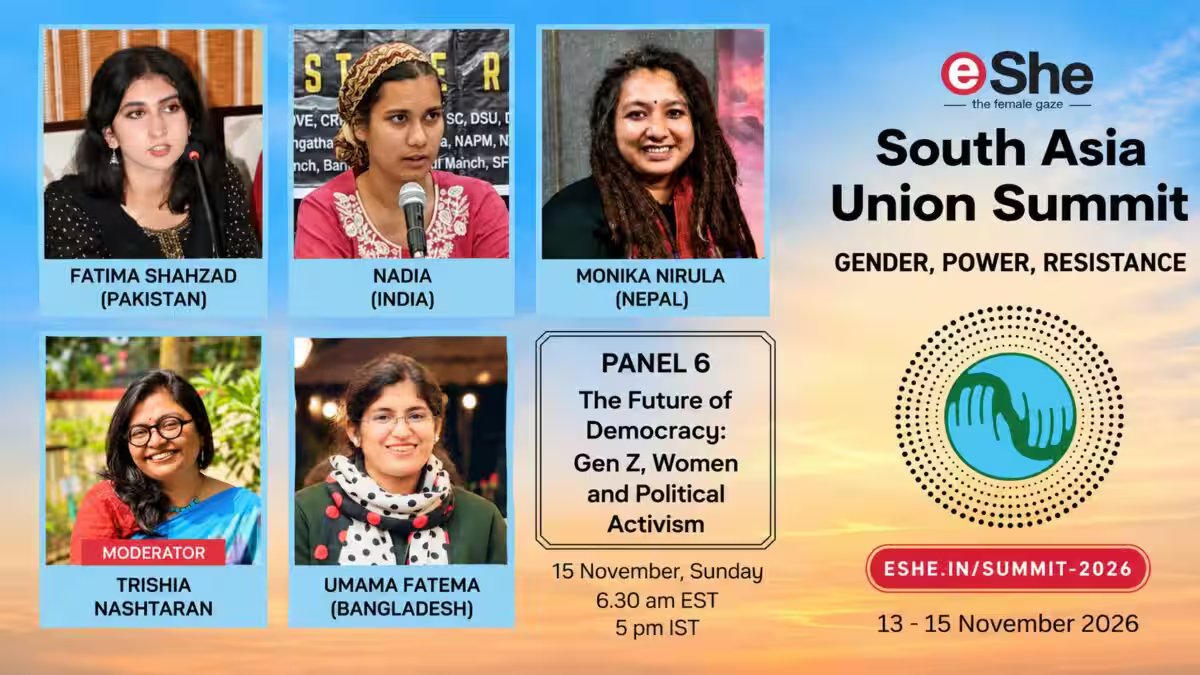
Four young women who took part in uprisings in Bangladesh, Nepal, India and Pakistan spoke at the ESHE South Asia Union Summit 2026 about the streets, the negotiating rooms and who ended up with the credit. The panel was titled “The Future of Democracy, Gen Z, Women, and Political Activism”. It was moderated by Trishia Nashtaran, a feminist organiser and the founder of Meye Network. The speakers were Umama Fatema, student leader and spokesperson of Bangladesh’s 2024 uprising; Fatima Shahzad, General Secretary of the Progressive Students Federation in Pakistan; Nadia, President of the Students’ Federation of India’s Delhi State Committee; and Monika Niroula, the Gen Z Movement Alliance’s representative to the Government of Nepal.
Bangladesh: women in front, men in the spotlight
Fatema said women pushed the 2024 uprising forward at each turning point. On 15 July, she said, a student organisation beat more than 100 female students outside the vice-chancellor’s house at Dhaka University. Whenever the movement needed a boost, she said, “it was always actually the girls.”
Her main example was 28 July in Chittagong, where girls surrounded a police van to stop boys being taken away. A journalist filmed it and posted the video on Facebook. The next day thousands came out in Chittagong, a conservative part of the country, many of them mothers with their daughters and sons. At Shaheed Minar on 3 August she met a woman whose son, an office worker, said he could not keep his mother at home and had come along to protect her.
 More from Lifestyle
The leadership looked different. After Sheikh Hasina left the country on 5 August, Fatema said, six or seven men became the visible leaders of the movement. She was one of the female coordinators and watched them on television from home, unsure how the country was now being run. Women step back once success arrives, she said: “They will not come and take the chairs. They will not claim the power.” The women coordinators were left asking, “Did we not play our part?”
Fatema left before the moderator’s closing question about what Bangladesh’s democracy should look like in ten years.
Nepal: the draft that got written
Niroula, a queer feminist activist, was one of the main negotiators of the 10-point agreement between Nepal’s Gen Z-led movement and the government. It began with five women and queer people who started collecting Facebook posts and conversations after state institutions were burnt on 9 September. The group grew into an alliance that included Indigenous, Muslim and Dalit members.
The negotiating rooms were full of “very loud, very angry young men” who met at odd hours, often over drinks. Her alliance had an advantage: “we had something down on paper, which none of these loud men would do.”
Getting the government to accept that the killings of 8 September were extrajudicial was the hardest point, Niroula said. The first reaction from a law ministry bureaucrat was: “If police with guns don’t shoot, then what will they do?” The alliance also failed to win a transitional justice commission. Officials told them the events lasted two days and were not an armed conflict, and that a commission would draw international attention. The agreement kept only the underlying principles.
The new parliament, she said, has consolidated representation of men from dominant hill castes. Her alliance argues for “maximum reparative representation”, and she floated a parliament made up only of queer people with disabilities for five years. The group also uses the phrase “persons of diverse gender identities and sexual orientations” in place of “minorities”, because the census does not reflect their numbers.
India and Pakistan: policing and posters
Nadia said the Jantar Mantar protests were triggered by NEET paper leaks. Many people there had no political background. The early crowds carried anti-reservation and Hindutva slogans, and some brought bangles to the site to shame ministers. Organisers shut those down quickly, she said. Trans women who came to the site still faced harassment and had poor access to washrooms, and tents eventually carried text saying they were queer-friendly.
The protests over the SIR, the revision of India’s voter lists, met a much heavier response, she said, with 50,000 police deployed from several forces. She said detained protesters faced sexual humiliation and women posting about the movement got rape threats online. She described the Delhi protests over rape cases that followed as having “a lack of political direction.” She also claimed that 63 per cent of those removed from voter lists were women, a figure the panel did not source. Of the movement overall, she said: “We are basically in the beginning stages.”
Shahzad spoke about art. Military rule in Pakistan is so entrenched, she said, that it is called “constitutional military rule”. When scholarships for students from ex-FATA and Balochistan were cut, she made a poster reading “We want education, not militarisation”. It went viral and got some organisers into trouble. She also made artwork for the Baloch Long March. With “very little democratic and political space left in society”, she said, art can still start conversations.
Her wish for the future includes political parties that come from the people. In the past 40 years, she said, there have been barely any. She also wants equality among Pakistan’s nations and collective ownership of what workers and peasants produce.
Nashtaran closed by saying the answers shared a concern with building something that works for everyone, including groups outside the dominant ones.