










The S&P/ASX 200 (XJO) finished 64.6 points lower at 9,082.2, 0.7% from its session high and 0.3% from its low. Arguably, the performance at benchmark level understated a far poorer performance in the broader-based S&P/ASX 300 (XKO), where advancers lagged decliners by a miserable 47 to 236.
For the week, the XJO finished up 61.4 points or 0.7% higher, 0.9% from its intraweek high and 1.3% from its intraweek low.
Bond yields ⬆️
Commodity prices ⬇️
Just look at that terrible market breadth… it was always going to be a tough day for Aussie stocks… ☹️
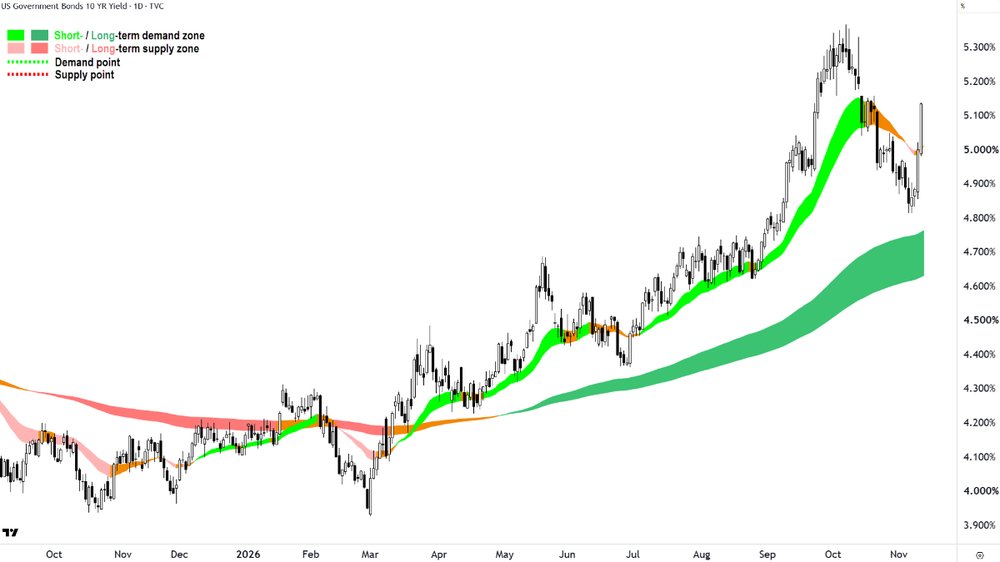
US 10-Year T-Bond Yield chart — 25 basis points in 2 sessions = 😱
The Utilities (XUJ) (+1.3%) sector was the standout as investors rotated into defence amid global uncertainty and a higher oil price. Defensive sectors are those whose earnings hold up regardless of the economic cycle – whatever happens to growth, we’ve still got to keep the lights on! APA Group (APA) (+1.6%) and Origin Energy (ORG) (+1.2%) led the way, with AGL Energy (AGL) (+0.9%) also higher.
The utility-like telcos gained modestly, lifting Communication Services (XTJ) (+0.2%). The cat videos must keep flowing, after all! Telstra Group (TLS) (+0.2%) and TPG Telecom (TPG) (+0.2%) both edged higher.
Consumer Staples (XSJ) (-0.4%) slipped but still beat the broader market. And look what gained – agricultural stocks — because we’ve still got to eat! Graincorp (GNC) (+5.3%) jumped and The A2 Milk Company (A2M) (+1.0%) also rose.
Financials (XFJ) (-0.4%) played their typical anchor role, gaining ground steadily through the session to narrow their loss by the close. The sector then popped in the closing price auction, likely reflecting compulsory flows, such as superannuation guarantee contributions. 🧃 Commonwealth Bank of Australia (CBA) (-0.5%) weighed as the sector’s biggest component, but still closed out the week 2% higher. National Australia Bank (NAB) (+0.2%) edged up and ANZ Group Holdings (ANZ) (0.0%) finished flat.
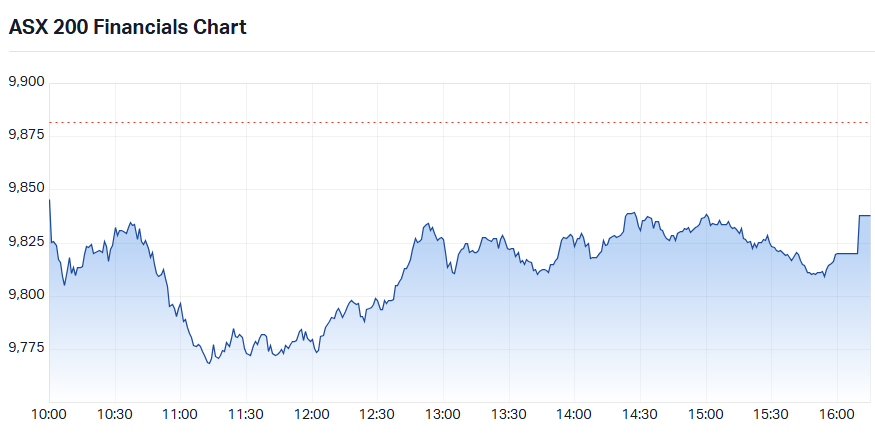
S&P/ASX 200 Financials Sector Index (XFJ) intraday chart
Health Care (XHJ) (-0.5%) also held up better than the broader market — because we’re still going to get sick! Healius (HLS) (+6.5%) and Resmed (RMD) (+1.4%) were solid, but ultimately the sector was weighed by pullbacks in CSL (CSL) (-0.8%) and Cochlear (COH) (-1.1%), both of which have run hard in recent weeks.
The Gold Sub-Index (XGD) (-2.5%) bore the brunt as US bond yields surged again overnight, fallout from hotter-than-expected inflation data that has markets pricing a certain 0.25% Fed rate hike in December.
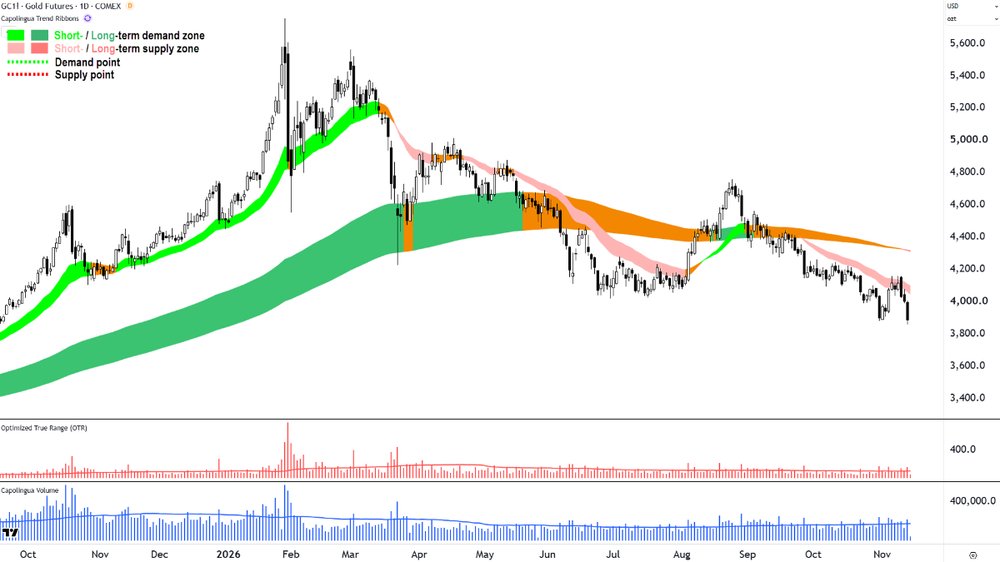
Bond yields up = a nightmare outcome for gold! 😭
Gold pays no yield, so higher bond yields raise the opportunity cost of holding it. COMEX gold futures dropped 2.9% overnight and, despite steadying in Asian trade, up 0.5% to US$3,906/oz, the damage was done. Resolute Mining (RSG) (-4.8%) and Black Cat Syndicate (BC8) (-4.8%) led losses, with Genesis Minerals (GMD) (-4.7%) and Evolution Mining (EVN) (-2.9%) also lower.
Materials (XMJ) (-1.6%) copped the other side of the yield surge. Higher yields crimp global growth expectations, which generally hits commodity prices, and base metals duly slid on the London Metal Exchange overnight, with aluminium down 2.1%, tin 1.2% and zinc 0.9%. BHP Group (BHP) (-1.3%) dragged the broader market lower, while South32 (S32) (-2.0%) also fell. Tin producer Metals X (MLX) (-4.1%) and Nickel Industries (NIC) (-3.0%) also retreated.
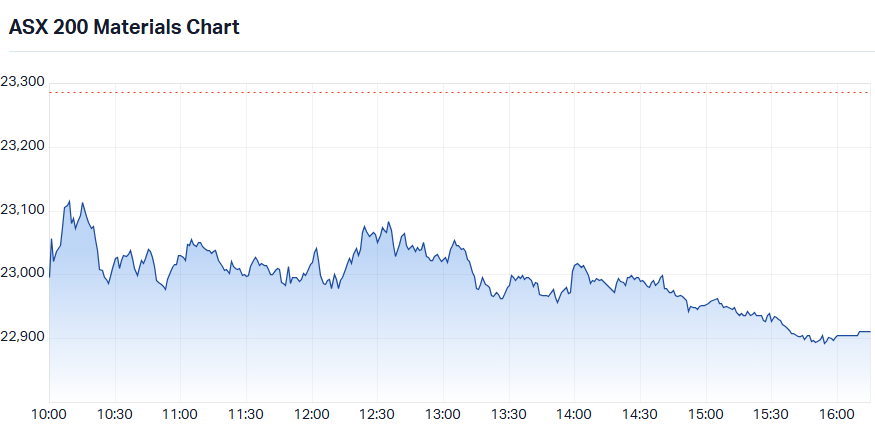
S&P/ASX 200 Materials Sector Index (XMJ) intraday chart
Copper stocks, which often trade as an AI proxy given the metal’s use in electronics, were also hit. Copper fell 1.2% on the LME, while COMEX copper futures – Dr Copper, so called for its knack of diagnosing the health of the global economy – fell 1.5% overnight and kept ebbing in Asian trade, down 0.4% to US$6.17/lb. Sandfire Resources (SFR) (-3.9%) fell, while Capstone Copper (CSC) (-5.4%) was hit harder after downgrading production guidance on maintenance delays and Chilean industrial action.
Lithium stocks were softer despite benchmark GFEX lithium carbonate futures extending their rebound into a second day, up 3.0% to CNY 91,780/t in Asian trade. Core Lithium (CXO) (-3.9%) and Elevra Lithium (ELV) (-1.1%) fell, though PLS Group (PLS) (+0.4%) notched a small gain.
Uranium stocks tracked their benchmark, the Sprott Uranium Miners ETF (URNM), which tumbled 5% overnight in New York, even as COMEX uranium futures edged 0.2% higher to US$90.70/lb in Asian trade. Paladin Energy (PDN) (-17.6%) fared worst after completing a $525 million equity raising. Deep Yellow (DYL) (-4.9%) and Boss Energy (BOE) (-4.7%) also fell, along with Bannerman Energy (BMN) (-3.4%). Enrichment technology play Silex Systems (SLX) (-5.2%) was caught in the sell-off too.
The A-REIT (XPJ) (-1.3%) sector was the other area to substantially falter. Real estate stocks are bond proxies, prized for steady, bond-like income, so they lose appeal when yields rise. Lendlease Group (LLC) (-8.4%) dived after the developer announced it had started a bond redemption process. Data centre developer Goodman Group (GMG) (-2.0%) and GPT Group (GPT) (-2.3%) also fell, while Charter Hall Group (CHC) (-1.3%) slipped after its remuneration report received a first strike at its annual general meeting.