









M.G. Quibria
What struck me most about the 3 November American midterm elections was not so much the scale of the Democratic victory as where it happened. Kansas, Iowa and Texas – states long regarded as Republican strongholds – helped hand Democrats control of both the House and the Senate, where they now hold at least 54 seats. The explanation was less ideological than economic. Voters were fed up with the rising cost of living, made worse by the war with Iran. Economists know this pattern well: sooner or later, political promises run up against household budgets. Bangladesh should take note. A government can hold a large parliamentary majority and speak of grand national goals, but when ordinary people cannot make ends meet, their loyalty does not last.
Yet American voters will probably see less economic change than they demanded. The people most likely to feel the result, for good or ill, live thousands of miles away: in the fuel queues of Dhaka and Karachi, in the garment factories of Bangladesh and Cambodia, and in households across South Asia that depend on remittances from the Gulf. For much of developing Asia, this election matters less for the laws Congress can pass than for what it can prevent the White House from doing.
A mandate without a lever
The UC Berkeley economist Barry Eichengreen has argued persuasively that a new Congress can do little to change economic policy conducted through executive orders. Congress could reclaim its tariff powers, but Trump would veto the bill, and overriding that veto would require a two-thirds majority in both chambers. On war powers, Congress sidestepped a veto in June with a concurrent resolution, but such resolutions are probably not binding, so enforcement remains the real problem.
The fiscal picture is worse. US debt held by the public is about 100% of GDP (gross debt is about 123%), and the deficit reached 6.2% of GDP in fiscal 2026. Neither party has a credible plan to close it. The 10-year Treasury yield stood at 4.87% the day after the vote. That matters well beyond America: high US yields tend to keep the dollar strong and draw capital away from the developing world. When a safe Treasury bond pays nearly 5%, investors demand higher returns to hold Asian bonds or shares. A stronger dollar also raises the cost of the region’s dollar-denominated debts and of oil, which is priced in dollars. For Bangladesh, whose gross reserves have only recently recovered to about $36 billion, a strong dollar makes every import bill and debt payment more expensive.
Vehicles queue along Matikata Road in Dhaka to reach a filling station on 18 April 2026. The Middle East conflict has disrupted energy supplies and increased costs, placing additional pressure on Bangladesh and other South Asian economies. Photo: Mehedi Hasan
“>
Vehicles queue along Matikata Road in Dhaka to reach a filling station on 18 April 2026. The Middle East conflict has disrupted energy supplies and increased costs, placing additional pressure on Bangladesh and other South Asian economies. Photo: Mehedi Hasan
The new Congress’s real power lies in blocking: it can refuse to fund new military operations, allow temporary tariffs to expire and use hearings to raise the political cost of escalation.
Asia’s oil lifeline
The election will affect Asia through four channels: war, trade, finance and aid. The war comes first, through oil. The day after the vote, Brent crude fell about 9% to a two-month low of around $94, as traders bet that a Democratic Congress would push the White House towards ending the Iran war. For developing Asia, which imports most of its energy, few market movements matter more.
The region has paid a heavy price for this war. The Asian Development Bank now expects growth in developing Asia to slow from 5.5% in 2025 to 5% this year, with inflation at 4.2%. The averages conceal the worst effects. Pakistan sources roughly 81% of its oil through the Gulf; its diesel prices nearly doubled after the war began. Sri Lanka, still recovering from its 2022 default, reintroduced fuel rationing. Bangladesh asked citizens to avoid unnecessary travel, paid more than double the normal price for spot LNG cargoes, and in April raised the diesel price to Tk 115 a litre; inflation remains above 8%. S&P Global identified Pakistan, Bangladesh and Sri Lanka as the most vulnerable economies in the region.
The war’s other blow is less visible: remittances. Nearly half of Bangladesh’s remittances come from the Middle East, while about 40–50% of Pakistan’s come from the Gulf states. In Nepal, remittances exceed a quarter of GDP. A prolonged war in the Gulf threatens the wages that keep millions of South Asian families afloat. So far, the money has kept coming: Bangladesh’s remittances reached a record $35.5 billion in FY26 and are up 13% in the first four months of the current fiscal year. That cushion will last only as long as the Gulf jobs supporting it.
The results of the US midterm elections on 3 November 2026 show Democrats gaining control of both the House of Representatives and the Senate. The shift could strengthen congressional oversight of trade policy, although presidential veto powers may constrain efforts to reverse existing tariffs.
“>
The results of the US midterm elections on 3 November 2026 show Democrats gaining control of both the House of Representatives and the Senate. The shift could strengthen congressional oversight of trade policy, although presidential veto powers may constrain efforts to reverse existing tariffs.
Table 1. How exposed is developing Asia to the Gulf?
| Country | Oil exposure | Remittances from the Gulf | Fallout so far |
| Pakistan | ~81% of oil comes through the Gulf (Devpolicy) | 40–50% of remittances (Dawn) | Diesel up from Rs281 to Rs520 a litre; four-day government work week in spring |
| Bangladesh | Heavily dependent on Gulf petroleum and LNG (ORF America) | Nearly half (ORF America) | Fuel queues; citizens told to avoid unnecessary travel |
| Sri Lanka | Petroleum ~a quarter of all imports (UN) | About half of remittances (IPS via The Morning) | Fuel rationing reintroduced |
| Nepal | All fuel via India; storage for ~13 days of petrol and diesel (New Business Age) | Remittances >25% of GDP, much of it from the Gulf (UN) | Nearly 6 in 10 households rely on remittances |
| India | About half of crude from the Gulf (Kpler via ThePrint) | ~38% of $135bn (ORF America) | Losses absorbed largely by state oil companies |
| Vietnam | ~85% of oil imports from the Gulf (Devpolicy) | A small share of about $16bn in total | Growth still forecast above 7% |
How might Congress restrain the war? The outgoing House passed an Iran war powers resolution for the third time in September, with seven Republicans supporting it. From January 2027, with the Senate also in Democratic hands, such a resolution could reach the president’s desk. Trump would veto it, but the vote, together with Congress’s control over war funding, would raise the political cost of escalation. If that pressure shortens the war, South Asia stands to gain a great deal. But it is too early to celebrate.
Brent rebounded to $98 the following day and remains nearly 40% above its pre-war level. Markets have priced in a political shift, not peace. And a weakened president might escalate the conflict to demonstrate strength.
Tariffs: Do not expect relief
The second channel is trade, and here developing Asia should temper its hopes. Earlier this year, the region’s governments, under considerable pressure, signed bilateral deals with Washington, some involving reciprocal tariffs and others taking the form of framework agreements. India’s tariff was reduced from 50% to 18%, Bangladesh settled at 19%, and Vietnam at 20%. But those deals rested on emergency powers that the Supreme Court struck down in February. Since 24 July, most of the region has instead faced a Section 301 tariff of 10% or 12.5%. The US Trade Representative imposed it after concluding that 60 trading partners were doing too little to prevent goods made with forced labour from entering their own markets. Countries with at least a partial import ban face a 10% tariff; the rest face 12.5%.
US President Donald Trump announces reciprocal tariffs in April 2025. Shifting American trade policies and tariff measures have created uncertainty for export-dependent Asian economies, including Bangladesh and Vietnam, whose garment industries rely heavily on access to the US market. Photo: AFP
“>
US President Donald Trump announces reciprocal tariffs in April 2025. Shifting American trade policies and tariff measures have created uncertainty for export-dependent Asian economies, including Bangladesh and Vietnam, whose garment industries rely heavily on access to the US market. Photo: AFP
For garment exporters such as Bangladesh and Vietnam, even a percentage point can determine where orders go. Bangladesh’s overall garment tariff is now lower than Vietnam’s and China’s, yet its apparel exports to the US were still down by about 6% in the first seven months of 2026. The new regime also promises Bangladesh, Cambodia, Indonesia and Malaysia three-year duty-free quotas for garments made with US cotton and textile inputs; Vietnam, India and Pakistan are excluded. As of November, the quotas are not yet in force.
Table 2. US tariffs on Asian exporters: February deals vs. today
| Country | Feb 2026 deal rate (voided) + MFN rate | Rate since July 24 (Section 301) + MFN rate |
| India | 18% + MFN rate | 10% + MFN rate |
| Pakistan | 19% + MFN rate | 10% + MFN rate |
| Bangladesh | 19% + MFN rate | 10% + MFN rate |
| Indonesia | 19% + MFN rate | 10% + MFN rate |
| Cambodia, Malaysia | 19% + MFN rate | 10% + MFN rate |
| Thailand | 19% + MFN rate | 12.5% + MFN rate |
| Vietnam | 20% + MFN rate | 12.5% + MFN rate |
Notes: Deal rates as announced in February 2026 (India TV, Business Today). Current rates are based on the USTR’s Section 301 list, effective from 24 July (USTR rate table). On top of these comes the ordinary most-favoured-nation (MFN) duty, which is steep for garments: a Bangladeshi garment now faces a total tariff of about 26.5%.
A Democratic Congress will not dismantle this system. Jefferies expects America’s average effective tariff to remain in the 10–20% range, even under divided government. The administration can rely on Sections 232 and 301 of US trade law. Both require investigations, but neither requires a vote in Congress.
Commercial vessels burn following attacks in the Middle East. The escalating conflict has disrupted maritime trade and energy supplies, pushing up oil and LNG prices and increasing inflationary pressures on energy-importing economies across South Asia. Photo: Reuters
“>
Commercial vessels burn following attacks in the Middle East. The escalating conflict has disrupted maritime trade and energy supplies, pushing up oil and LNG prices and increasing inflationary pressures on energy-importing economies across South Asia. Photo: Reuters
Still, Congress is not powerless, as this year has shown. After the Supreme Court struck down the emergency tariffs in February, the White House turned to Section 122 of the Trade Act of 1974. It allows tariffs of up to 15%, but only for 150 days unless Congress extends them. Congress did not act, and the surcharge expired in July. But the White House replaced it that same day with Section 301 tariffs, which require no congressional vote. Where the law requires a vote, Congress matters, and the new majority will be far less willing to rubber-stamp new tariff authority. Expect more hearings on how tariffs raise prices for American consumers. That is not relief, but it does constrain the White House and give Asian negotiators a little more room.
Asian exporters’ greater concern is unpredictability. A weakened president, unable to legislate, may rely even more heavily on trade as a lever he alone controls. The firms that suffer most are small and medium-sized suppliers in Dhaka, Karachi and Ho Chi Minh City, which cannot hedge against sudden changes in trade rules.
Capital and aid
The third channel is finance. During previous periods of divided government, a weaker dollar has helped emerging-market currencies and bonds. This week, the dollar slipped to a one-month low against the euro. AI-related stocks also fell sharply on 5 November, affecting Korea and Taiwan and, through the semiconductor supply chain, Malaysia, Vietnam and the Philippines.
The fourth channel is aid. Foreign aid appropriations require approval from both chambers, so the new majority is better placed to resist further cuts to aid, which the State Department has administered since USAID was dismantled in 2025. For aid-dependent countries in South Asia and the Pacific, that is modestly good news. For Bangladesh, it matters most in Cox’s Bazar, where Washington remains the largest donor to the humanitarian response supporting more than a million Rohingya refugees. But the funding will come with tougher congressional scrutiny of governance and human rights.
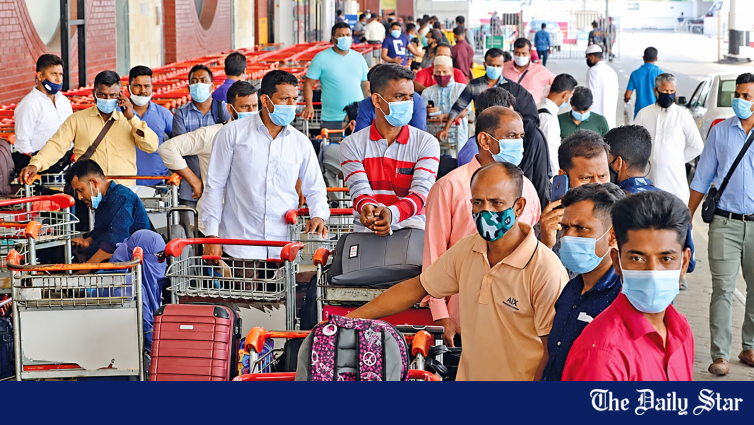
Bangladeshi migrant workers prepare to leave for overseas employment. With nearly half of Bangladesh’s annual remittances of $35.5 billion originating from the Middle East, prolonged regional instability could threaten household incomes and the country’s foreign exchange earnings. Photo: Star
“>
Bangladeshi migrant workers prepare to leave for overseas employment. With nearly half of Bangladesh’s annual remittances of $35.5 billion originating from the Middle East, prolonged regional instability could threaten household incomes and the country’s foreign exchange earnings. Photo: Star
Asian policymakers should stop waiting for Washington to fix things. If oil prices ease, governments in Pakistan, Bangladesh and Sri Lanka should use the breathing space to rebuild reserves and replace blanket fuel subsidies with targeted support. Blanket subsidies mostly benefit more affluent car owners and businesses while draining already stretched budgets; cash transfers targeted at poor households cost less and protect those who need them most. Exporters should continue diversifying markets, deepening regional trade within Asia and moving up the value chain rather than relying on a tariff advantage of a percentage point or two. Bangladesh has a particular opportunity: the UN’s decision in late October to defer its LDC graduation until 2029 preserves duty-free access to Europe for another three years. That provides time to move beyond basic cotton garments into man-made fibres, where Vietnam currently leads. The region should also invest seriously in energy security, from storage to renewables, so that the next war in the Gulf does not once again leave petrol pumps empty from Colombo to Kathmandu.
The midterms have changed American politics more than they will change American policy. For the next two years, developing Asia will have to contend with an America that is divided at home and unpredictable abroad. The countries that prepare for this, rather than hoping it will pass, will emerge in the strongest position. For Bangladesh, that means using these two years to pursue domestic reforms, not waiting to see what Washington does next.
Dr M G Quibria is an economist and public policy commentator whose work explores trade, development, governance and democratic change in Bangladesh and beyond. He can be reached at [email protected].