







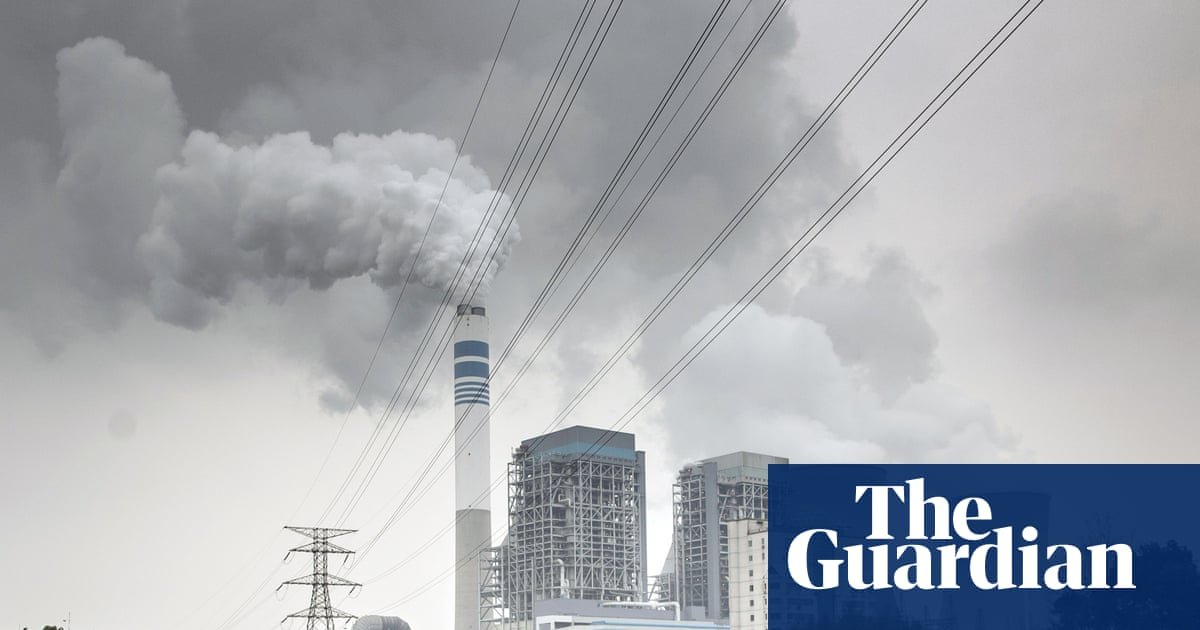
China has ruled out hosting the Cop33 UN climate summit in 2028 after months of deliberations, leaving the field open for other Asian countries to hold it, the Guardian understands.
The decision will disappoint many countries and climate experts, who had hoped the world’s biggest emitter would take the lead on the global stage, as the US under Donald Trump has vacated all forms of international cooperation on the climate.
Al Gore, the former US vice-president, was among those left disheartened by the decision. “I would be very much in favour of that idea [of China hosting the summit],” he told the Guardian. “It’s too bad.”
China is in the midst of an economic transformation, from being heavily dependent on coal to becoming an “electro state”. John Kerry, the former US secretary of state, told the Guardian that China was leaving the rest of the world behind in forging and using the low-carbon technologies of the future.
Renewable energy generation capacity has now outstripped coal in China, and its greenhouse gas emissions appear to have declined slightly this year. Sales of electric vehicles in the country have also taken off, making up nearly two-thirds of the market last month, and China’s clean energy industries drove more than 90% of the country’s investment growth last year.
The rules of the UN Framework Convention on Climate Change (UNFCCC) mean an Asian country should host in 2028.
Gareth Redmond-King, the international lead at the Energy and Climate Intelligence Unit thinktank, said China’s position as an industrial powerhouse would have made it a formidable contender to hold the summit.
“It would undoubtedly be significant for the world’s biggest emitter and second-biggest economy to host a climate Cop,” he said. “They’re leading the world on investment, manufacture and deployment of clean energy tech, and their emissions have started to tick down. As a leadership story, China hosting Cop33 would be a big deal.”
It is not clear why China has decided against hosting the conference, but several experts that spoke to the Guardian suggested that the US electoral cycle was likely to have been a factor. The next US presidential election will take place on 7 November 2028, and Cop33 is scheduled for 6 to 17 November that year.
After the strong showing by Democrats in the recent midterm elections, in which voter concern over the climate crisis was thought to be a factor, the Democrats will be hoping to elect a climate-friendly president in 2028. But even if they succeed, Trump will still be in office until the following January.
The US president rejects climate science and withdrew the US from the Paris agreement, and is also withdrawing from its parent treaty, the 1992 UNFCCC.
after newsletter promotion
China seeks to be seen as a leader among developing countries, but has been wary of stepping into the gap left by the US. Under the Democratic presidents Joe Biden and Barack Obama, the US and China enjoyed a close partnership on climate issues, setting joint targets on reducing methane and developing clean technology.
Cop33 will be an important meeting because it will include the “global stocktake” – a mechanism under the 2015 Paris climate agreement that examines countries’ progress on cutting emissions in line with the goal of limiting global temperature rises to 1.5C. That limit is now certain to be surpassed, but experts say countries should now try to minimise the temperature “overshoot”, to avoid worse ravages from extreme weather.
India’s government considered offering to host Cop33 for several months earlier this year, but also decided against it. India’s coal use has been increasing, even as the country exceeds its own renewable energy targets.
The Guardian understands that other countries mulling a bid to host Cop33 include Uzbekistan, South Korea, Indonesia and Thailand. No decision on a host is likely to be made at this year’s Cop31 meeting, which is ongoing in Turkey, with the Turkish and Australian governments jointly presiding over the summit.