







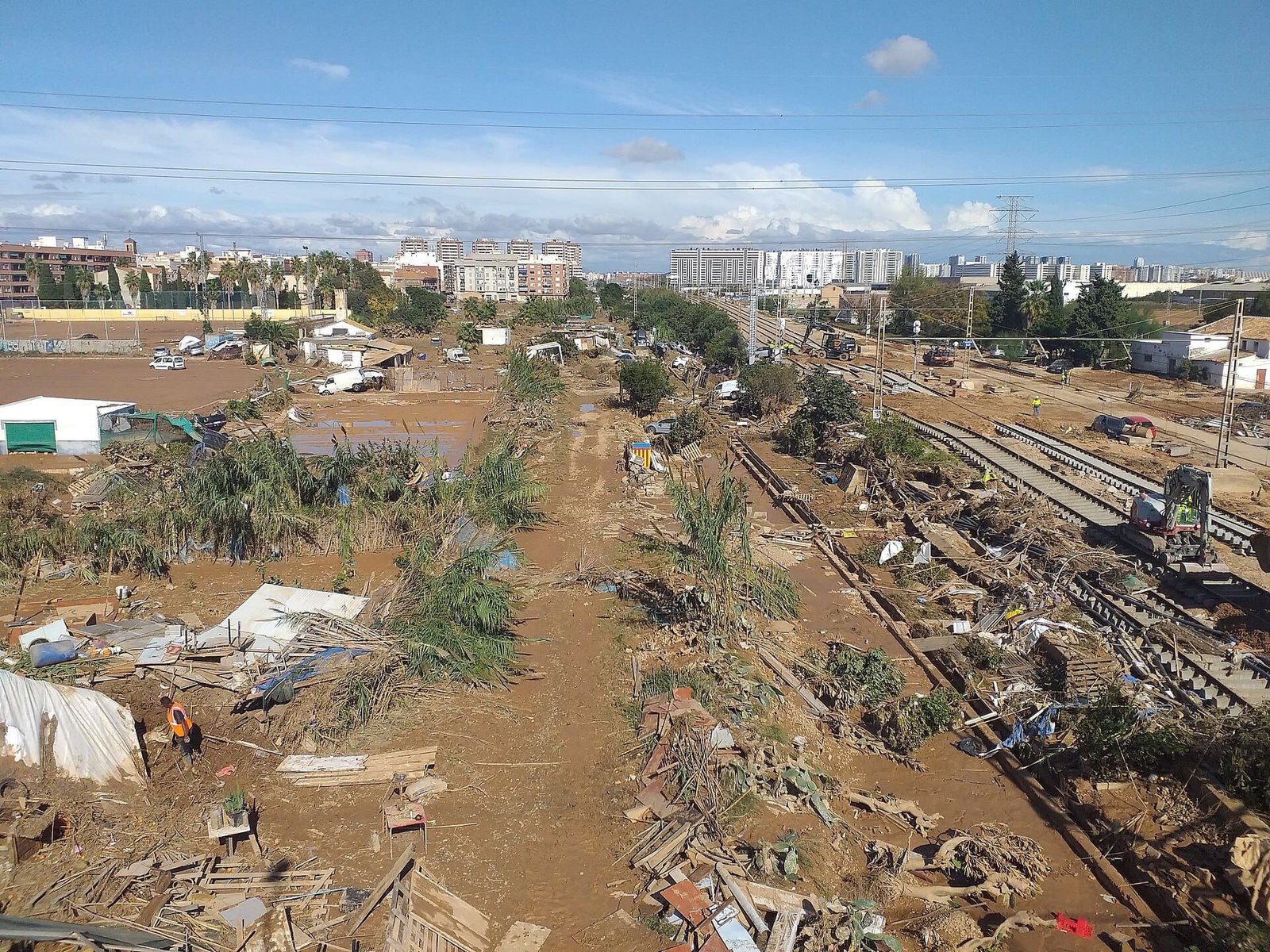

An image of Camí de Sedaví, a local street in the municipality of the same name, south of Valencia city, taken in the aftermath of the floods of 2024. Cars and debris were dragged onto streets, rail tracks and across tunnels. Photo by Pacopac / Wikimedia Commons
Key points:
-
Spain’s public-private insurer of last resort faces solvency questions as extreme climate events rapidly deplete its reserves.
-
The 2024 floods consumed two-fifths of the CCS reserve, surpassing the combined costs of its ten largest historical disasters.
-
Actuaries warn that unpredictable weather extremes are making high-risk regions nearly uninsurable and threatening private market affordability.
-
Industry experts urge a pivot from post-disaster compensation to proactive climate adaptation to keep insurance systems sustainable.
As Spain grapples with extreme weather, questions are rising over whether its public-private insurer of last resort can keep up.
From destructive wildfires and record-breaking heatwaves to torrential rainfall and flooding along the Mediterranean coast, recent months have exposed homes, businesses and infrastructure to a growing range of climate-related risks.
In Spain, a public-private insurance system provides an additional safety net against certain natural disasters. But with increased warnings from the Intergovernmental Panel on Climate Change (IPCC) that increasing temperatures will worsen drought conditions and increase favourable weather conditions for wildfires, and create greater regional uncertainty around extreme precipitation, some experts are warning that such schemes could come under pressure in the future, as insurance and actuarial models change.
Growing pressure on public-private insurance schemes
The Consorcio de Compensación de Seguros (CCS) is a Spanish public body that compensates policyholders for damage caused by extraordinary events, including floods, earthquakes and exceptionally strong winds. Homeowners with qualifying insurance policies pay a mandatory surcharge that funds the scheme.
While private insurers generally cover everyday risks, the CCS handles specific catastrophic events, providing financial protection to insured homeowners after major disasters. However, its coverage is not unlimited and does not extend to every climate-related hazard, including wildfires and heatwaves.
Spain’s public-private insurance system offers protection today, but whether it can withstand repeated catastrophes over the longer term is a different question.
Pablo Girgado, an insurance law expert at Rovira i Virgili University in Tarragona, Spain, says the CCS does not currently face a funding problem. However, repeated disasters on the scale of the 2024 Valencian floods would deplete its reserves.
“Its capacity to pay is guaranteed in the short term, but over the long term it could not sustain costs of that scale,” he said.
One option would be to increase the surcharge on insurance policies that finance the fund, Girgado said. But that would also raise costs for policyholders, exposing a tension between keeping the system financially sustainable and keeping insurance affordable.
“Spain does not yet have areas excluded from coverage, but premiums are rising and compensation is being limited,” he said.
Changing statistics and rising uncertainty
The insurance industry is at a crossroads. Insurance professionals have sounded the alarm, noting that models show increasing climate-damage risk, risks that “either aren’t being communicated to or aren’t being properly internalised by government.”
Experts warn that these risks could increase insurance costs and put pressure on public finances, growing an insurance gap of 25% in the EU alone. The European Central Bank has warned that insurance losses could even become a systemic risk to the wider EU economy.
The challenge is estimating probabilities when statistical distributions are changing and uncertainty is increasing.
“We are losing a traditional actuarial assumption,” namely that “the past is a reasonably reliable guide to the future,” said Juan Manuel López Zafra, an actuary and professor at Cunef University.
He is especially concerned about accumulated risks, with different phenomena simultaneously affecting interconnected regions and economic activities.
In some areas, he warns, certain risks could become “practically impossible to insure,” particularly when high exposure combines with insufficient or prohibitively expensive reinsurance capacity. Insurability depends not only on the likelihood of a disaster, but also on whether insurers have the financial capacity to absorb potentially catastrophic losses. When private insurers can no longer provide affordable coverage, he argues, public-private partnerships become essential, with the state stepping in to help maintain protection.
The limits of insurability, he explains, depend not only on the probability of a disaster but also on the financial capacity of insurers to absorb potentially catastrophic losses.
“A technically correct insurance premium is useless if nobody can afford it, or if there is insufficient insurance capacity,” he explains.
Prevention rather than compensation
Public-private partnerships like the CCS can help spread the financial burden of major disasters between the insurance sector and a public institution, said Francisco Lisbona, head of resilience solutions at Zurich Spain. However, Lisbona warns that compensation alone is insufficient to address the growing risks posed by climate change.
“In the face of climate change, we cannot limit ourselves to providing compensation after a catastrophe. The major challenge in the coming years will be to better understand where we are vulnerable, invest in adaptation before events occur, and make assets, businesses and communities more resilient,” he said.
López Zafra agrees that public-private cooperation can preserve coverage that the private market would otherwise be unable to provide.
“This is precisely where the state must step in,” he said.
For businesses, the consequences extend beyond physical damage to disruptions in the supply chain, providers and recovery times, Lisbona said.
But rising climate exposure does not automatically translate into higher premiums or deductibles, he added. Insurance conditions depend on multiple underwriting factors. While private insurers cover conventional risks, Spain’s CCS provides an extra layer of protection against extraordinary events
Lisbona warns that insurance will become increasingly difficult to maintain as extreme weather risks, exposure and vulnerability grow. “Yet, precisely for this reason, we believe the response should not be limited to transferring or avoiding risk; rather, we must also work to reduce it.”
Withstanding future disasters
One of the biggest issues is that compensation for extreme weather events like flooding has increased. Zurich’s PERC report estimates the total economic impact of the Valencia floods in 2024 was approximately €20.3bn, although this figure includes losses subject to different insurance mechanisms.
By September 2025, according to figures cited by Zurich, the CCS had paid 207,558 claims, totalling €3.64bn.

Francisco Solano, deputy director of studies and international relations at the CCS, acknowledged costs started to increase in 2015, after decades of declining average costs per claim.
“This may well indicate an increase in the severity of flood events, which are becoming increasingly intense, as we unfortunately witnessed in October 2024,” he said
The Valencia catastrophe was unprecedented. According to Solano, its cost to the CCS represented approximately two-fifths of the institution’s stabilisation reserve.
“The damage from the Dana in Valencia exceeds the combined cost of the ten most expensive loss events in the entire 71-year history of the CCS,” he said.
Nevertheless, he insists that the institution had sufficient financial capacity to respond, as it is “prepared for such high-intensity, low-frequency events.”
Unlike conventional insurance premiums, the CCS surcharge — a mandatory additional charge included in eligible insurance policies to fund Spain’s public compensation system for extraordinary disasters — is uniform across Spain and depends on the type of risk and insured capital, rather than geographical location.
This system, he said, helps prevent sharp increases in the cost of extraordinary-risk protection, particularly for floods, earthquakes and windstorms.
Solano highlighted the importance of cooperation between public authorities and private insurers, citing Spain and France as examples of countries with public-private insurance systems. While Spain’s CCS compensates policyholders for certain extraordinary risks, France’s Cat Nat scheme relies on private insurers backed by state-guaranteed public reinsurance.
“The role of the public sector is not to replace the private sector, but to complement it in order to facilitate the insurability of risks, to the benefit of the market itself and society as a whole.”
For Girgado, cooperation between insurers and the state must be accompanied by measures that reduce the damage before a claim arises.
“The sector is concerned; I see it at conferences and industry meetings,” he said. “The focus is shifting towards prevention.”
That means improving the ability to anticipate extreme events and reducing exposure to their effects, alongside maintaining the funds needed to compensate those affected.
This page was last updated November 11, 2026
Written by

Natàlia Costa is a Barcelona-based journalist with nearly two decades of experience covering social affairs, climate-related issues and current affairs in southern Europe. Her work has appeared in international publications including Parade, Business Insider and Hyphen Online, as well as Spanish outlets such as La Vanguardia, El Mundo, Diari ARA and 20 Minutos.