









Last Updated:
Political trajectory of ex-President Mukherjee saw a paradox: While his equation with Congress grew strained, his relationship with PM Modi evolved into one of mutual respect




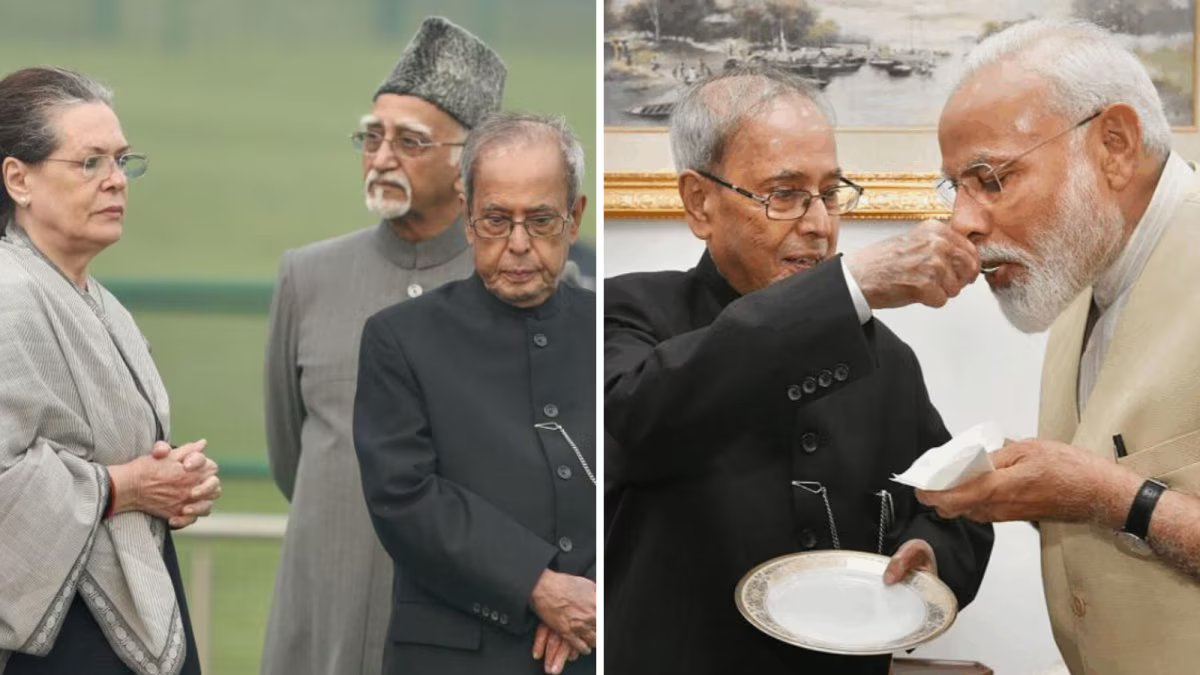
Pranab Mukherjee with Sonia Gandhi and PM Modi. (PTI/ File)
In her newly released memoir, Belonging: A Journey of Love, Sonia Gandhi has shed light on the complex political dynamics within the UPA.
The political trajectory of former President Pranab Mukherjee in his later years saw a distinct paradox: while his equation with the Congress leadership grew increasingly strained, his relationship with Prime Minister Narendra Modi evolved into one of mutual respect and unexpected warmth.
SONIA GANDHI MEMOIR
The book reveals how the internal equation between the Congress leadership and former President Pranab Mukherjee shifted, while also contrasting her own rare, distinct relationship with Prime Minister Narendra Modi.
Sonia Gandhi’s memoir confirms long-standing speculation regarding Pranab Mukherjee’s Prime Ministerial ambitions. Gandhi recalls a conversation in 2010 when Mukherjee was serving as a top minister. Frustrated by deep, serious differences with then-Finance Minister P. Chidambaram, Mukherjee suggested to Gandhi that perhaps “it was time for a change at the top”.
Gandhi writes that she was “shocked” by the suggestion, interpreting it as a clear hint of his “long-held desire to become prime minister” by replacing Dr. Manmohan Singh. To defuse the situation, Gandhi gently changed the subject. While she notes he may have been disappointed, she asserts that Mukherjee never held it against her.
To manage party dynamics and honor his vast experience, the Congress-led UPA subsequently nominated Mukherjee as their presidential candidate in 2012, moving him from active party politics to the highest constitutional office. Gandhi stresses that despite the incident, she continued to visit him regularly to consult his immense political wisdom.
At A Glance
Sonia Gandhi revealed in her memoir that Pranab Mukherjee suggested a change at the top in 2010 due to frustrations with P. Chidambaram.
The UPA nominated Mukherjee as their presidential candidate in 2012, moving him from active party politics to the presidency.
Mukherjee alienated the Congress party brass in June 2018 by accepting an invitation to address RSS cadres in Nagpur.
The Modi-led BJP government conferred India’s highest civilian honor, the Bharat Ratna, upon Mukherjee in 2019.
The revelation sparked an immediate reaction from Mukherjee’s daughter, Sharmistha Mukherjee. She defended her father’s merit-based ambitions, questioning why anyone should be “shocked” by a highly experienced, hardworking, and brilliant statesman aspiring to be Prime Minister.
THE DECLINE IN EQUATION WITH CONGRESS
Mukherjee’s distance from the Congress establishment widened significantly after he moved to Rashtrapati Bhavan in 2012, culminating in public disagreements and sharp retrospective criticism.
In his posthumously published final memoir, The Presidential Years 2012-2017, Mukherjee explicitly wrote that the Congress party lost its political focus after his elevation to the presidency. He noted that while Sonia Gandhi could no longer handle party affairs effectively, Dr. Manmohan Singh’s prolonged absence from the house dissolved personal equations with MPs.
The ultimate breaking point for many within Congress occurred in June 2018, when Mukherjee accepted an invitation to address Rashtriya Swayamsevak Sangh (RSS) cadres in Nagpur. Despite intense, public pleading and condemnation from top Congress leaders—who viewed the visit as a betrayal of secular ideals—Mukherjee went ahead, delivering a speech on Indian nationalism that further alienated him from the party brass.
Following his death, his daughter Sharmistha Mukherjee noted that the family felt the Congress leadership increasingly distanced itself from Mukherjee’s legacy, contrasting sharply with how he was treated by the ruling dispensation.
WARM EQUATION WITH PM MODI
Despite their starkly contrasting ideological backgrounds, Mukherjee and PM Narendra Modi developed a deeply respectful, functional, and emotional bond during their time as President and Prime Minister.
Upon demitting the office of President in 2017, PM Modi penned an emotional letter to Mukherjee, describing him as a father figure and a mentor who guided him through the complexities of governance when Modi first arrived in New Delhi as a political outsider.
In 2019, the Modi-led BJP government conferred India’s highest civilian honor, the Bharat Ratna, upon Mukherjee. This move was viewed by political analysts as a masterstroke that honored a legendary statesman while subtly highlighting how Congress had failed to give its own veteran the ultimate recognition.
In his writings, Mukherjee did not give Modi a completely free pass—he characterized Modi’s first term as autocratic and criticized the government’s management of parliamentary friction. However, he heavily praised Modi’s foreign policy acumen, grasp of economic fundamentals, and his charismatic leadership style.
Until his death in August 2020, Mukherjee maintained an open-door policy with PM Modi. The Prime Minister frequently visited him to seek guidance on critical national matters, a striking contrast to the palpable coldness that characterized Mukherjee’s relationship with the 10 Janpath establishment in his twilight years.
Quick Answers
 Ask News18
In her memoir Belonging: A Journey of Love, Sonia Gandhi recalled that Pranab Mukherjee expressed deep frustration over differences with then-Finance Minister P. Chidambaram in 2010 and suggested it was time for a “change at the top”, which she interpreted as a hint of his long-held desire to become Prime Minister.
Ask News18About the Author

At the news desk for 20 years, the story of her life has revolved around finding pun, facts while reporting, on radio, heading a daily newspaper desk, teaching mass media students to now editing speci…Read More
November 11, 2026, 19:55 IST
Read More