







The move comes as India’s merchandise exports to Bangladesh, Afghanistan, Nepal, Bhutan, Sri Lanka, Maldives and Pakistan fell by 1.3% to $25.7 billion in FY26.
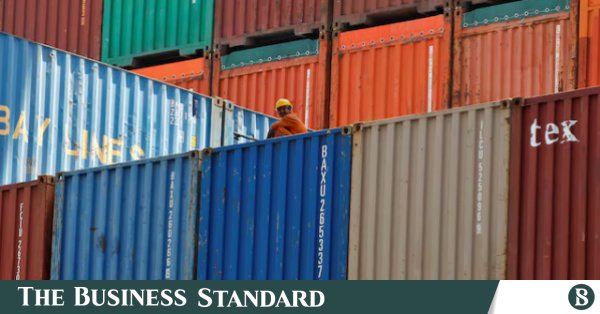
A worker sits on a ship carrying containers at Mundra Port in the western Indian state of Gujarat April 1, 2014. REUTERS/Amit Dave/File Photo
“>

A worker sits on a ship carrying containers at Mundra Port in the western Indian state of Gujarat April 1, 2014. REUTERS/Amit Dave/File Photo
The Indian government is mapping regulatory and market-access barriers Indian exporters face in its seven South Asian neighbours as part of a drive to diversify overseas markets to achieve its $1-trillion total exports target this fiscal year.
Indian exporters have been asked to flag hurdles like import restrictions, licensing requirements, product standards, technical regulations, banking and payment curbs, high import tariffs and delays in regulatory approvals, The Economic Times reported today (11 November) citing officials.
The move comes as India’s merchandise exports to Bangladesh, Afghanistan, Nepal, Bhutan, Sri Lanka, Maldives and Pakistan fell by 1.3% to $25.7 billion in FY26, after rising 2% in FY25 and declining 8.57% in FY24.

India’s yarn exporters to Bangladesh said they have sought expeditious certification of rules of origin.
Bangladesh purchases about 45% of India’s total cotton yarn exports.
India’s chilli and turmeric exports to Sri Lanka have been hit by issues over pesticide residues beyond accepted levels.
Work is underway to resolve non-tariff barriers with all South Asian countries and broaden trade facilitation measures.
Efforts are also being made to increase India’s exports of certain products including chemicals and pharmaceuticals to South Asian markets, officials said.
Indian industry is also trying to identify products that have robust export demand, actual and potential, in South Asian countries.
An Indian industry representative said political issues in South Asia need to be resolved for boosting trade in the region.
Ajay Sahai, director general of the Federation of Indian Exporters Organisations, welcomed New Delhi’s move, saying it is “strategically good” to improve intra-South Asia trade and India’s export diversification initiatives to reach the $1-trillion export target.
While the South Asian Free Trade Area (Safta) exists, Bangladesh, India and Sri Lanka are also members of the Asia-Pacific Trade Agreement, which includes China.
India and Maldives have held the first round of negotiations for a bilateral trade agreement.
Political relations between India and Bangladesh have undergone considerable changes since the ouster of Sheikh Hasina’s Awami League regime in August 2024.
Prior to that, a commerce secretary-level meeting between India and Bangladesh was held in New Delhi on 4 March 2022, when it was agreed to finalise a study on a possible bilateral comprehensive economic partnership agreement (Cepa). But the initiative has not made headway since then.