
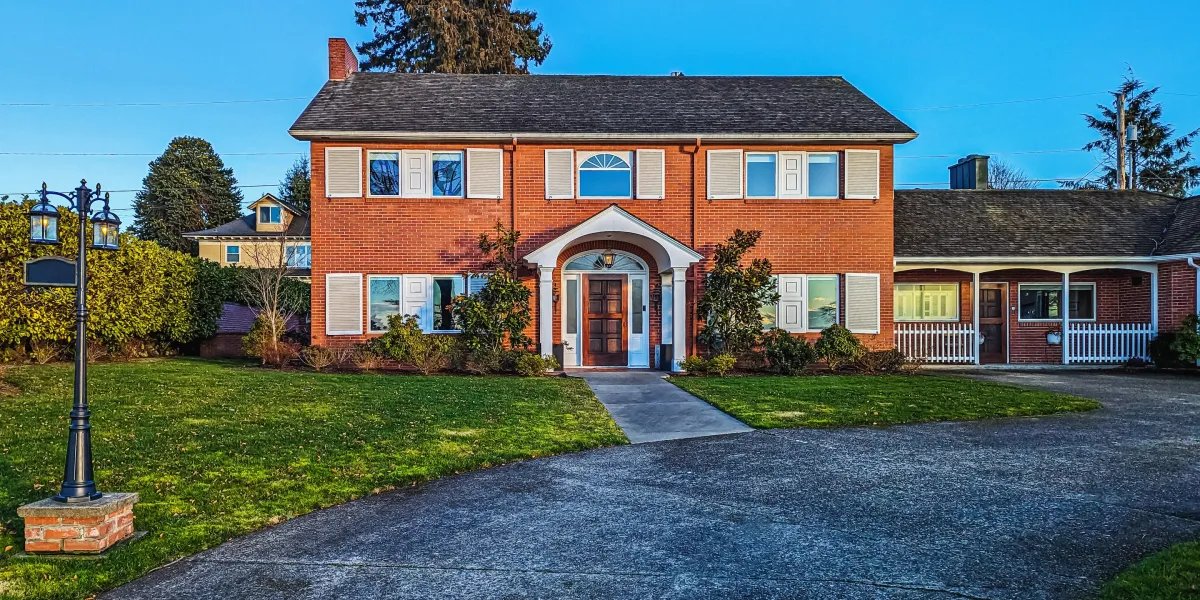
Americans have never paid more for a home. The median existing home sold for a record $440,600 in June, according to the National Association of Realtors. Yet the brick house, the kind built to stand for a century, has nearly vanished from new construction.
Brick or brick veneer covered just 16.8% of new single-family homes started in 2025, down from almost a quarter in 2012, according to a National Association of Home Builders analysis of Census data. And most of the homes that still look like brick houses aren’t. They’re wood-frame houses with a layer of brick veneer attached to the outside.
A home can mean a lot of things. A place to raise a family. An investment. A refuge. A milestone. But somewhere along the way, American homebuilding changed the question. Not “will this last a lifetime?” Just “will it last the mortgage?”
“We didn’t decide to build houses that just outlast the mortgage. We kind of drifted there,” said Dan D’Agostino, founder of Plan Architecture and a residential architect based in New Jersey.
The distinction between real brick and veneer matters. A structural masonry wall holds up the building itself. Veneer is an exterior finish, while the wood frame behind it does the structural work.
The change reflects a postwar housing boom, a shrinking skilled-labor pool, rising construction costs, and a preference for homes that could be built quickly and cheaply. But some architects and builders say it also changed what Americans expect from the places they live, and what buyers paying record prices actually get for their money.
Why builders traded masonry for wood framing
The shift away from structural masonry accelerated after World War II, when returning veterans and their families needed affordable homes, and needed them quickly. Developers such as Levitt & Sons met that demand with standardized designs and faster construction methods. Between 1947 and 1951, the company built 17,447 houses in Levittown on Long Island, at times finishing 10 to 12 homes a day.
“Levittown was a legitimate solution to a genuine crisis,” Steven Menotti, CEO of construction safety company Menotti Enterprise, told Fortune. “They needed shelter urgently, and a carpentry team got the job done faster than a masonry team ever would have.”
Brick construction requires skilled workers to lay individual bricks, one at a time. Wood framing can be assembled by crews with less specialized training, and it moves much faster. Matt DiBara, CEO of DiBara Masonry and a fourth-generation stonemason, said the economics were simple.
“It came down to cost and speed,” DiBara said. “After World War II the country needed homes that were more affordable and could be built in large batches, and a framing crew can close in a house way quicker and cheaper than a masonry crew can lay up solid walls.”
Brick veneer let builders keep the familiar look of masonry without relying on it to hold up the house. By the 1970s and 1980s, DiBara said, that approach had become standard.
The labor pool shrank along with it. Bricklaying is a specialized trade that takes years to master, while wood framing is easier to standardize and scale. The pressure hasn’t eased: the construction industry will need an estimated 456,000 new workers in 2027, according to the Associated Builders and Contractors.
“Today the hard part of building a true masonry house isn’t the brick. It’s finding people who can lay it,” D’Agostino said.
Jerel McCants, the architect overseeing the restoration of Tampa Union Station, which opened in 1912, sees the same problem. Skilled brick masons are not equally available across the country, he said, and regional differences in the workforce influence which materials builders choose. Brick’s beauty comes from the time and craftsmanship it demands.
“You can’t mass produce erecting a brick wall,” he told Fortune.
That distinction also complicates the historical record. Brick was the primary exterior wall material on 35% of new single-family homes completed in 1973, according to Census Bureau data. D’Agostino cautions against reading that as a measure of brick houses.
“That figure refers to brick veneer used as exterior cladding over wood frame construction. These are fundamentally different building systems,” he said.
Brick never disappeared entirely from American home exteriors. Its role as the structure holding a house up largely did.
What buyers gave up when brick became decorative
The move to wood framing didn’t make every new home inferior. Modern construction offers advantages in insulation, building performance, and affordability, and amid an affordability crisis, the median price of a new home was $400,400 in September, according to the Census Bureau. New homes are now cheaper than existing ones for the first time in data going back to 1974, in part because builders are putting up smaller houses. But experts say homeowners lost some of what structural masonry provided.
Fire resistance is one. A masonry wall offers protection a decorative brick exterior cannot replicate.
“Whereas masonry walls will stand after a fire, the wood frame behind a veneer wall will burn just like any other wood frame if the fire gains access to it,” said Menotti, an FDNY-certified Construction Site Fire Safety Manager. “I see the results of this substitution frequently in my fire investigation work.”
D’Agostino points to another: the longevity of what’s hidden behind a home’s exterior.
“A real brick wall holds the house up, resists fire, evens out heat and cold, and with some repointing goes well past a hundred years,” he said. “Look at the old rowhouses in Philadelphia and Baltimore. With thin brick, the house only lasts as long as the wood and sheathing behind it, and those fail quietly.”
Not all veneer is equal, though. D’Agostino notes that full-depth brick veneer with an air gap behind it can serve as a durable rainscreen. His concern is with thinner brick products that lack those characteristics.
For McCants, the difference comes down to the materials themselves.
“Brick—it’s just dirt and water, right? So it’s going to be there forever,” he said. He estimates brick can last 100 years or longer, compared with roughly 30 years for some newer exterior products. Actual lifespans vary by material and installation, but he believes the industry has steadily traded permanence for convenience.
The shift also cost the trade its craft. Masonry demands specialized knowledge, from laying individual bricks to building arches, bonds, and decorative details.
“What I miss most is the craft. On an old brick building you can see the mason’s hand everywhere: the bond, the arches, the cornice, the way the joints were struck. Thin brick can copy the pattern, but there’s nobody’s hand in it. And once you stop building that way, you stop passing that knowledge down,” D’Agostino said.
Houses built for one generation, not several
Economics explains much of the shift. But architectural historian and geographer Thalia Toha, who studied at Princeton University and works at the Lafayette History Museum in Colorado, told Fortune that changing attitudes toward homeownership also played a role.
Brick’s place in American residential architecture has never been uniform, she said. In some communities, it was associated with urban commerce and traditional city buildings. The postwar suburban boom brought a new emphasis on affordability, customization, and distance from city life.
The American ideal of homeownership shifted, too.
“Before World War II, it was still fairly common for elders to live with adult children in a multi-generational agrarian setting. In the years following the servicemen’s return from the war, the American Dream narrative shifted. As a reward for their service, the grounding principle of homeownership is that every serviceman and their nuclear family deserves their own home. This includes a house separate from their older parents,” she said. “Because a house no longer necessarily had to last beyond one generation, brick’s timeless quality also loses value. One could also say that the one-generational time frame parallels with the single life of a 30-year mortgage time frame.”
McCants sees a similar change in how Americans live now. People relocate for jobs and other opportunities, he said, which has dulled the appeal of a home meant to stay in one family for a century.
“People don’t even stay in the same homes anymore like they used to, right? I grew up in the same house as a kid, you know, but nowadays people move every five to seven years into a new house,” he said.
The data is more mixed. The typical seller had owned their home for a record 11 years, according to the National Association of Realtors’ 2025 buyer and seller profile, and buyers expect to stay 15. Still, few expect to hand a house down, and builders price accordingly.
“But that’s not the appeal to builders right now, because they want something that’s going to be quick, fast, and last just long enough for people to occupy,” McCants said.
D’Agostino sees the same tension between cost and longevity.
“The lower expectations for durability were a side effect. Once everything was built around speed, nobody got paid for how long a house would last,” he said.
Wildfires and new tools could revive brick, in some places
Despite the economic and labor hurdles, some experts believe masonry could find a new foothold in American homebuilding.
Wildfires and other disasters have renewed interest in fire-resistant materials, particularly where homeowners face growing fire risk. DiBara also believes new construction technology could make brick more accessible by reducing the specialized labor it requires.
“We’re getting better at creating more modular systems for brick, like prefabricated brick veneer systems, and there are even brick kits with tools that set and level the mortar for a full brick,” DiBara said. “When it gets easier to lay brick and you don’t need five years plus to learn how, a lot more people can get into the trade and a lot more brick gets built.”
He sees demand for resilient construction as another catalyst.
“Look at the wildfires in California and all the natural disasters we keep seeing. People want something that holds up, and masonry is a much more resilient structure,” he said. “Put the demand for resilience together with systems that make brick easier to build, and I think brick makes a real comeback.”
Toha believes architectural revivals tend to follow broader cultural change. If car-dependent suburban development falls out of favor and homeowners gravitate toward urban-style architecture, brick could become more desirable again.
Not everyone expects structural masonry to return to the average American home. D’Agostino sees its future in specialized uses: fire-prone regions, historic urban neighborhoods, and buildings designed to last a century or longer.
“For the average house? I don’t think so. Back when everyone built with brick, it was the best technology around. Today we should use the best we’ve got, balancing performance and efficiency,” he said. “Doing it the old way just to be old-fashioned is fake, and it’ll never catch on.”
For McCants, the larger issue is whether the industry has any incentive to build homes that outlast their first owners.
“People move, people get jobs, people are very mobile nowadays. They move out of the city into different states,” he said. “It’s more of a transient lifestyle than what it was in the past, where people lived in the same place for generations. It’s not like that anymore.”
The homes going up today, if they last, will one day belong to someone who hasn’t been born yet. Whether they last is a decision builders are making now.










Leave a Reply