
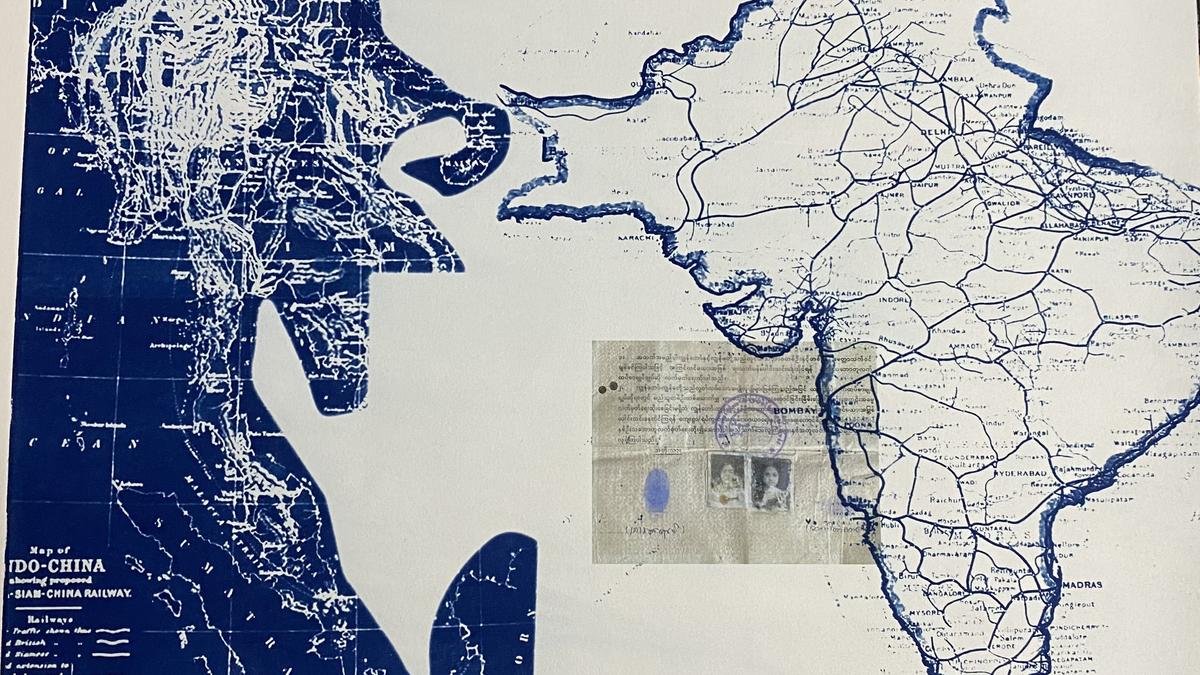
The seeds of Dilpreet Bhullar’s photobook Lands We Inherit: Lines We Breathe trace back to the 2019 Citizenship Amendment Act protests in India. Though as a Sikh, she was not directly affected by the amendment, she felt compelled to stand in solidarity with other minorities being impacted, says the writer, researcher, and editor who shuttles between Delhi and Mumbai. “The discriminatory feature of the CAA was that, when taken in conjunction with the National Register of Citizens (NRC), it specifically excludes Muslims (from Pakistan, Afghanistan and Bangladesh), Sri Lankan Tamils, Rohingyas and Tibetan refugees from the list of minorities eligible to apply for Indian citizenship – a violation of India‘s secular constitution,” she explains in the book, which is currently on display at Offset Projects in New Delhi.

Around the same time, she was also commissioned to write an archival, research-based piece on Rohingya refugees for a Routledge publication. When she did, her sister pointed out that the people at the centre of the essay were unlikely to read it. “That comment really stayed with me,” says Dilpreet, the recipient of the Alliance for Historical Dialogue and Accountability Fellowship (Columbia University) and the International Centre for Advocates Against Discrimination Fellowship (ICAAD), both in New York, which supported the project.

One of the objects which were photographed
| Photo Credit:
Dilpreet Bhullar
She began visiting refugees at the Rohingya refugee camps in Kalindi Kunj (New Delhi), Nuh (Haryana), Narwal and Bathindi (Jammu and Kashmir), the Tibetan refugee camp in Majnu ka Tilla (New Delhi) and the Afghan refugees of Khirki Extension (New Delhi), asking them to come to these meetings with an object that meant something to them. “It would be an icebreaker to have a conversation around,” she says, recalling how every one of these conversations, 36 in all, started with being emotive and personal, but would ultimately be connected to something deeply political.

“They would start by talking about how it was a normal day, and suddenly, towards the end of the story, it would be all connected to how some Government had intervened in their everyday life, and it ended up being interrupted,” says Dilpreet, who would photograph these objects, one of which included a tie brought by an Afghan woman that once belonged to her son, who was killed in a car bombing. “The statement that the personal is very political is very close to me. I have always believed that whatever you do is politically motivated, even if not intentionally, incidentally.”
From exhibition to book

Dilpreet Bhullar
| Photo Credit:
Special Arrangement
These photographs went on to become part of A Home in the Constant Flux: A Call to the Verb Memory, an exhibition which was held in various public art institutes across India and New York. And Lands We Inherit: Lines We Breathe, which consists of photo-documentation of the objects and personal testimonials by refugees, and archival maps rendered in cyanotype, is a reimagining of this photo-based research project. “As a writer and editor, I always had this fleeting idea that, if everything goes well, I would turn it into a book,” she says, adding that this book emerged as a part of a residency between Offset Projects in New Delhi and Halden Bookworks in Norway. “The idea was to have an intimate book, which could be accessible not just to Indians, but across the globe,” she says.

While she does not explicitly give away the names and origins of the refugees or the objects, the decision to use cyanotypes of archival maps, all pre-Partition, dating to the 17th or 18th Century, hints at it. For instance, at the opening night, one person noticed that an object was placed over a part of the map, which is now Afghanistan, and asked her about it. “That was the intention. I wanted people to come into the image, look at it closely and try to make their own stories around it, without me giving away everything.”

The preciousness of an object is not in its material value but in how invested you are in it emotionally, says Dilpreet
| Photo Credit:
Dilpreet Bhullar
Additionally, maps suggest to viewers how landmasses were carved out. “It is important to see where we started from and where we are today,” says Dilpreet, who chose to make objects the central point of conversation for a specific reason.
In her view, political narratives often try to dissociate people from their histories, but people always carry small things along to have that sense of belonging. “It is an abstract idea, but that object makes it possible to talk about certain things, which are both personal and political,” she says, pointing out that it is not the scale of the object that is important but the story behind it. “Even if it is a broken box or earrings or a tattered book, it is all about carrying history. The preciousness is not in its monetary value, but in how invested you are in it emotionally,” she says.
Though she is aware that a project like this may not change the ground reality drastically, she believes that it could lead to a shift in perception. “The idea of the entire geography and time changes when you read or listen to these things. This documentation is a way of speaking to a small community, but one that is listening,” says Dilpreet, who is currently looking for the right publishing house to take up this project. “Photo books, even globally, are usually self-published, but I am in no position to do that. So, I need a publishing house to market and disseminate the book to the right audience,” she says.
Lands We Inherit: Lines We Breathe is on display at Offset Projects, New Delhi, till November 20, Monday, Friday, and Saturday, between 11am and 6pm.
Published – November 11, 2026 01:58 pm IST


Leave a Reply