
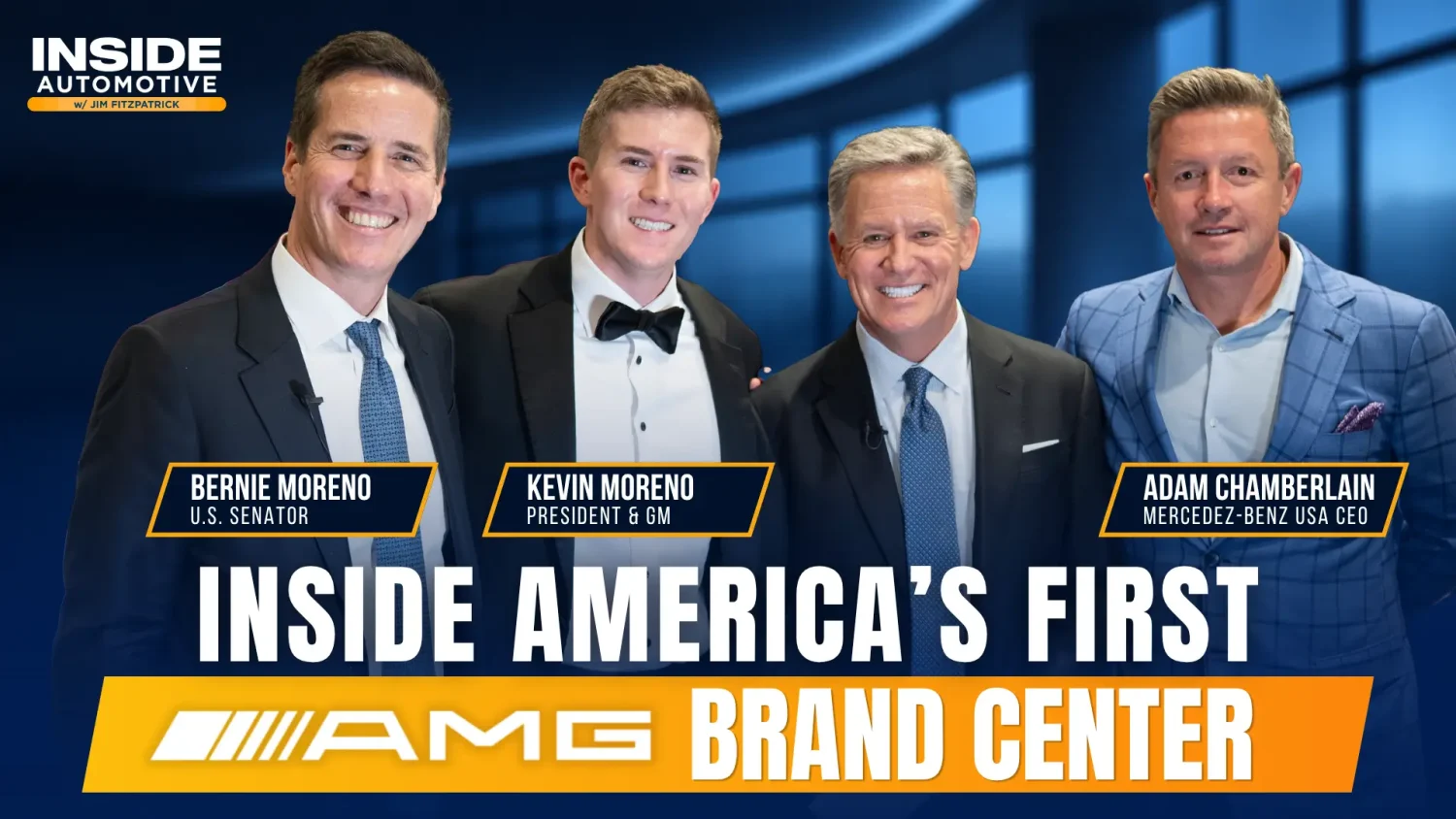
The first dedicated Mercedes-AMG brand center in the United States is giving customers a new way to experience the luxury performance brand while highlighting the role dealerships still play in an increasingly digital retail environment. On this exclusive episode of Inside Automotive, we spoke with President Kevin Moreno, U.S. Senator Bernie Moreno, and Mercedes-Benz USA CEO Adam Chamberlain at the grand opening of Mercedes-Benz of Columbus North in Sunbury, Ohio, where the group discussed the debt if the nation’s first dedicated AMG Brand Center, the changing role of the physical store and how luxury retail balances halo performance with consumer affordability.
The path toward launching Mercedes-Benz of Columbus North began six years ago with an initiative led by Former Auto Dealer Bernie Moreno, Partner Roger Penske Jr., and Dirk Schluter, Former Owner of Mercedes-Benz of Mansfield. When Bernie entered public service, leadership transitioned to Kevin, who partnered with Penske and Schluter to acquire the historic Mansfield franchise and move operations approximately 45 miles south to Sunbury in Delaware County.
The new location is the first dedicated Mercedes-AMG Brand Center in the United States and one of about a dozen worldwide, joining global sites in cities such as Tokyo, Beijing, and Toronto. Rather than operating purely as a standalone AMG boutique, the store serves as a full-suite franchise, pairing the performance sub-brand with passenger cars, SUVs, Maybach models, and commercial Sprinter vans.
“We’re one of about 12 in the world, but mostly they’re reserved for Tokyo, Beijing. The closest one to us is actually Toronto. We had the privilege of opening the very first one in the United States. It’s, it’s been a huge honor and accomplishment, and, we’re right now actually in the AMG delivery room.” – Kevin Moreno
Within four months of opening, the dealership has posted significant operational growth. According to Kevin, the store achieved the number-two volume ranking for Mercedes-Benz dealerships statewide, ranked second in Ohio for AMG sales, led the state in parts purchases and earned perfect customer satisfaction index scores. For Kevin, the opening represents both a business milestone and a personal achievement. Having grown up in the automotive business alongside his father, he said the opportunity to build the store around Mercedes-Benz was especially meaningful.
Balancing physical presence and digital retailing
Mercedes-Benz USA CEO Adam Chamberlain said facilities like this remain important even as consumers increasingly shop and purchase vehicles online. While digital tools and AI are changing automotive retail, customers still value the opportunity to see, touch and drive a vehicle.
Addressing the shift toward digital transactions, Chamberlain explained that while AI and online tools streamline the purchase path, automotive retail still depends on sensory engagement. For high-performance and luxury vehicles, customers still prioritize test drives, hearing and hands-on evaluation. Chamberlain noted that while building an architectural showcase requires substantial capital, the facility’s ultimate success rests on the energy and customer focus of the staff inside.
Kevin reinforced that showroom personnel remain the cornerstone of repeat business. While Partner Roger Penske Jr. led the facility’s construction and design, Kevin focused on hiring and training the 34-person team. He reminded his staff from opening day that while an impressive facility may draw customers in, they’ll only return if the service experience exceeds expectations.
However, Bernie framed the operational approach as a three-legged stool, based on:
- The product
- The facility
- The team
He also noted that luxury vehicles are aspirational purchases that reward personal achievement. As a result, the delivery experience and customer interactions must match the vehicle’s precision and engineering.
AMG performance and entry-level accessibility
For Mercedes-Benz USA, AMG models represent a considerable portion of brand volume, accounting for approximately 35% of U.S. sales, or roughly 100,000 units annually. Chamberlain highlighted that AMG acts as a “brand halo” that elevates consumer desirability across the entire portfolio.
“In automotive retail, AI and all the other digital tools are, are hugely important, but… the love of touching an automobile and, and testing that, driving it is still super important. So to create a really cool brand center, brand halo, that you can come into, have a great experience, is still super important…” Adam Chamberlain
To balance this high-performance focus with broader market affordability concerns, Chamberlain stated that Mercedes-Benz USA has introduced aggressive lease incentives across its entry-level lineup, including the CLA, GLA, and GLB. Further, establishing competitive monthly payment options creates an accessible entry point into the franchise, allowing dealers to retain customers as their earning power grows.
Bernie added that a disciplined Certified Pre-Owned (CPO) operation further protects affordability. Since modern certified vehicles undergo rigorous conditioning, buyers entering through the pre-owned department receive the exact same high-touch delivery and service experience as those purchasing flagship vehicles.
“We’ve freed manufacturers, to allow consumer choice to rule. So somebody who wants to buy an electric vehicle, a hybrid, a plug-in hybrid, a gas car, an 8 cylinder or a 12 cylinder or a 16 cylinder, they can buy whatever they want. But the government shouldn’t play a role in that.” – Bernie Moreno
Nevertheless, when discussing the regulatory and political landscape, Senator Bernie Moreno noted that critical issues affecting retail automotive remain largely bipartisan. He mentioned that efforts to safeguard domestic industry competitiveness and encourage local production continue to find support across party lines. He said federal policy is increasingly shifting away from prescriptive powertrain mandates toward consumer choice, allowing buyers to choose among internal combustion engines, plug-in hybrids, and battery-electric vehicles based on their needs. Ultimately, automotive retail success depends on listening to consumer demand and maintaining agile dealership operations regardless of broader political shifts.







Leave a Reply